IN Brief:
- Rhine Europe Terminals operates three container terminals in Strasbourg and Lauterbourg, tying Rhine, rail, and road flows into one of France’s biggest inland freight systems.
- BKT’s PORTMAX PM 90 has been adopted more widely on RET reach stackers, with the operator citing stability, manoeuvrability, and service life.
- As inland terminals push for higher asset utilisation and lower downtime, tyre specification is becoming part of the operational efficiency equation.
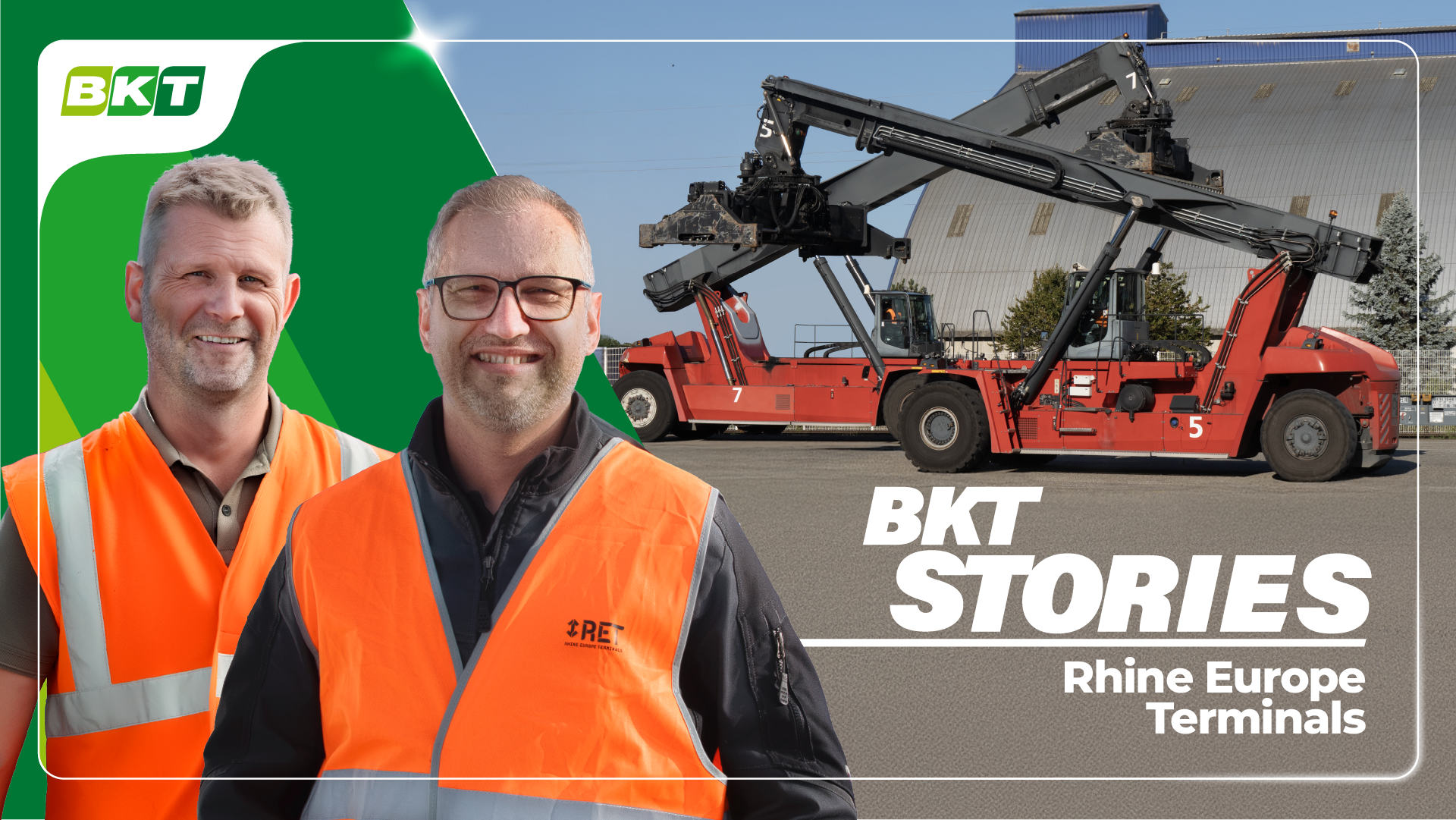
BKT has strengthened its presence at Rhine Europe Terminals, where the off-highway tyre manufacturer’s PORTMAX PM 90 is now being used more widely on reach stackers working across the Port of Strasbourg system.
The relationship began with initial trials in 2019 and has since expanded after testing across a broader fleet at RET’s terminals. Stephane Rick, Technical Manager at Rhine Europe Terminals, said the staged rollout allowed the operator to assess stability, durability, and overall performance in different operating conditions before broadening deployment. “The results were excellent, leading us to choose BKT as a partner for our daily operations,” he said.
That is a material decision in a terminal environment where reach stackers are under constant stress. Port handling cycles mean heavy lifts, sharp turns, uneven surfaces, frequent reversing, and repeated stop-start movement, while the machines themselves rely on tyres as their only point of contact with the ground. In practice, that makes tyre behaviour central to stability at lift height, cornering grip, braking confidence, and the pace at which equipment can be turned back into service.
RET said long service life was another decisive factor, both technically and commercially. Lower wear rates reduce the frequency of change-outs and help contain hourly operating cost, while predictable performance matters just as much in yards where tight manoeuvring space leaves little room for drift or instability. The company also pointed to lower rolling resistance as a contributor to fuel efficiency, which remains a live concern even in highly localised container handling operations.
The Strasbourg context gives the deployment broader weight than a routine component decision. The Port of Strasbourg is France’s second-largest inland port, with annual handling capacity of around 600,000 TEU and regular rail shuttle links into major maritime gateways. Rhine Europe Terminals runs three container sites within that network, making equipment reliability a direct supply chain issue rather than a workshop concern. Lost hours on a reach stacker do not stay local for long when river, rail, and road transfers are tightly sequenced.
BKT’s PORTMAX PM 90 is designed specifically for reach stackers and other heavy industrial handling duties, with an all-steel radial construction aimed at durability, heat resistance, and stable operation under load. For operators at inland ports, that kind of component choice increasingly sits inside the wider question of throughput resilience. Strasbourg is already planning further rail-side expansion over the next few years, and as volumes rise the pressure on yard assets will rise with them.