IN Brief:
- Ningbo-Zhoushan moved 8,574 TEU by sea-rail on 14 August and 8,172 TEU the following day.
- Ningbo has set a 2026 sea-rail target of at least 2.2 million TEU.
- Fixed trains, inland hubs, and automated handling are expanding the port’s hinterland capacity.
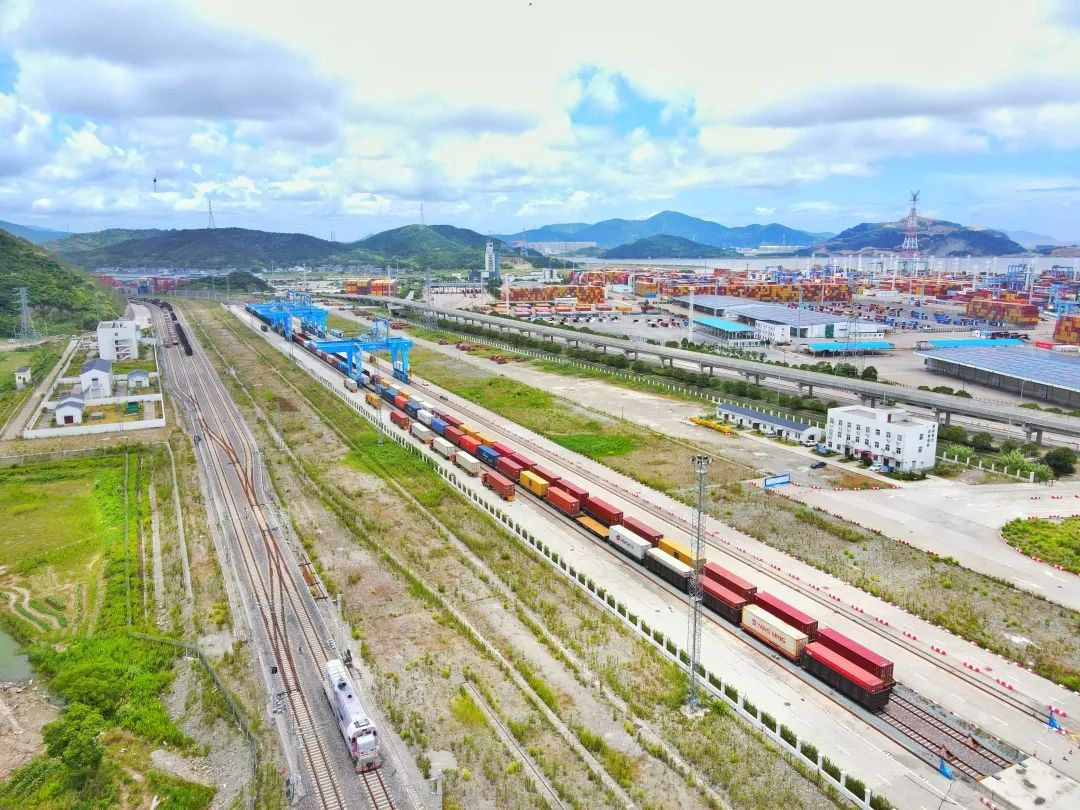
Ningbo-Zhoushan Port has pushed daily sea-rail container traffic beyond 8,000 TEU on consecutive days, setting new operating records as the Chinese gateway expands fixed inland rail services and dry-port connections into major manufacturing regions.
The port handled 8,574 TEU by sea-rail on 14 August and 8,172 TEU on 15 August. The two results followed continued investment in inland terminals, scheduled trains, and handling technology intended to move larger container volumes between production centres and the coast without relying solely on long-distance trucking.
Ningbo has been building that inland network for several years. Municipal authorities have set a 2026 target of at least 2.2 million TEU for container sea-rail intermodal traffic, with loaded containers expected to account for more than half of the total.
The scale is already substantial. Official Ningbo figures show sea-rail traffic reaching 679,000 TEU during the first four months of 2026, up 7.4% year on year, supported by additional fixed services and inland hubs connected with the Beilun and Chuanshan port areas.
The latest records also arrived after weather disruption affected ports in eastern China. Typhoon-related closures and vessel delays had placed pressure on container flows, leaving the rail network to absorb recovering volumes as terminal operations normalised.
Rail extends the port interface inland
Sea-rail services allow part of the port process to take place away from the waterfront. Cargo can be consolidated at inland hubs, transferred onto scheduled trains, and delivered to the container terminals in larger blocks rather than arriving as a continuous stream of individual road movements.
The Yiwu Suxi International Hub is one element of that system. Official Ningbo material describes the inland facility as an extension of the maritime gateway, with fixed services connecting it to Ningbo-Zhoushan and equipment designed to accelerate rail-container handling.
Six remote-controlled rail-mounted gantry cranes operate at the Suxi hub alongside automated and manually driven vehicles. Ningbo authorities say the equipment has increased unloading efficiency by 61%, while 24-hour customs clearance supports continuous processing of containerised cargo.
Fixed services also give carriers and cargo owners a more structured timetable for inland movements. Rail is less flexible than trucking for individual consignments, but scheduled trains can move large batches of containers while reducing the number of long-haul road journeys required to feed a major maritime terminal.
Quayside crane productivity is only one part of a container gateway’s capacity. Boxes must also leave the yard quickly enough to prevent congestion from consuming the space needed for incoming vessels and export cargo.
Intermodal capacity supports recovery
Weather disruption exposes the same dependency from the opposite direction. When terminals close temporarily, inland cargo continues to accumulate. Once marine operations resume, the port must process delayed vessel calls while restarting the flow of containers from inland production centres.
A larger rail network gives operators more control over that restart. Containers can be staged at inland terminals, train departures can be adjusted, and blocks of cargo can be released towards the coast in a more managed sequence than an uncontrolled surge of truck arrivals.
The system does not eliminate weather risk. Rail-bound cargo still depends on the maritime terminal reopening, vessel schedules recovering, and sufficient yard and crane capacity being available when the train reaches the port.
It does, however, add another transport mode to a gateway serving a very large manufacturing hinterland. Ningbo-Zhoushan draws export cargo from Zhejiang and from inland provinces where distance makes the efficiency of the landside leg increasingly important to total journey time and cost.
The 2.2 million TEU target shows that sea-rail is being treated as a core cargo channel rather than a marginal alternative. Annual targets for volume and loaded-container ratios also indicate that the policy is focused on commercially productive traffic, not simply the number of train movements.
Two record days do not establish a new sustainable daily average. Peak throughput can reflect the release of delayed cargo after disruption, and the network will still be judged on reliability across normal operating periods.
The August results nevertheless establish that the inland rail system can process more than 8,000 TEU in a day while the wider gateway continues handling very large maritime volumes. Sustaining that performance will place increasing demands on train paths, dry-port handling, equipment availability, customs processes, and coordination between factories, rail operators, and terminals.
Ningbo-Zhoushan’s expansion is increasingly a network problem rather than a berth problem. Further container growth will depend on the inland system removing boxes at a pace that keeps the maritime terminals productive rather than simply transferring congestion beyond the quay.