
IN Brief:
- T45 provides 224,000 sq ft of urban logistics accommodation across 23 units in Leeds.
- Every unit has achieved EPC A and includes PV, air-source heat pumps, efficient lighting, and EV charging.
- The Cross Green development sits less than one mile from the M1 and around three miles from Leeds city centre.
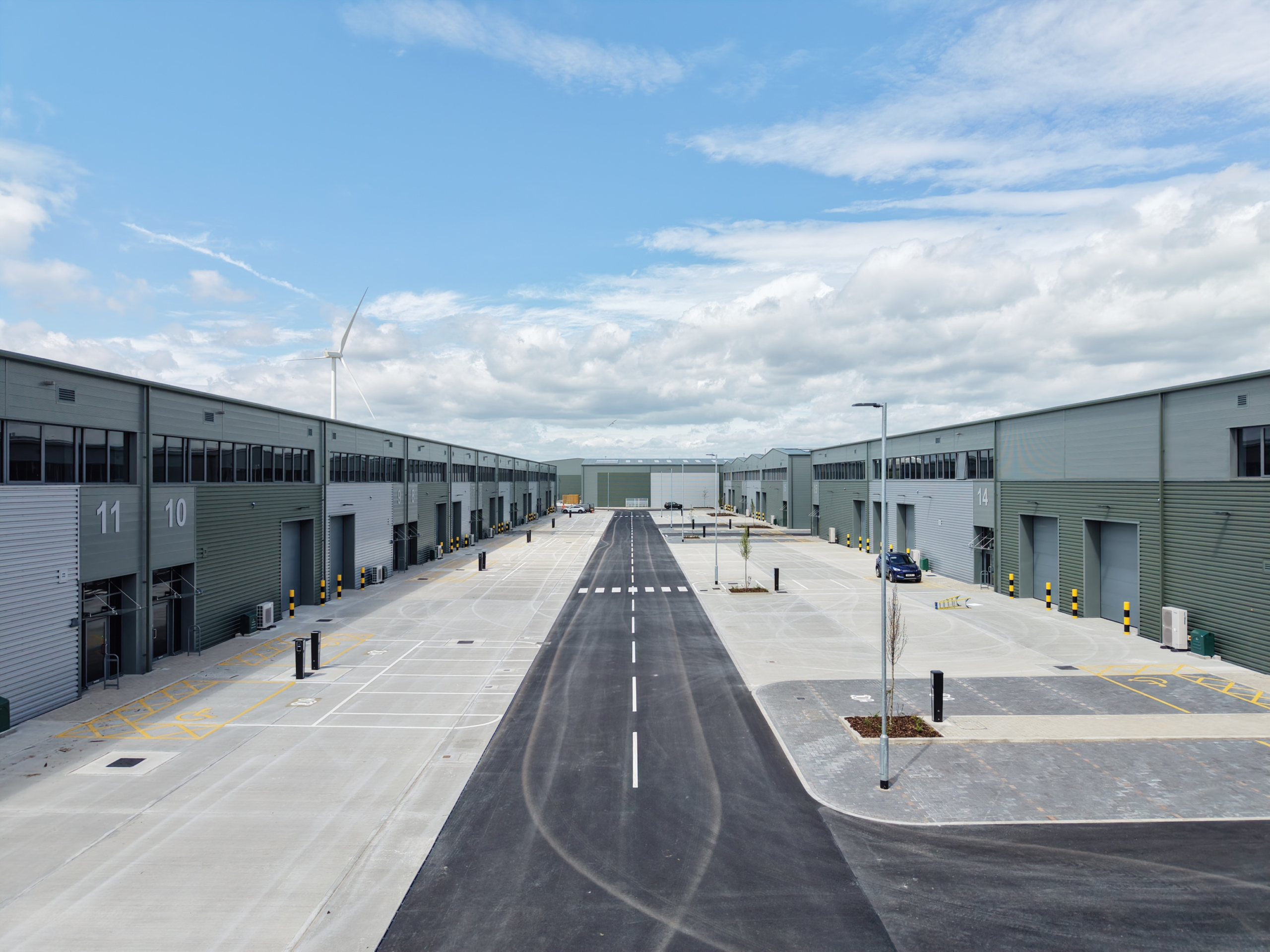
Caddick Construction has completed T45, a 224,000 sq ft urban logistics development on the A63 in Leeds, handing over 23 industrial units delivered for developer Chancerygate.
The development sits within the established Cross Green industrial area, less than a mile from the M1 and around three miles from Leeds city centre. Units range from 4,490 sq ft to 32,635 sq ft, giving the estate a multi-let format capable of accommodating smaller logistics, industrial, trade, and distribution operations alongside larger occupiers.
Every unit has achieved an EPC A rating and incorporates photovoltaic panels, air-source heat pumps, high-performance insulated cladding and roof materials, efficient LED lighting, and electric vehicle charging points. The buildings also include electric loading doors, fitted offices and kitchens, while external works provide landscaped communal and wellbeing areas.
The wider scheme has achieved a BREEAM Excellent rating, adding another measure to the energy specification incorporated into the individual buildings. Those standards are increasingly important in logistics property because energy consumption affects occupation costs long after rent and service charges have been agreed.
Lighting, heating, office accommodation, handling equipment, and growing numbers of electric vehicles can all contribute to warehouse electricity demand. Installing solar generation, efficient heating, and charging infrastructure during construction reduces the amount of immediate retrofit required from occupiers moving into new space.
The site’s position provides the other side of the operating case. Access to the M1 gives occupiers a direct connection to the regional and national road network while keeping facilities close to the Leeds urban market, allowing businesses to balance motorway access against the time required to reach customers, suppliers, or industrial sites within the city.
Steve Ford, Regional Managing Director, Caddick Construction North East & Yorkshire, said: “We’re proud to build on our long-standing partnership with Chancerygate to successfully deliver a high-quality urban logistics development for the city of Leeds.”
T45 is the fourth scheme Caddick has delivered for Chancerygate. Earlier projects include Gateway 44, a logistics hub and drive-thru development in Carlisle; Mersey Reach in Aintree; and nine industrial units at the Novus development in Knutsford.
The repeated relationship gives the contractor and developer an established delivery model for multi-let industrial property. Schemes of this type have to provide enough standardisation to make construction economic while retaining sufficient variation in building size and specification to attract businesses with different operating requirements.
T45 ranges from units below 5,000 sq ft to buildings above 30,000 sq ft. That breadth makes the estate different from the large single-occupier fulfilment centres often associated with logistics development, where one tenant can control several hundred thousand square feet and dominate the site’s traffic and labour requirements.
A multi-let estate can instead accommodate urban distribution, trade, service, light manufacturing, and regional logistics operations in the same location. The approach widens the potential tenant base while allowing companies to place smaller quantities of inventory or operating capacity close to the markets they serve.
The development was brought forward by Chancerygate with Bridges Fund Management before being included in a 750,000 sq ft portfolio acquired by Indurent. That transaction covered 76 industrial and logistics units across T45 in Leeds, Torque in Birmingham, and Holbrook Park in Coventry.
Indurent’s portfolio strategy has focused on modern urban logistics property with strong connectivity and sustainability credentials. The Leeds scheme fits that model through its road access, range of unit sizes, and energy specification, while its position in Cross Green places the new accommodation within an established employment area rather than an untested logistics location.
Occupier activity has already started. JoyExpress, the express-delivery operation associated with JD.com, has taken approximately 14,000 sq ft at T45 on a five-year lease to support its UK expansion, providing an early example of the type of urban distribution requirement the development is designed to serve.
The location is particularly relevant for such operations. Last-mile and regional delivery networks do not necessarily require the enormous floorplates associated with national fulfilment centres, but they do need practical road access and sufficient proximity to population centres to prevent the final transport leg consuming too much driver time.
Caddick also recorded a series of local employment and community measures during construction. The project supported 12 apprentices and achieved 100% diversion of recorded construction waste from landfill, while Caddick and Chancerygate jointly donated £3,000 to Leeds-based child sleep poverty charity Zarach.
Community activity included a CV workshop for Notre Dame Sixth Form College, visits for Leeds Beckett University architectural students, mock interviews at Trinity Academy Leeds, and a work placement for an electrical student from Leeds College of Building.
The contractor is a registered partner of the Considerate Constructors Scheme and achieved 45 out of 45 on both inspections at T45. Those results close out the construction phase, but the more enduring measure will be how the buildings perform once occupied.
Energy ratings and sustainability certifications establish the design and delivery position at handover; they do not determine how much energy an occupier eventually consumes. Warehouse operating hours, vehicle charging, heating settings, equipment selection, and the density of activity inside each unit will all influence actual performance.
The same applies to logistics efficiency. A building beside the M1 does not automatically create a well-designed supply chain, but it gives operators a useful physical starting point when the network requires access to both Leeds and longer-distance road routes.
T45 now moves fully into its leasing and operating phase with all 23 units delivered. The construction programme has provided the intended combination of motorway connectivity, flexible unit sizes, and energy-efficient infrastructure; the next test is how effectively those attributes translate into occupied logistics and industrial capacity across the estate.
