IN Brief:
- EDECS will strengthen the existing 610-metre quay wall at DP World’s Port of Luanda container terminal.
- The works comprise 120 piles up to 45 metres long, structural beams, A150 crane rails, testing, and electrical services.
- The award prepares for rail-mounted ship-to-shore cranes; throughput improvements and project completion remain future outcomes.
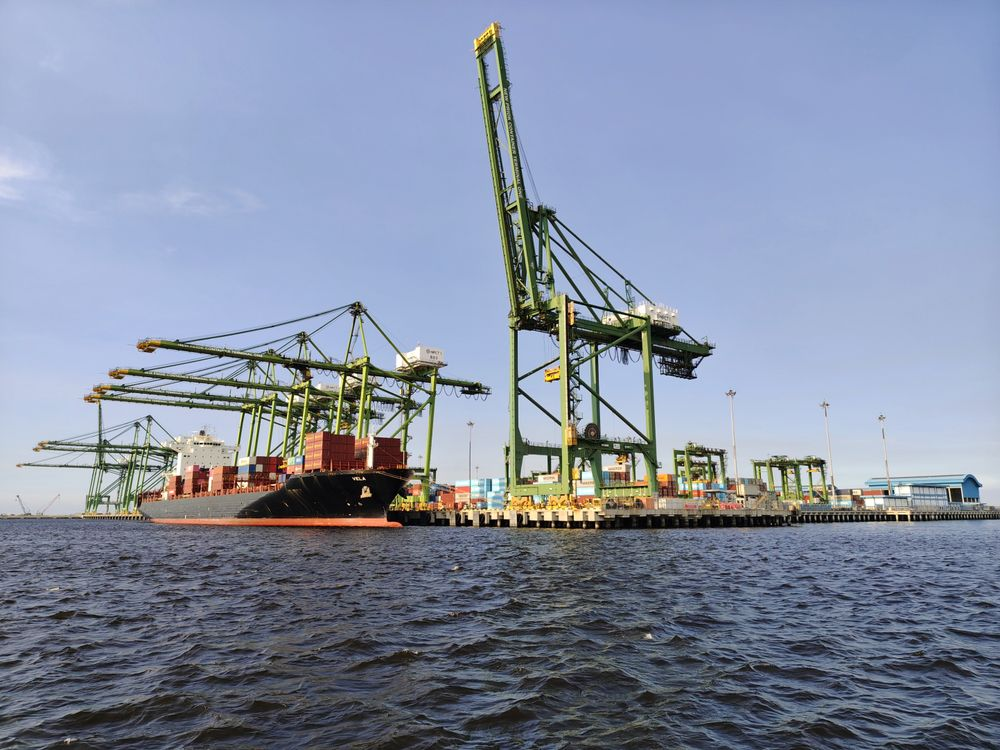
EDECS Group has won a design-and-build contract from DP World to strengthen 610 metres of quay wall at its container terminal in the Port of Luanda, Angola. The works will prepare the existing waterfront for rail-mounted ship-to-shore cranes, replacing the terminal’s current reliance on mobile harbour cranes for the affected operations.
The contracted scope includes 120 piles, each one metre in diameter and extending up to 45 metres in length, together with reinforced concrete beams, crane rails, and utility installations. The structural package will change how the quay supports lifting equipment and transfers its loads into the foundations. The award concerns infrastructure enabling a future crane installation, rather than an operational commissioning milestone for the cranes themselves.
Rail-mounted ship-to-shore gantries impose concentrated and moving loads through their travel wheels and rails. The quay structure must accommodate those loads along a precisely defined route, including forces generated while a crane travels and handles containers. EDECS will construct a new reinforced concrete back beam on the landside and extend the existing capping beam, providing structural support for the new rail arrangement alongside the waterfront.
The deep piling programme is intended to establish the load-carrying capacity beneath those elements. The contractor has specified ultrasonic cross-hole testing, high-strain dynamic tests, pile integrity assessments, and working and non-working load tests. The methods examine foundation continuity and response under different imposed loads. They are part of the planned verification programme; the award does not imply that piling or acceptance testing has already been completed.
The rail installation will include A150 crane rails, buffer stops, stow pins, tie-downs, cable drums, and panzer belt systems. Rail alignment and anchorage have a direct bearing on crane travel and operating stability, while stopping and securing equipment is necessary when machines are parked or exposed to high winds. Cable handling provides an organised route for the electrical supply as a crane moves along the berth.
Electrical and service works are included in the same package. EDECS will provide cables and ducts, quay substations, low-voltage and extra-low-voltage networks, wet and dry utilities, and firefighting infrastructure. These elements connect the new lifting equipment to the terminal’s fixed services and safety systems. The companies have not identified an installed power rating, a crane supplier, or the number of gantries to be commissioned under a separate equipment programme.
DP World expects the conversion to allow faster ship loading and discharge, with scope to reduce vessel turnaround times. Ship-to-shore cranes can operate with a different reach and lifting cycle from mobile harbour cranes, but a terminal’s realised throughput also depends on yard handling, available storage space, truck flows, berth access, and vessel stowage plans. There is no measured new handling rate for Luanda because the infrastructure works and crane transition remain ahead.
The operator has also linked the upgrade to accommodating larger and deeper-draught vessels. Whether those ships can use a berth depends on the nautical depth, channel and berthing conditions as well as crane capability and quay strength. The current contract identifies structural and equipment support works rather than a confirmed dredging programme or revised vessel-draught limit. DP World’s existing terminal information lists a 610-metre linear quay, matching the extent of the new reinforcement package.
Luanda’s development follows DP World’s earlier programme to increase terminal container capacity, reported in October. That broader plan included a projected capacity of 1.2 million TEU; the EDECS award identifies one construction step towards the intended handling arrangements. A projected terminal figure should not be presented as throughput already achieved, or attributed solely to the latest piling and rail works.
Working along an existing quay introduces operational coordination issues that differ from construction on an unused site. Piling equipment, rail installation, and service connections require physical access to the waterfront and may have to be sequenced around vessel movements. DP World has not published a detailed construction phasing plan or stated which berths, if any, will be unavailable during the work. Cargo-handling continuity and the duration of any constraints therefore remain to be established by the operator.
EDECS has previously worked with DP World on port infrastructure at Dar es Salaam in Tanzania. The Luanda commission extends that contracting relationship to Angola’s main maritime gateway, with a defined foundation, rail, and utility package. The announcement gives neither the contract value nor a scheduled completion or handover date, leaving the next measurable steps as completion of the quay reinforcement, structural acceptance, and eventual installation of the rail-mounted cranes.