IN Brief:
- Blue Jay coordinated multiple robotic arms for pick, stow, and consolidation in a single workspace at same-day sites.
- Amazon is reallocating staff and reusing core robotics and AI capabilities developed for the prototype.
- The pause underlines how quickly large operators are iterating automation designs to balance throughput, footprint, maintainability, and cost.
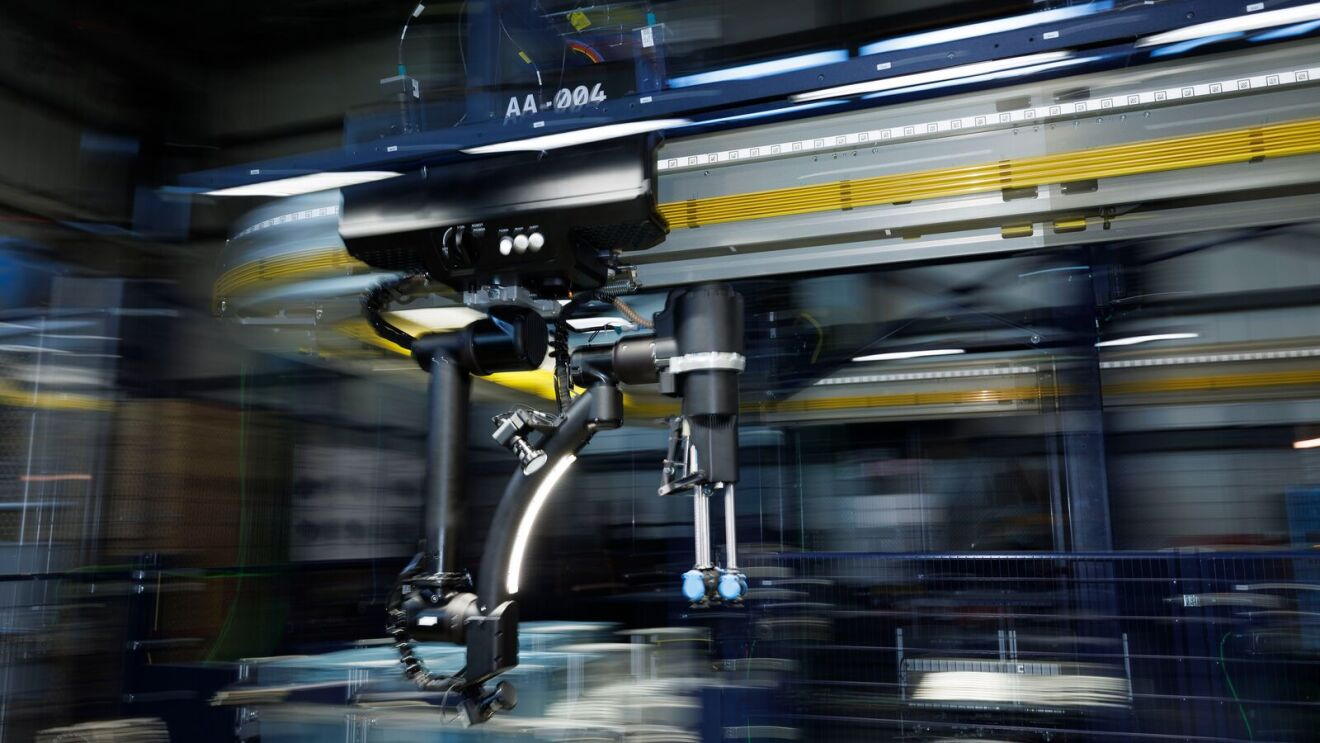
Amazon has halted its Blue Jay warehouse robotics project, a multi-armed system it unveiled in October 2025 as part of its push to compress more fulfilment work into smaller, faster-turning same-day delivery sites. The company described Blue Jay as a ceiling-mounted robotics system that orchestrates multiple arms to pick, stow, and consolidate parcels in one “harmonised workflow,” effectively collapsing functions that would typically be spread across separate stations.
At launch, Amazon said Blue Jay had moved from concept to production in just over a year, aided by simulation and digital twins that allowed engineers to iterate virtually before committing to hardware. In early testing at a South Carolina facility, the company said the system could handle around 75% of the item types stored at the site — a meaningful coverage threshold for any automated handling system facing real-world SKU variability.
The project has now been paused, with Amazon framing Blue Jay as a prototype programme whose most valuable outputs will live on elsewhere. Terrence Clark, spokesperson at Amazon, said: “In this case, we’re actually accelerating the use of the underlying technology developed for Blue Jay, and nearly all of the technologies are being carried over and will continue to support employees across our network.” That positions Blue Jay less as a cancelled bet than a hardware configuration that failed to earn a permanent place on the roadmap, even as its sensing, control, and manipulation work is repurposed.
That reuse matters because Blue Jay sat at the intersection of two stubborn warehouse engineering problems: high-speed manipulation and space efficiency. Multi-arm systems can, in theory, reduce conveyance and buffer requirements by doing more work in a tighter footprint, but they also introduce new constraints around access for maintenance, uptime resilience, and the cost of building and deploying complex assemblies at scale. The economics are unforgiving when the target environment is a same-day operation with tight cut-off times and limited backroom space.
Amazon’s broader robotics estate continues to expand, and Blue Jay’s pause does not change the underlying direction of travel. The company has said it has deployed more than one million robots since 2012, spanning mobile platforms designed for moving inventory and carts, and robotic arms handling individual items and packages. In practice, the network’s automation strategy has become a portfolio approach: different buildings, flows, and product mixes are matched with different combinations of mobile robots, arms, and software orchestration, rather than a single “standard” blueprint.
For operators watching Amazon closely, the most telling signal is the speed of iteration. Blue Jay was presented as production-ready technology in late 2025, and is now being treated as a prototype whose components will be folded into other programmes. That cadence suggests that, even at Amazon’s scale, warehouse robotics remains a continuous engineering exercise — with hardware choices changing as quickly as the software controlling them.