IN Brief:
- Dermalogica’s Carson distribution centre has moved to autonomous aerial cycle counting.
- Corvus One scans the facility 52 times per year without human pilots.
- High-frequency imaging is intended to improve accuracy, occupancy reporting, and capacity planning.
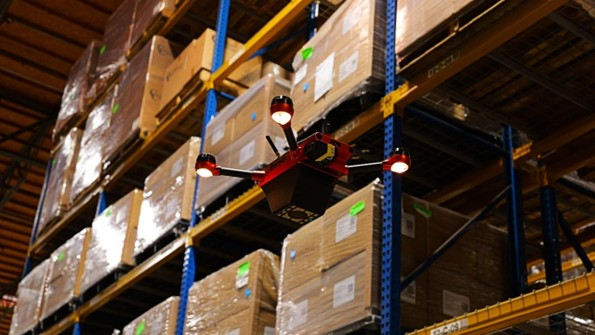
Dermalogica has deployed Corvus Robotics’ Corvus One autonomous inventory management system at its global headquarters and primary distribution centre in Carson, California, putting aerial cycle counting into live warehouse operations. The facility manufactures and distributes professional-grade skincare products across retail, wholesale, and e-commerce channels, and is now using autonomous scans to increase inventory visibility without adding labour to manual counts.
Corvus One operates in the warehouse outside active picking hours, performing autonomous aerial inventory scans that image stock locations and generate facility-wide inventory data. Dermalogica says the system will complete 52 scans per year — effectively moving to weekly imaging — which Corvus Robotics describes as a 600% increase in inventory imaging frequency compared with the site’s prior manual cycle counting cadence.
Before deployment, Dermalogica’s inventory counting required a dedicated cycle counter and could take up to two months to complete a full pass through the facility. With Corvus One in place, the business says it has repurposed approximately 120 labour hours per month, redirecting that time to other operational work while maintaining more regular inventory checks.
“Deployment was seamless and required no downtime,” said Jason Brown, Director of U.S. Logistics at Dermalogica. “Corvus Robotics has become a valuable partner in modernizing our inventory management. Corvus One delivers the consistent accuracy we need to protect revenue and operate to tight forecasts. With continuous warehouse visibility, we can sell what we produce with confidence and plan future growth on a stronger operational foundation.”
Dermalogica’s operating model is built around production aligned to sales forecasts with limited buffer stock, which raises the operational cost of inventory errors and delayed corrections. In that context, the move to high-frequency scans is aimed at tightening the loop between what is produced, what is stored, and what can be allocated to fulfilment across channels, with occupancy reporting also feeding space planning and capacity management decisions.
Corvus Robotics positions the system as fully autonomous and deployable without warehouse infrastructure modifications. The drones navigate indoor environments using onboard AI and computer vision, capturing high-resolution inventory data that can be integrated into existing warehouse workflows. Corvus also promotes the platform’s ability to map inventory locations in three-dimensional space and synchronise results with warehouse management systems, with discrepancy reporting supported by image records of storage slots.
“Retailers and brands operating global distribution networks cannot afford blind spots,” said Jackie Wu, CEO of Corvus Robotics. “Dermalogica’s Carson facility is a high-throughput environment serving customers around the world. Corvus One provides continuous, autonomous inventory intelligence without disrupting operations. This is the standard modern supply chains are moving toward.”
Autonomous inventory scanning is increasingly being framed as a way to hold or improve accuracy while reducing dependence on scarce operational labour, particularly as warehouses push for tighter cycle counting without interrupting picking. Dermalogica’s deployment signals a shift from periodic inventory validation to a more continuous audit rhythm, with the operational payoff tied to how quickly discrepancies are detected, corrected, and prevented from reoccurring.