IN Brief:
- Exotec has opened a 25,000 sqm HQ and production hub near Lille.
- The site integrates R&D, production, and operations, including an 8,560 sqm production area with 11 internal systems.
- The facility is designed to support faster industrialisation and higher deployment volumes.
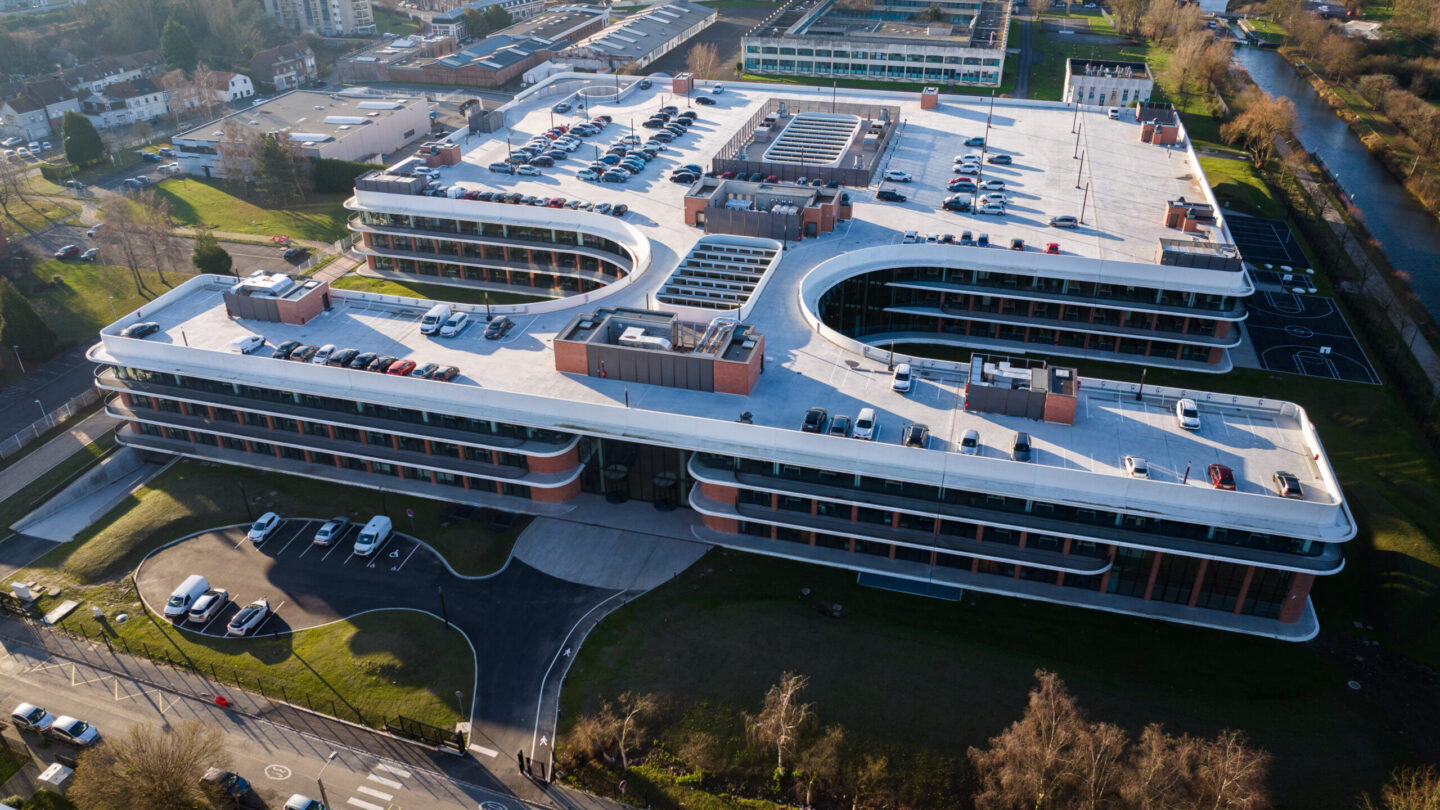
Exotec has opened its new global headquarters, Imaginarium, in Wasquehal in northern France, bringing research, development, production, and operations into a single site as the company scales warehouse robotics deployments across Europe and North America. The company said the 25,000-square-metre building will operate as a combined innovation and industrial hub, consolidating more than 700 employees across engineering, product, and support functions.
The physical integration is not cosmetic. Warehouse automation providers have spent the past decade proving technology in pilots and early rollouts; the bottleneck now is industrialisation: repeatable builds, predictable testing, and the ability to ramp output without quality drift. Exotec’s new headquarters is designed to address that constraint directly, with production and validation built into the same footprint as product development.
According to Exotec, the site includes an 8,560-square-metre production area equipped with 11 operational Exotec systems, used for manufacturing, system testing, validation, and continuous improvement of software and hardware. For customers, that kind of internal capacity tends to show up in shorter lead times, cleaner acceptance testing, and faster iteration on known failure points, particularly when deployments involve complex site conditions and evolving operational requirements.
Imaginarium also formalises the company’s longer-term commitment to building in Europe while serving a global customer base. The headquarters was developed with BMG Group under a 12-year forward-funded lease agreement signed in 2022, and Exotec framed the investment as a way to strengthen its ability to develop “robust, scalable solutions” closely aligned to customer requirements. As Romain Moulin put it, “Imaginarium represents a major technological and industrial investment.”
The opening was also tied to Exosummit, a new flagship event intended to bring together customers, partners, investors, and other industry stakeholders. That matters in a practical sense because automation vendors increasingly sell multi-year roadmaps rather than one-off projects; customer confidence depends on visibility into the vendor’s capacity to support systems, maintain spares, and keep software development moving after go-live.
For the European intralogistics market, the move underlines a broader shift: robotics and high-density picking systems are no longer “innovation budgets” but core infrastructure for retailers, manufacturers, and 3PLs. Vendors that can industrialise effectively — build faster, test harder, and deploy with fewer exceptions — will be the ones that win in the next cycle, when buyers focus less on novelty and more on predictable performance at scale.