IN Brief:
- The 1,000 sq m installation uses seven AMRs, two fork mobile robots, and a rail-mounted palletising robot.
- Capacity reaches 515 flour bags per hour across 45 product references.
- Fives' warehouse control system coordinates the equipment with the mill's existing warehouse management system.
Moulins Dumée has commissioned an automated flour fulfilment system at its Gron mill in France, combining mobile robots, robotic palletising, software control, and export loading equipment across a 1,000 sq m logistics area.
The installation was designed and implemented by Fives with support from Etyo and was inaugurated on 24 September. It can prepare up to 515 flour bags per hour across 45 product references for artisan bakery and industrial customers.
The physical handling task is demanding because individual bags weigh 25kg. Fives says the project virtually eliminates manual handling of those bags while increasing processing capacity and supporting mixed-product pallet preparation as well as bag-by-bag loading for export containers.
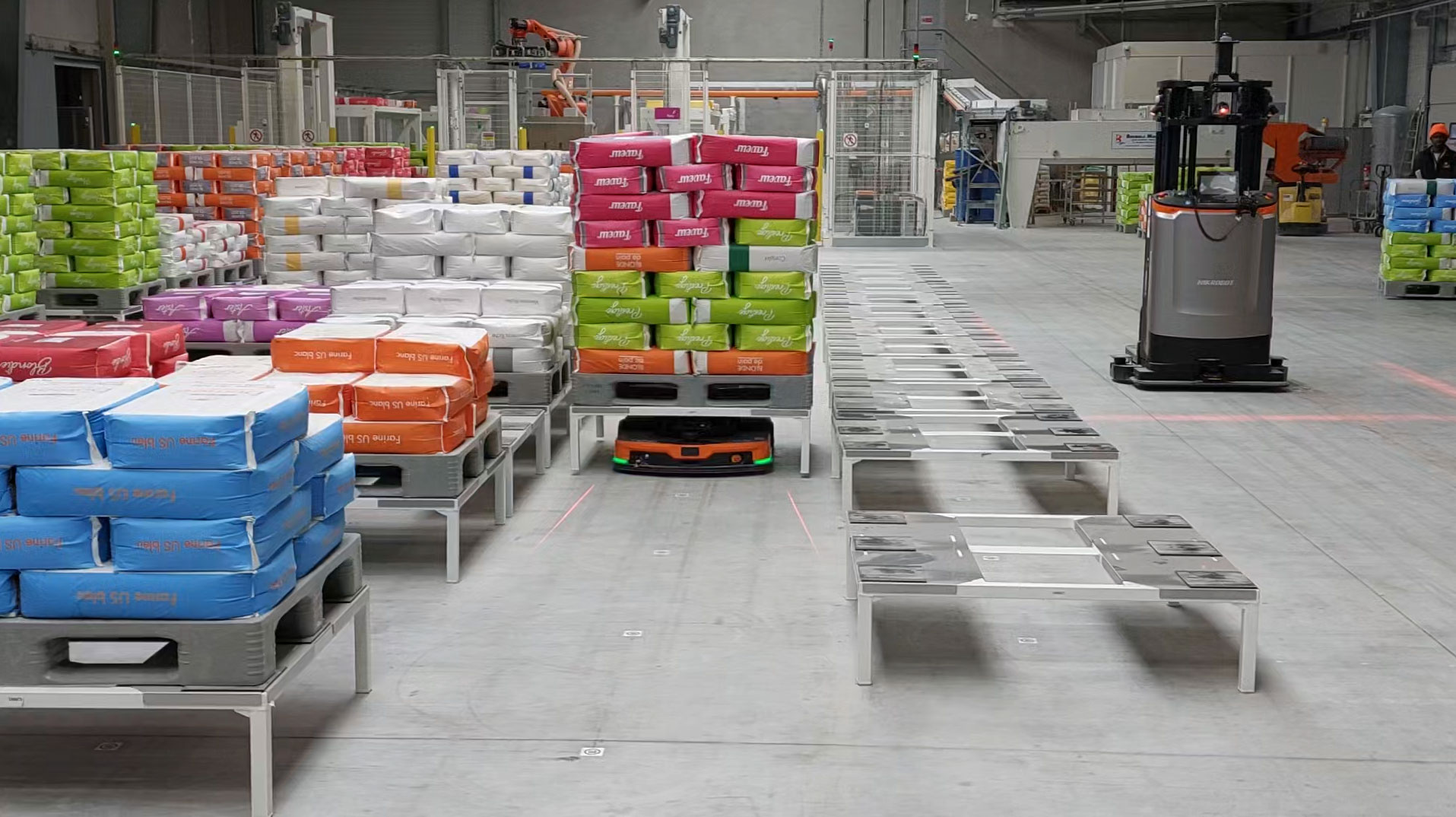
The equipment comprises a rail-mounted palletising robot, seven autonomous mobile robots, two fork mobile robots, and a telescopic conveyor dedicated to export shipments. A Fives warehouse control system coordinates the equipment and interfaces with the site’s warehouse management system to manage material flows.
The autonomous mobile robots transport pallets between operating areas and supply the order picking robot. Fives says the use of mobile equipment reduces the amount of fixed infrastructure required and gives the installation more flexibility than a heavily mechanised system based around permanent conveyor routes.
The project also had to work around existing equipment. Fives designed the new system to integrate with the stacker crane already operating at Gron, and says installation was completed without disrupting mill operations. That makes the project a brownfield automation exercise rather than a new warehouse designed around robotics from the outset.
The operating mix helps explain the choice of flexible equipment. Moulins Dumée handles 45 product references within the automated process, so the system has to prepare more than repeated full pallets of a single flour type. Mixed-product pallets require the right bags to arrive at the palletising point in the correct sequence, while export orders add a separate bag-by-bag loading flow.
Software therefore carries as much responsibility as the mobile hardware. The warehouse control system has to orchestrate robot movements, pallet transfers, and order preparation while exchanging information with the warehouse management system. Any mismatch between the physical bag, its product reference, and the customer order would undermine the accuracy gains the automation is intended to deliver.
Fives puts the installation’s processing capacity at up to 150 tonnes of flour per day. The segment being automated represents about 3,000 tonnes of bagged flour per month, equivalent to nearly one-third of Moulins Dumée’s monthly volumes.
Those figures show that the project is material to the mill’s outbound logistics without attempting to automate every tonne of flour produced. The system is concentrated on the bagged product flow where repeated lifting, product variation, pallet building, and export loading create a more complex handling requirement.
Removing routine lifting of 25kg sacks changes the labour profile around that process. Operators are moved away from repetitive manual handling while the operation becomes more dependent on equipment availability, robot recovery, software control, and maintenance. Fives describes improved working conditions as one of the immediate benefits alongside higher throughput and better traceability.
The technology also provides a contrast with Fives’ recent Viaposte automation project. Both involve automated material flow, but the Gron installation is built around dense sacks, pallet assembly, and food production logistics rather than parcel sorting. That difference matters when selecting the balance between fixed machinery and mobile transport.
At Gron, the AMRs provide the transport layer while the rail-mounted robot concentrates automation on palletising. This separates two functions that would otherwise require fixed conveying between every point. If order patterns or workstation positions change, software-directed mobile routes can be altered more easily than a permanent conveyor layout.
The same flexibility can help when volumes change, but it does not remove the need for capacity discipline. Seven AMRs, two fork mobile robots, the palletising cell, and the export conveyor all have to remain balanced if the system is to sustain its quoted 515-bag hourly rate. A bottleneck at one stage would reduce the benefit of spare capacity elsewhere.
Traceability becomes similarly important at higher speed. Fives lists stronger material-flow traceability and more accurate order preparation among the project’s benefits. In a 45-reference environment, those functions are necessary to make higher throughput useful rather than simply moving mistakes faster through the warehouse.
The installation gives Moulins Dumée a defined automation platform for a substantial share of its bagged flour business while retaining its existing warehouse infrastructure. Its performance will be measured in routine operation: maintaining the planned handling rate, reducing manual lifting, and keeping mixed orders accurate across domestic and export flows.