IN Brief:
- Eight 18,600 TEU vessels ordered from New Times Shipbuilding in China.
- 366-metre ships target deployment flexibility versus the largest newbuilds.
- Dual-fuel engines support conventional bunker fuel, or liquefied gas operation.
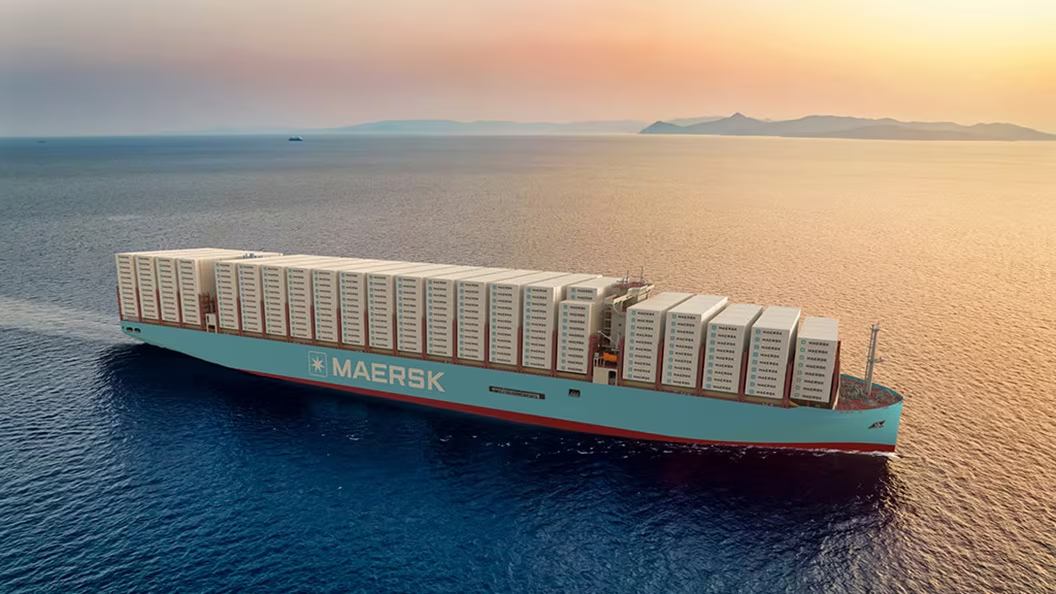
Maersk has signed an agreement with New Times Shipbuilding for eight new large container vessels, continuing a fleet renewal programme that is placing a premium on fuel efficiency and route flexibility. The ships are scheduled for delivery in 2029 and 2030, and will form a new series of 18,600 TEU vessels.
Maersk said all eight ships will share the same characteristics. At 366 metres in length and 58.6 metres in breadth, the company described the vessels as more compact than the current maximum container vessel length of 400 metres, a sizing decision it links directly to network deployment options. The ships will be equipped with dual-fuel engines able to operate on conventional bunker fuel, or liquefied gas.
Anda Cristescu, Head of Chartering & Newbuilding at Maersk, said: “We are pleased to have signed this agreement for eight large vessels. The order is part of our ongoing fleet renewal and helps maintain our fleet’s competitive edge.”
Cristescu also tied the order to operational flexibility, arguing that there is a point at which sheer scale becomes a constraint. “Deployment flexibility has been a key factor in our decision-making. Although these vessels are large, they offer greater flexibility than the largest ships currently being built in our industry. This provides us with multiple deployment options across both our current and future network,” she said.
Ocean freight has been forced into constant re-optimisation over the past few years, as carriers adjust rotations, ports face intermittent congestion, and routes are reshaped by geopolitics, weather disruption, and changing demand. Larger, fuel-efficient vessels can lower unit costs on stable lanes, but flexible deployment is the feature that matters when networks are being rebalanced, or when capacity has to be moved quickly between corridors.
Maersk said the order supports its wider renewal plans. Following the agreement, the company said it now has 33 vessels on order, with four scheduled for delivery in the remainder of 2026. It also reiterated its ambition to reach net zero greenhouse gas emissions by 2040 across its business, citing new technologies, new vessels, and reduced-emissions fuels as part of that pathway.
The first impact of the newbuild order will be strategic rather than immediate, given the 2029–2030 delivery window. Even so, the investment signals that, despite the noise around “deglobalisation,” major carriers are still planning for high-volume, long-haul container trade — and are selecting ship designs that keep more routing options open when the next reshuffle arrives.