IN Brief:
- The 134.2km Pinglu Canal will open for navigation on 16 September.
- The waterway is designed for vessels of up to 5,000 tonnes and links the Xijiang system with the Beibu Gulf.
- Chinese authorities estimate affected southwest China–ASEAN routes could become 560km shorter, with logistics costs falling by 18% to 30%.
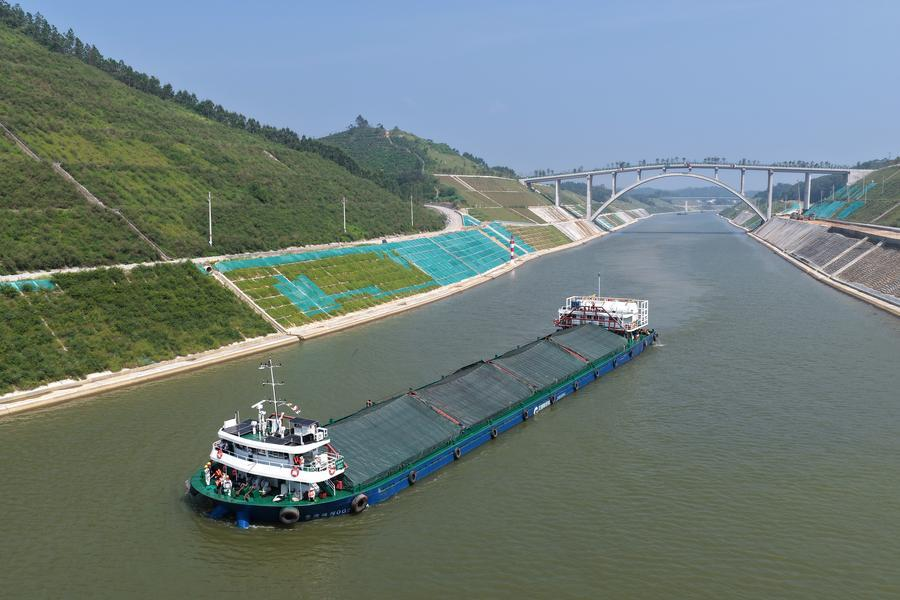
China’s Pinglu Canal will open to navigation on 16 September, creating a new river-to-sea freight route from the Xijiang River system to the Beibu Gulf and shortening the path between southwest China and ASEAN markets. The 134.2km waterway in Guangxi Zhuang Autonomous Region is designed for vessels of up to 5,000 tonnes and forms part of the New International Land-Sea Trade Corridor.
The canal gives inland cargo a more direct southern outlet rather than sending traffic east towards established coastal gateways. Chinese authorities estimate that affected shipping routes between the southwest hinterland and ASEAN will become about 560km shorter, with logistics costs expected to fall by 18% to 30%.
Vessel trials began in August using loaded and unloaded ships of different sizes to test locks, anchorages, tidal docking, night navigation, overtaking, turning, and operation under adverse conditions. BeiDou positioning, drones, and onboard sensors were used to collect information on vessel movements, currents, and safe separation distances.
The project has an estimated investment value of RMB72.7 billion and is China’s first major river-to-sea canal planned and coordinated at national level since 1949. It runs from the Xijiang system to the Beibu Gulf, adding an inland-waterway route alongside the rail and road links already used to connect western China with southern ports.
That additional route arrives as traffic on the New International Land-Sea Trade Corridor continues to expand. Rail services on the corridor handled a record 1.425 million TEU in 2025, up 47.6% year on year, while the wider network had reached 593 ports in 128 countries and regions by early July 2026.
Beibu Gulf Port has also grown rapidly as western China has developed alternative access to international markets. Container throughput increased from 2.28 million TEU in 2017 to 10.06 million TEU in 2025, and the port now operates shipping links covering major ASEAN gateways.
The canal adds a waterborne option for cargo that may be less suited to long road movements or where rail capacity and pricing make an alternative attractive. Bulk, breakbulk, and heavier industrial flows can benefit particularly from inland water transport when the lower line-haul cost outweighs the additional handling and transit time involved.
China–ASEAN trade provides a large cargo base around which those services can develop. Bilateral trade reached RMB4.34 trillion in the first half of 2026, an increase of 18.2% from the same period a year earlier. Manufacturers and commodity shippers in western China will now have another route through which those flows can reach the coast.
The physical shortcut alone will not determine how much freight changes route. Shipping frequency, terminal dwell, equipment availability, transfer times, and connections at Beibu Gulf will decide whether the projected distance reduction translates into lower end-to-end costs for individual cargo owners.
Water transport is particularly sensitive to those interfaces. A cheaper canal leg can lose part of its advantage if cargo waits for a sailing, requires additional handling, or reaches the coast without a suitable onward connection. Forwarders and shippers will therefore compare the new service pattern with established rail, road, and eastern-port routings rather than treating the canal as an automatic replacement.
The new route may also influence how shippers divide cargo between modes. Higher-value or time-sensitive goods can remain on rail and road where speed justifies the premium, while heavier or less urgent consignments may be better suited to water transport. That gives logistics planners another way to match transport cost and transit time to the value and urgency of individual shipments rather than applying one routing model across an entire supply chain.
Its resilience value is more straightforward. Western exporters and importers gain another route to the coast, reducing the need to rely on the same corridors for every category of cargo. That extra choice becomes more valuable when congestion, capacity constraints, disruption, or relative transport prices change elsewhere in the network.
The 16 September opening therefore begins the commercial test of a project whose engineering is already largely complete. The next measure will be the quality and frequency of the logistics services built around it, and whether the 560km geographic shortcut produces a comparable advantage across complete China–ASEAN supply chains.