IN Brief:
- SK hynix is building an 874.6bn-won shared supplier testing facility inside its first Yongin memory plant.
- Trinity Fab is designed for 51 processing, measurement and auxiliary tools, with four additional computing systems reported separately.
- Full operation is planned for the fourth quarter of 2027, with shorter supplier qualification cycles an intended outcome.
SK hynix is building a shared testing facility inside its first memory fabrication plant at Yongin, South Korea, where domestic materials, components and equipment suppliers will be able to validate products under conditions resembling commercial semiconductor production. Trinity Fab is budgeted at 874.6 billion won in combined company and public investment. The facility remains under construction, with equipment installation expected after its planned May 2027 opening and evaluation services targeted for the fourth quarter of that year.
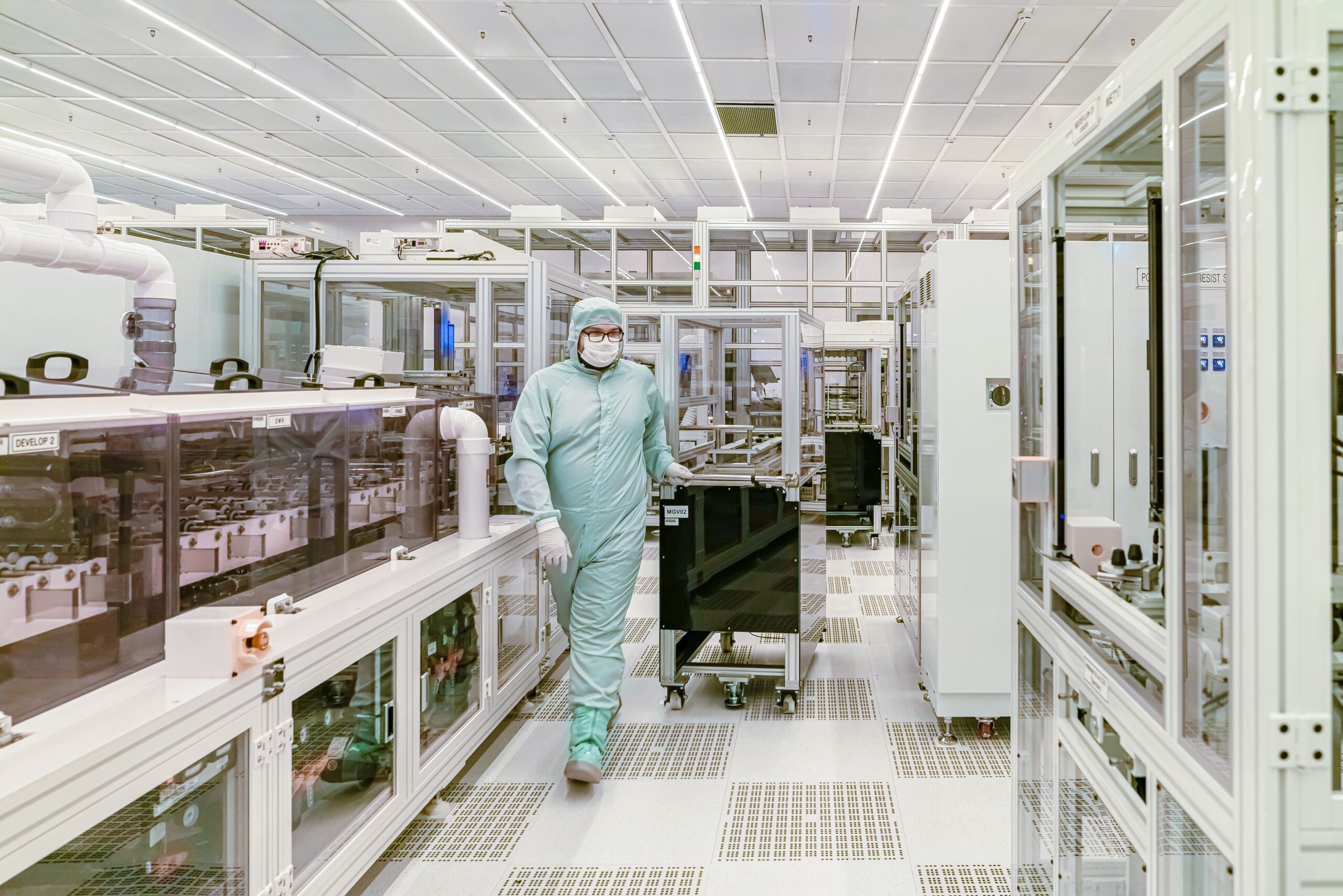
Trinity Fab will occupy approximately 3,305 square metres on the third floor of the first Yongin plant, known as Y1. Its proposed clean room sits close to the manufacturer’s future memory processing area, but separate access arrangements and security controls are intended to protect the production line. The shared facility places supplier development equipment near SK hynix engineers without allowing independent companies unrestricted access to commercial manufacturing operations.
Plans call for 51 physical tools: 26 front-end process machines, 11 metrology and inspection machines, and 14 auxiliary units. Some reports give a total of 55 by including four computing systems. The equipment supports stages such as lithography, etching, deposition, cleaning, and measurement on 300-millimetre wafers. Materials that perform adequately in a supplier’s laboratory can behave differently in a production clean room, where contamination control, process compatibility, and repeatability affect the suitability of an input for high-volume manufacturing.
Argon fluoride immersion lithography is included in the planned tool inventory, while extreme ultraviolet (EUV) lithography will remain outside Trinity Fab’s own equipment list. SK hynix has discussed helping suppliers obtain access to EUV equipment elsewhere in its production facilities where later-stage validation requires it. That arrangement has not been demonstrated through routine third-party testing. Access to advanced machines is particularly valuable for small suppliers because even a single scanner can exceed the capital budget of a specialist component development programme.
The layout reserves approximately 2,645 square metres for common process evaluation and roughly 661 square metres for 15 supplier rental rooms. Those rooms would allow companies to install their own machines while drawing on clean room utilities and technical support. At the November site visit, the interior had yet to receive its planned process tools, so the testing capacity described by the company is prospective. Constructing the clean room, installing equipment, validating utilities, and selecting users are separate steps before qualification work can begin.
SK hynix wants to reduce the development and commercial qualification cycle for supplier products from about three years to two, an ambition reported alongside the project rather than a demonstrated outcome. Faster iteration could come from testing a chemical, material, or machine in a facility designed around the same wafer dimensions and operating constraints as the intended production line. Suppliers would still have to meet the manufacturer’s yield, reliability, and process control requirements before receiving approval for routine use.
A dedicated foundation is expected to manage access and evaluate applicant companies, while the final charging arrangements have not been settled consistently across public accounts. The project also includes space where suppliers can install their own equipment for continuing development. Tool availability, engineering support, contamination rules, and the cost of participation will determine how widely the test centre can serve smaller businesses. Demand for access does not establish how many products will ultimately qualify for purchase.
Alongside Trinity Fab, SK hynix has described a broader supplier support programme worth approximately 1.4 trillion won over five years. That commitment covers development activity across research, testing, production, and sales and is separate from the facility’s 874.6 billion won budget. Company-backed qualification infrastructure can reduce one barrier to developing specialist inputs, but it cannot substitute for the production volumes, commercial terms, and quality evidence needed to build a sustainable supply relationship.
Construction at Yongin is proceeding across a much larger memory manufacturing development, with the Y1 plant and subsequent phases intended to anchor a substantial supplier cluster. Bringing toolmakers and material developers close to an end user can reduce the delay between test results, engineering feedback, and an altered design. The location also introduces practical limits: the manufacturer must keep process information confidential, segregate suppliers with competing technologies, and control movements into sensitive clean room areas.
Semiconductor qualification is unusually sensitive to defects that can propagate across several manufacturing steps. A valve, deposition precursor, or surface treatment chemical can meet its own specification yet still affect downstream wafer yield under different process conditions. A facility designed around production equipment allows those effects to be investigated before a candidate input reaches a commercial line. The eventual reduction in supplier development time will need to be established through completed evaluations rather than assumptions about the benefits of proximity.
Trinity Fab’s scheduled 2027 installation and service milestones will provide the first tests of delivery against the investment plan. The number of suppliers accepted, tools commissioned, qualification projects completed, and products subsequently introduced into commercial manufacturing will indicate whether the shared facility changes procurement outcomes. For now, the manufacturer and its public partners have committed capital to the testing stage of the semiconductor supply chain, rather than announced qualified replacement inputs.