IN Brief:
- Transpak and Ace Pillar are showcasing an Intelligent Mixed-Load Palletizing System at interpack 2026.
- The system combines high-speed strapping, 2D/3D AI vision, robotic palletising, and automated strap cutting.
- The TM30S robot supports palletising payloads up to 35kg for mixed-size materials.
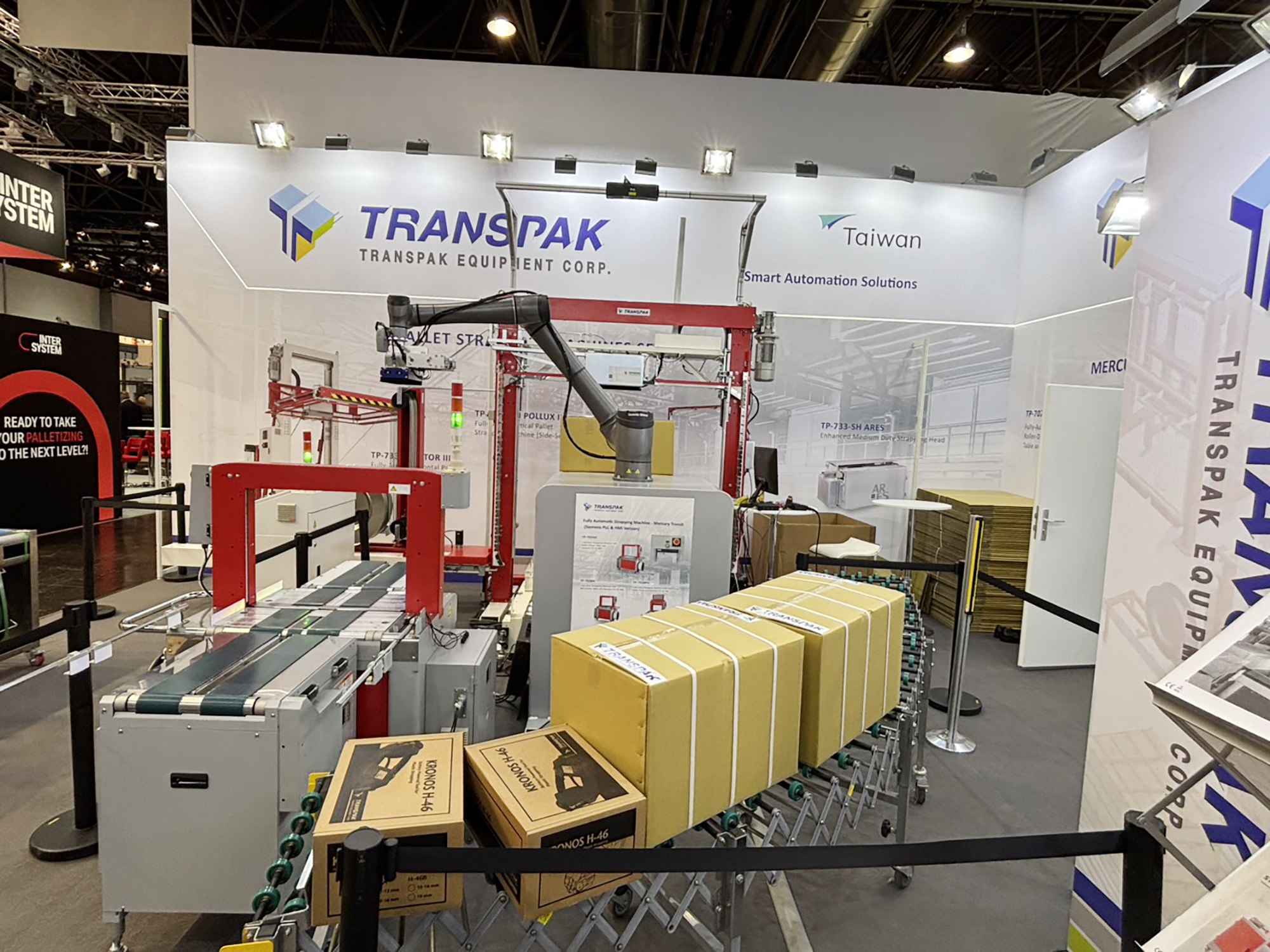
Transpak and parent company Ace Pillar are showcasing an Intelligent Mixed-Load Palletizing System at interpack 2026, combining strapping, AI vision recognition, robotic palletising, and depalletising technologies.
The system is designed for manufacturers managing high-mix production, varied carton sizes, labour shortages, and heavier end-of-line handling requirements. It brings together Transpak’s strapping equipment with Ace Pillar’s automation and vision capabilities to create a more integrated palletising workflow.
At the centre of the line is the TP-702BH high-speed fully automatic strapping machine, which delivers throughput of up to 65 bundles per minute. The system also uses the TP-733VTS Zelos pallet strapping machine to improve load stability during transport, adding an automated securing stage after pallet formation.
Robotic handling is provided by the TM30S palletising robot. In a palletising application, the robot supports a maximum payload of 35kg and is paired with Ace Pillar’s 2D/3D AI dual-vision technology. The vision system identifies and handles mixed-size materials, enabling more flexible palletising where carton dimensions, weights, and presentation are not fully uniform.
The exhibition also marks Transpak’s move from standalone equipment supply towards integrated logistics automation. The system spans palletising and depalletising applications, including Ace Pillar’s automatic strap-cutting depalletising technology. That addition gives the line relevance at both ends of goods movement, from production dispatch to warehouse receiving, unpacking, and replenishment.
Mixed-load palletising remains one of the more difficult areas of automation. Uniform cartons, predictable weights, and consistent dimensions are easier to automate, but many real production and distribution environments deal with changing SKUs, retailer-specific formats, ecommerce assortment variation, and frequent product changeovers. Vision systems and smarter control software are increasingly used to let robots identify products, adjust grip strategy, and build more stable pallets.
The system is being shown at interpack 2026 in Düsseldorf, one of the major global exhibitions for packaging, processing, and end-of-line technology. Transpak and Ace Pillar will also show further automation technologies at Automation Taipei later in 2026.
The launch follows a wider move towards warehouse automation built around connected cells rather than standalone machinery. SAP and Cyberwave’s autonomous AI robot deployment showed how live warehouse automation is increasingly shaped by software control, data integration, and robotic decision-making. Palletising is moving along the same path.
Labour availability continues to shape investment in manufacturing, food production, packaging, and distribution. Repetitive lifting, strapping, pallet building, and depalletising remain physically demanding tasks with safety, consistency, and throughput consequences. Automation can reduce manual handling, but it needs enough flexibility to deal with the variability that defines many production lines.
That is why mixed-load capability is gaining attention. Manufacturers are handling shorter runs, more SKUs, retailer-specific packaging, ecommerce-driven assortment changes, and more frequent product changeovers. A palletising cell that works only on stable, repeatable product flows can still deliver value in some facilities, but it leaves many operations untouched. Vision-led robotic systems are being positioned to handle a wider portion of real warehouse and factory work.
Strapping integration also strengthens the operational case. Palletising automation without load securing can simply move the bottleneck downstream. By combining high-speed bundle strapping with pallet strapping and robotic pallet formation, Transpak and Ace Pillar are targeting the full movement from packaged goods to transport-ready load. That can reduce handovers, improve consistency, and support faster dispatch where line-end throughput is constrained.
The depalletising element extends the system into inbound logistics. Automated strap cutting and intelligent recognition can support warehouses that receive mixed pallets from suppliers, cross-dock operations, and manufacturing sites that need to break down loads before feeding production. As labour costs and safety expectations rise, depalletising is becoming as important as palletising in the automation investment case.
Successful deployment will depend on integration. End-of-line automation has to work with conveyors, warehouse management systems, production schedules, safety controls, maintenance routines, and operator workflows. The strongest systems will be those that can be installed without forcing a full redesign of existing operations, while still delivering measurable gains in labour use, safety, throughput, and load quality.