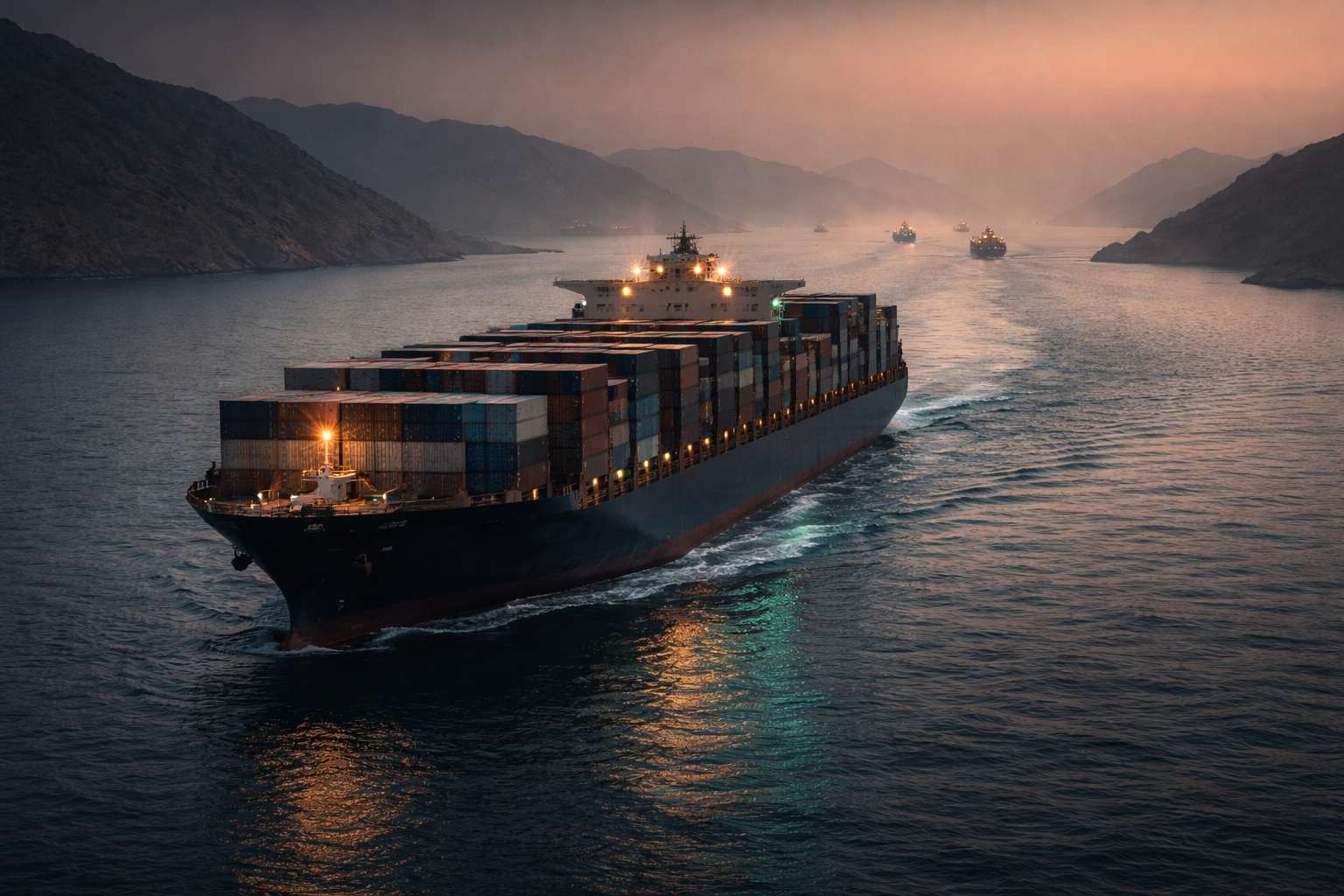
The Iran–US conflict that erupted on 28 February has shifted from geopolitics to logistics with depressing speed. On 2 March, Iran said the Strait of Hormuz was closed and threatened vessels attempting to transit, a move that has turned a narrow stretch of water into an immediate constraint on global trade.
For container shipping, the sting is not that Hormuz is a major East–West artery in the way the Suez Canal is, but that it is the gate for every deepsea call into the Arabian Gulf. The Gulf’s role as a distribution hub for the Middle East, parts of South Asia, and East Africa means disruption is felt well beyond the immediate combat radius. The region’s largest container port, DP World’s Jebel Ali, handled 15.5m TEU in 2024 — volumes that do not move when ships stop moving.
The timing is particularly painful because freight markets were softening. Drewry’s World Container Index fell to $1,899 per 40ft container on 26 February, continuing a multi-week decline as capacity and schedules slowly stabilised. The Red Sea, meanwhile, had begun to show cautious signs of a phased return, including limited test movements on some services. That optimism has been overtaken by recent events, with carriers now reinstating diversions around the Cape of Good Hope and shelving Suez plans again.
Operational decisions have been broadly consistent: reduce exposure, protect crews, and avoid sailing where insurance cannot be secured.
Maersk’s customer advisory stated the company is “suspending all vessel crossings in the Strait of Hormuz until further notice,” warning of delays and service adjustments for Arabian Gulf calls. Hapag-Lloyd has likewise announced it is “suspending all vessel transits through the [Strait of Hormuz] until further notice,” citing the security situation and the strait’s official closure.
Ocean Network Express has moved on bookings, issuing a “Temporary Suspension of Bookings to and from the Persian Gulf” as the situation escalated. At TPM26, ONE chief executive Jeremy Nixon said around 100 container ships — roughly 10% of the global container fleet — were caught in the Hormuz backlog, a figure that speaks to immediate network shock rather than a distant risk.
MSC has taken an even broader step, suspending all bookings for worldwide cargo to the Middle East until further notice. CMA CGM has instructed vessels to adjust operating posture and introduced emergency conflict surcharges across a wide list of Middle East and adjacent markets, including a $2,000 surcharge for 20ft dry containers and $3,000 for 40ft dry containers on affected moves.
Chinese carrier COSCO has instructed Gulf-bound vessels to prioritise navigational safety, including speed reductions and proceeding to sheltered anchorages or “safe waters,” effectively signalling slower transits and more waiting time even where passage remains technically possible.
The consequential cost of conflict
For energy-linked supply chains, Hormuz is not a “regional” problem. The US Energy Information Administration estimates that flows through the Strait of Hormuz in 2024 and 1Q25 represented more than a quarter of global seaborne oil trade and about one-fifth of global oil and petroleum product consumption. It also estimates around one-fifth of global LNG trade transited Hormuz in 2024, primarily from Qatar.
That is why underwriters, rather than navies, can end up acting as the effective blockade. Reuters reported major insurers cancelling war-risk coverage for Gulf voyages and cited war-risk premiums rising to as much as 1% of a ship’s value, alongside reports of ships stranded and multiple tankers damaged. When insurance availability collapses, the question of “can you sail?” becomes less about seamanship and more about whether a voyage is financeable.
Similar pressure comes on the LNG front. Reuters reported Qatar — responsible for roughly 20% of global LNG exports — suspending LNG production after strikes on key Ras Laffan facilities, and noted Qatar’s exports route through Hormuz. In practical terms, that feeds straight into European and Asian gas pricing, power costs for energy-intensive manufacturing, and bunker price expectations for shipping.
Containerised trade is exposed differently, but it is still exposed. A Hormuz closure does not merely delay a handful of port calls; it strands ships, boxes, and equipment where networks cannot rebalance quickly. Nixon’s “10% of the fleet” figure matters because container shipping is a system optimised for utilisation — a sudden “fleet shrink” shows up as blank sailings, equipment shortages, missed feeders, and congestion surcharges in places that never appear on a war map.
For supply chain leaders, the immediate impact will be felt in three places: lead times, landed cost, and contractual friction.
Lead times first. Gulf-bound cargo is now facing a mix of suspended bookings, “wait at anchor” instructions, and service reshuffles. Even where cargo is rebooked via alternate routings, the system absorbs delay at multiple handoffs: origin cut-offs, transhipment windows, and inland drayage at destination once terminals reopen at normal cadence. Forwarders are already warning customers to expect delays and higher costs as services adjust.
Landed cost follows quickly. Conflict surcharges and war-risk premiums are direct adds, but the bigger bill often arrives indirectly: longer voyages, higher fuel burn, and disruption-driven inefficiency. The Middle East is also a pricing engine for petrochemicals and industrial feedstocks; if energy markets remain volatile, the knock-on effects show up in everything from packaging and polymers to fertilisers and specialty chemicals, with procurement teams forced back into shorter quote-validity windows and more frequent repricing.
Then there is the legal and commercial layer. When a strait becomes “effectively blocked” because insurers step away, force majeure arguments, detention and demurrage disputes, and cargo abandonment edge from edge-case to weekly admin. Some shippers will find that “routing flexibility” written into contracts was always going to be tested in court, not in a procurement meeting.
How this changes the 2026 outlook
Before the first missile, the 2026 outlook was already softer than many executives wanted to admit. In October 2025, the WTO downgraded its forecast for 2026 merchandise trade volume growth to 0.5%, reflecting a more fragile baseline for global demand and trade momentum. The shipping market, meanwhile, was drifting back towards surplus capacity dynamics, with rates easing and carriers looking for any credible path back to shorter routings without triggering another price collapse.
The Hormuz shock changes the character of risk more than it changes the underlying physics of supply and demand. If the disruption persists, it tightens capacity by immobilising ships and forcing longer routings, and it pushes cost volatility back into contracts that had started to settle. If it resolves quickly, the lesson is still commercial: insurers, carriers, and beneficial cargo owners have now been reminded that the “post-Red Sea reset” was never a reset, just a pause between disruptions.
Either way, 2026 planning is now less about chasing lowest-cost transport and more about paying for options. In a year where trade growth was already forecast to be anaemic, the margin for logistics error has become thinner.