IN Brief:
- Outdoor-capable autonomous tuggers and forklifts are turning charging into a hard availability constraint.
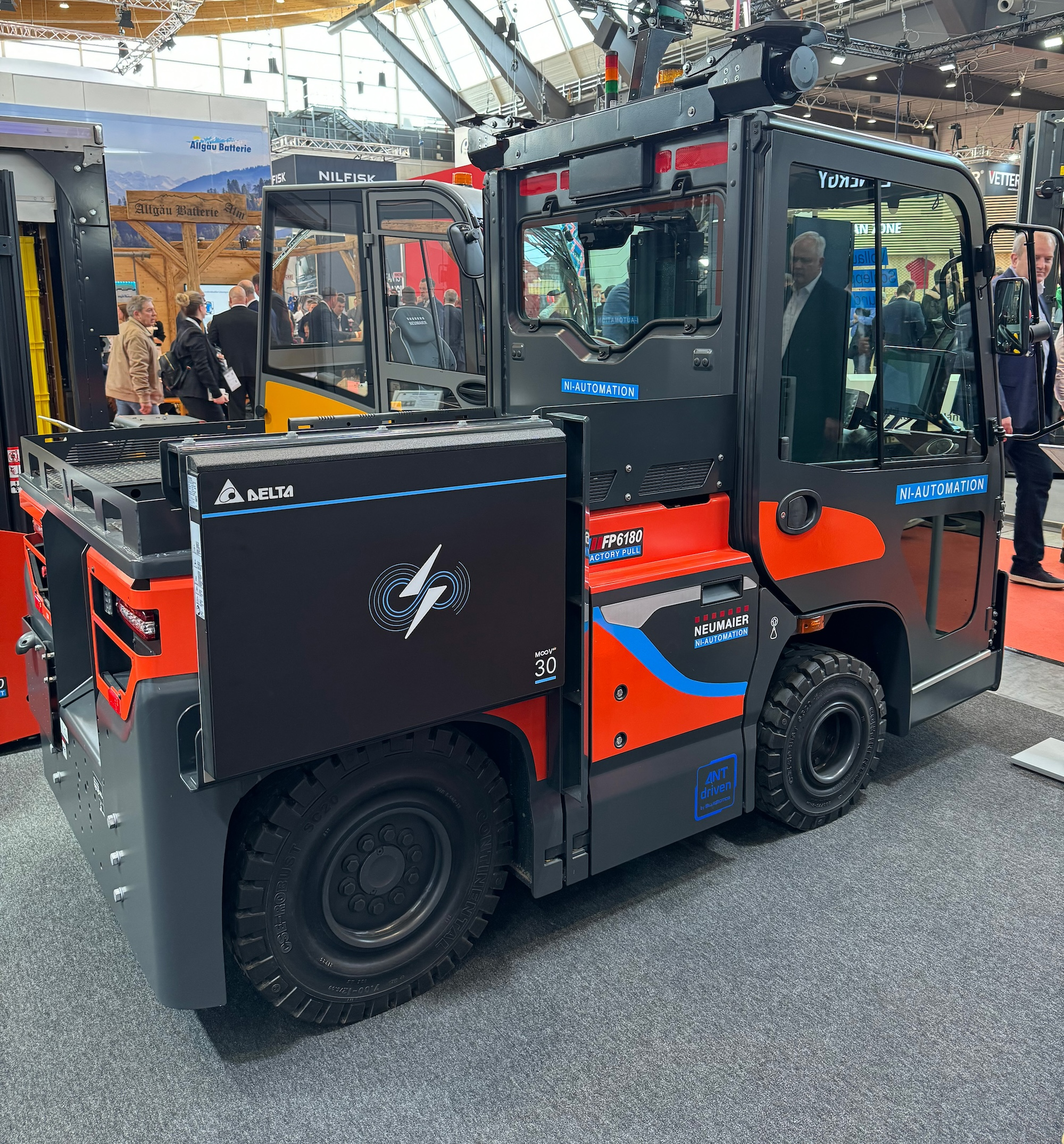
- Neumaier has integrated Delta’s MOOVair inductive pads for 80 V opportunity charging at 10 kW and 30 kW.
- Shared pads, CAN/Ethernet integration, and interference-resistant comms are shaping the next phase of unattended fleet operation.
In automated intralogistics, the weak link is rarely routing software or sensor coverage. It is often the unglamorous interface between a vehicle and the energy it needs to keep moving. When fleets are expected to operate through shift changes, weather swings, and tightly timed production cycles, scheduled charging breaks stop looking like a planning assumption and start looking like a failure mode.
Neumaier Industry GmbH & Co. KG, a medium-sized intralogistics specialist based in Hofstetten in Germany’s Black Forest, has been pushing into that failure mode by design. The company develops tailored automation concepts across tugger train systems, automated guided vehicles for outdoor routes, forklifts, undercarriage shuttles, low- and high-lift trucks, very-narrow-aisle automation, conveyor systems, and logistics software, with deployments spanning multiple industrial sectors. The common thread is the same, whether the route is under a canopy or across an exposed yard: if the transport chain pauses, the operation absorbs the shock.
For Neumaier, the requirement was blunt. Its autonomous vehicles needed a charging infrastructure that could support 24/7 operation without manual intervention, run with minimal maintenance burden, and remain reliable in outdoor conditions that are hostile to connectors, seals, and tolerances. The electrical constraint sharpened the search further: the applications demanded an 80 V supply, a niche that limits the number of industrial-grade options available.
Outdoor automation raises the bar
Most automated charging discussions assume relatively clean indoor environments, predictable stopping positions, and controlled access. Outdoor intralogistics does not offer those comforts. Water ingress, dirt, grit, freeze–thaw cycles, and mechanical impacts from daily operations all degrade exposed interfaces, and any requirement to plug and unplug a connector introduces both human dependency and a maintenance item that scales with fleet size.
That is why Neumaier moved away from cable-based charging for these projects. Plug-in systems can be engineered to be robust, but they still rely on physical contact surfaces, repeated mating cycles, and connector alignment. Over time, those are exactly the elements that accumulate wear, contamination, and intermittent faults, particularly when vehicles are operating beyond warehouse walls.
Inductive charging shifts the interface from metal-to-metal contact to controlled energy transfer across an air gap. In practical terms, that means no exposed charging contacts, fewer mechanical wear points, and less sensitivity to the grime and moisture that collect wherever vehicles stop. It also makes opportunity charging viable: short, frequent top-ups during normal operational pauses, rather than a single extended stop that takes the vehicle out of the flow.
Neumaier’s partner on the charging side was Delta, which supplies power and automation technologies and offers its MOOVair wireless charging portfolio in power classes ranging from 1 kW to 30 kW. The attraction, in this case, was not the concept of inductive charging itself, but the ability to deliver a robust, standards-aligned 80 V solution with system-level interfaces that could be embedded into automated fleet control.
Two conversions, one charging architecture
The work centred on two customer projects, both focused on autonomous outdoor operation.
The first was an autonomous outdoor tugger train, built by converting a manual Linde P180 tractor into what Neumaier describes as its “Factory Train FT630”. The scope went beyond navigation autonomy. The vehicle also required fully automated loading and unloading of tugger trailers, and automated charging without an operator stepping in to connect hardware.
For that application, Neumaier selected Delta’s MOOVair 30, a 30 kW inductive charging system designed for 80 V operation. The system is specified to deliver up to 300 A and to achieve 95% efficiency across a distance of up to 150 mm, including tolerance for slight misalignment between the vehicle and the charging pad. Misalignment tolerance is not a cosmetic specification in automated environments; it is the difference between a charging event that completes reliably and a vehicle that sits waiting for a recovery routine.
The environmental specification also matters. The MOOVair 30 is rated to IP69, targeting protection against dust ingress and high-pressure water exposure, which aligns with outdoor deployment where cleaning regimes and weather can both be aggressive. From an integration standpoint, the system offers Ethernet and CAN bus interfaces, giving it a direct path into existing vehicle controls and fleet management layers, rather than sitting as an isolated charging appliance.
Neumaier’s second project tackled autonomous outdoor counterbalanced forklifts, based on the conversion of several Linde E16 trucks. These vehicles sit at a different point in the duty-cycle spectrum: less about fixed-route towing and more about flexible movements, variable loads, and frequent stopping patterns. The charging system still needed to be automatic and contactless, but the power class could be lower.
Here, Neumaier chose Delta’s MOOVair 10, a 10 kW system specified to provide up to 275 A of charging current. As with the tugger train application, the rationale was rooted in removing the connector and its associated maintenance overhead, while enabling charging events to be woven into normal operational pauses.
The MOOVair 10 deployment also introduced a second technical layer: communication between the charging pad and the vehicle. Delta’s patented Pad-Pad-Link technology uses a magnetic communication field rather than relying on crowded wireless bands such as 2.4 GHz. In industrial sites where Wi-Fi, Bluetooth devices, scanners, access points, and machine connectivity compete for spectrum — and where dust, moisture, and occlusion are routine — a short-range magnetic communication method is a pragmatic approach. It keeps the data link local to the charging interaction, reduces exposure to radio interference, and supports a tighter loop between alignment, charging state, and safety interlocks.
Integration for tomorrow
In both projects, the MOOVair systems were integrated during vehicle conversion rather than added as an afterthought. That matters because the charging pad, vehicle-side receiver, protection hardware, communications, and control logic all need to be treated as a single subsystem. Outdoor ruggedisation is not simply a higher ingress rating; it is how cable routing is protected, how mounts deal with vibration, how clearances are maintained through temperature shifts, and how maintenance access is preserved without exposing the very interfaces the design is trying to eliminate.
Neumaier’s requirements set the integration bar: a fully weatherproof, rugged design; no exposed contacts; maintenance-free operation as far as practical; secure, reliable communication at the charging point; and complete automation of the charging process so that the vehicle can return to work without operator intervention. Delta and Neumaier worked closely at development level to implement the systems under those constraints, with inductive charging positioned as a durability and reliability play as much as an automation one.
The operational implication is straightforward. If a vehicle can collect energy in short intervals during natural pauses — docking, trailer handling, staging, or task transitions — then the depot-style model of “run until empty, then stop” becomes less dominant. That shifts planning away from allocating time blocks for charging and towards ensuring that the route network includes enough predictable micro-stops to keep the battery within an acceptable window.
It also changes the investment logic. A charging point that can be shared across multiple vehicles, rather than being permanently assigned, reduces both floor-space pressure and the number of charging assets required as fleets scale. In yard operations where space is always contested, that is not a minor detail.
Neumaier’s two deployments do not claim to solve every charging scenario, and inductive systems still have to compete on cost, installation complexity, and standardisation. What they do show is how quickly charging becomes a systems engineering topic once autonomy moves outdoors. When vehicles are expected to run continuously, the charging interface becomes part of the control architecture, the site layout, and the maintenance strategy.
For operators building towards higher levels of unattended operation, that is the real shift. Charging is being pulled into the same design conversation as routing, safety zoning, and fleet orchestration — and that is where it will stay.