IN Brief:
- SAP and Cyberwave have deployed autonomous AI robots inside SAP’s St. Leon-Rot warehouse in Germany.
- The robots perform box folding, packaging, and in-house shipping fulfilment tasks.
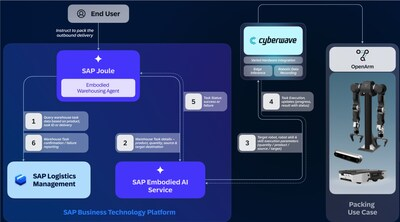
- The integration links SAP Logistics Management, SAP Embodied AI Service, SAP BTP, and Cyberwave’s training and deployment platform.
SAP and Cyberwave have deployed fully autonomous AI-powered robots inside SAP’s logistics warehouse in St. Leon-Rot, Germany, bringing physical AI into live packaging and fulfilment workflows.
The robots are carrying out box folding, packaging, and in-house shipping fulfilment tasks without manual intervention. The deployment runs on SAP Logistics Management, SAP’s cloud-native logistics execution system, with task translation handled through SAP Embodied AI Service and integration supported by SAP Business Technology Platform and Cyberwave’s robotics platform.
Cyberwave’s system combines demonstration-based data collection, vision-language-action models, reinforcement learning, and real-time feedback loops. The approach is designed to let robots operate in variable warehouse conditions, where cartons, labels, order profiles, product flows, and physical layouts change more often than fixed automation systems comfortably allow.
Packaging work remains difficult to automate at scale because the task is more variable than it appears. Boxes arrive in different sizes, orientations, and conditions. Fulfilment priorities change through the day. Operators adjust processes around demand peaks, carrier cut-offs, and exceptions. A robotic system that can interpret tasks from the execution layer and adapt to physical variation has a different operating profile from equipment built around narrow, pre-defined movements.
The St. Leon-Rot deployment arrives as warehouse automation suppliers place more emphasis on adaptable software layers and enterprise integration. IN Supply recently covered KION’s investment in ZIKOO Robotics, which focused on pallet-level automation, high-density storage, and AI-driven orchestration. It has also covered Skild AI’s acquisition of Zebra’s warehouse robotics automation business, including Fetch Robotics and Symmetry Fulfillment capabilities.
Those moves point to a market that is shifting away from isolated automation cells and toward systems that can learn, integrate, and adapt inside existing warehouse execution environments. The robot controller is only one part of the stack. Labour planning, WMS, warehouse execution, exception handling, order prioritisation, transport cut-offs, and real-time feedback all shape whether automation improves flow or becomes another operating constraint.
SAP’s involvement gives the project an enterprise systems dimension. Many warehouses already use business software to manage orders, stock, transport, purchasing, and finance, while physical automation often sits in a more fragmented layer beneath those processes. Connecting robots directly into a logistics execution system narrows the gap between business instruction and physical task completion.
Live operation will test the system more severely than any controlled demonstration. Warehouses expose robotics to damaged cartons, partial stock, substitutions, changing product mixes, staff movement, replenishment interruptions, and rush orders. Robots that can be trained more quickly and adapted without deep robotics expertise could expand automation into tasks that have previously remained manual because the engineering burden outweighed the return.
Labour pressures add another driver. Warehouses continue to deal with recruitment difficulty, high churn in repetitive roles, ergonomic strain, and rising throughput expectations across ecommerce, retail, spare parts, healthcare, and manufacturing supply chains. Automating repetitive packaging and fulfilment work shifts human effort toward supervision, exception management, process improvement, and system control.
Physical AI in warehousing is still a developing category, and large-scale adoption will depend on reliability, cost, safety, integration depth, and ease of training. The SAP and Cyberwave deployment gives the market a working reference point inside a live logistics environment, where robotics is being tied directly to execution software rather than treated as a standalone automation project.