IN Brief:
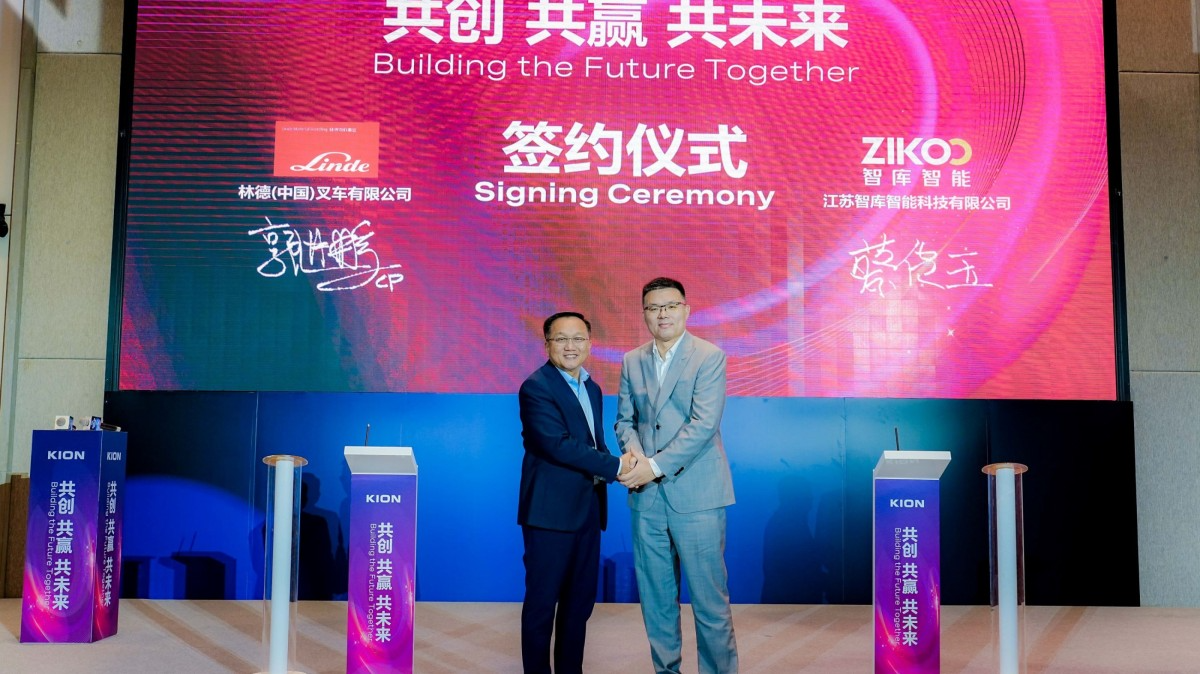
- KION has taken a strategic equity stake in China-based ZIKOO Robotics.
- The partnership covers high-density pallet storage, warehouse robotics, and intelligent warehouse software.
- KION’s Linde Material Handling China brand and ZIKOO have launched an AI Smart Warehouse solution.
KION Group has made a strategic equity investment in ZIKOO Robotics, expanding its position in pallet-level warehouse automation and high-density storage systems.
ZIKOO Robotics, based in Nanjing, China, develops pallet storage robotics and warehouse automation technologies. The partnership will focus on high-density pallet storage systems, warehouse robotics, and intelligent warehouse software platforms, combining KION’s intralogistics, industrial truck, and system integration experience with ZIKOO’s robotics and storage technology.
The investment coincides with the launch of the AI Smart Warehouse, developed by KION’s Linde Material Handling China brand and ZIKOO. The system integrates pallet-handling robots, high-speed lifting technologies, and intelligent software. AI algorithms are used to analyse inventory layouts, travel paths, and equipment resources, allowing multiple robots and workflows to be coordinated through the same control structure.
KION said the solution can increase storage space utilisation by around 30% compared with traditional automated systems, while supporting higher inbound and outbound performance. Its modular design allows users to expand the system as operational requirements grow.
Pallet-level automation is gaining ground as warehouses, factories, 3PL sites, and distribution centres look for more capacity from existing real estate. Large facilities remain expensive to build and difficult to staff, while many operators are still working inside legacy buildings that were not designed for automated flows. Dense storage systems can change the economics of those sites by increasing storage capacity and reducing unnecessary vehicle movement.
The investment also shows the changing role of materials handling suppliers. Industrial truck groups are no longer competing only on forklifts, reach trucks, and service networks. The market is moving towards integrated intralogistics systems that combine trucks, robotics, automated storage, software, energy management, and maintenance. Customers increasingly want equipment that works as part of an orchestrated warehouse rather than a collection of standalone assets.
ZIKOO gives KION additional depth in a Chinese automation market that has developed quickly around e-commerce, manufacturing, export logistics, and dense urban warehousing. China has become an important proving ground for warehouse robotics because operators there often face high throughput, constrained space, and fast-changing fulfilment requirements.
The modular nature of the AI Smart Warehouse also speaks to a wider automation challenge. Many companies want robotics and dense storage, but they are cautious about large, fixed systems that require long deployments and leave limited room for operational change. Pallet-handling robotics linked to intelligent software can offer a more staged route into automation, particularly where SKU profiles, order volumes, or customer requirements are shifting.
The partnership strengthens KION’s automation ecosystem at a point when intralogistics suppliers are being pushed to deliver more complete systems. Space utilisation, labour efficiency, robotics, and warehouse software are now part of the same investment decision.