IN Brief:
- Romark Logistics has selected DexoryView to enhance inventory management at its Hazleton warehouse.
- Autonomous robots perform inventory checks between shifts, reducing disruption to automated guided vehicle operations.
- The deployment gives Romark a pathway to expand real-time warehouse visibility across additional facilities.
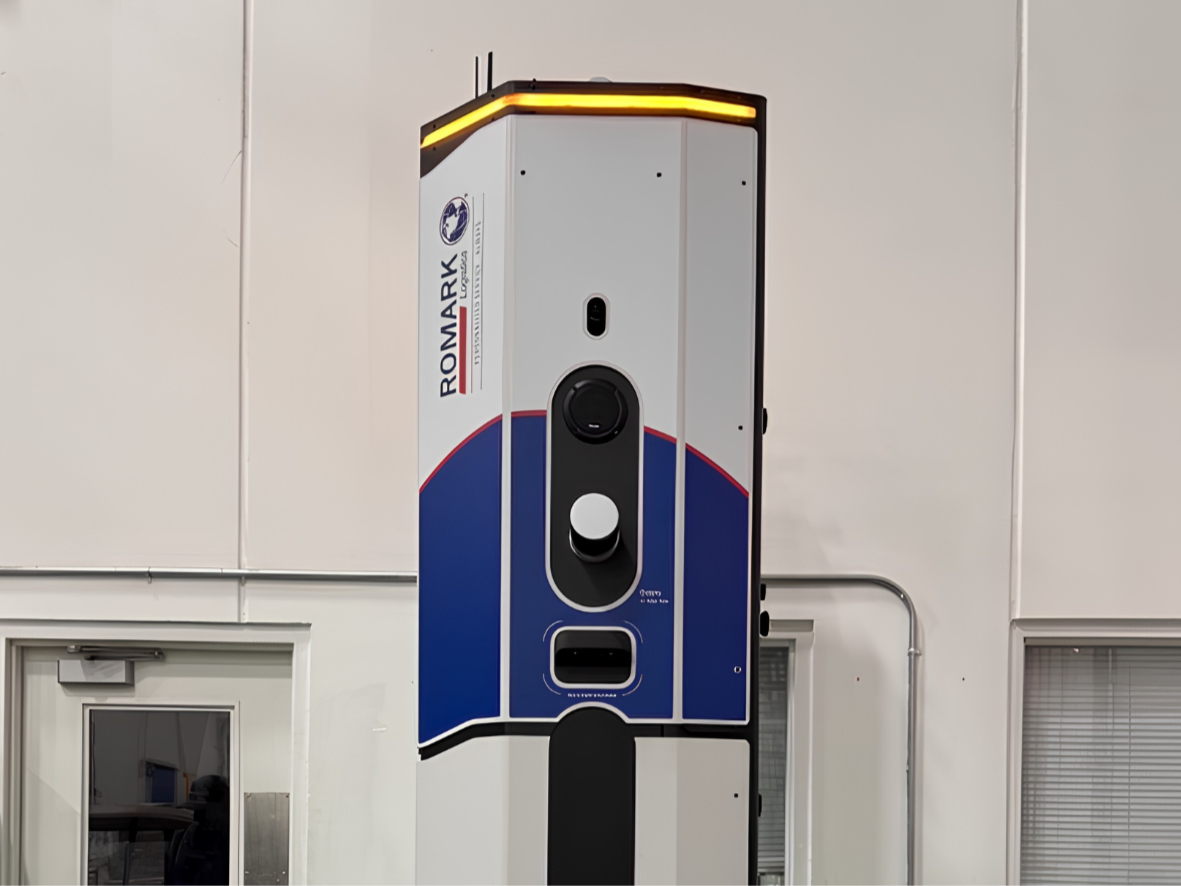
Romark Logistics has deployed Dexory’s AI-powered warehouse visibility platform, DexoryView, at its Hazleton, Pennsylvania, facility to improve inventory management and cycle counting across a high-volume confectionery operation.
The deployment uses autonomous robots to scan warehouse aisles and capture inventory data without pausing live operations. The robots perform checks between shifts, completing multiple aisles per day while automated guided vehicle activity continues and equipment remains in active workflows.
DexoryView creates an AI-powered digital twin of the warehouse, giving operators continuously updated insight into inventory location, stock accuracy, and operational discrepancies. Romark will use the platform to validate inventory more quickly and free warehouse teams to focus on exception handling, process improvement, and inventory optimisation.
“Dexory enables us to validate inventory quickly without disrupting our automated operations,” said Kevin Gamber, associate director of automation at Romark Logistics. “We can complete cycle counts more efficiently within our existing shift structure, allowing our team to focus on resolving discrepancies and improving overall inventory accuracy.”
The Hazleton site handles high-volume confectionery products in a fully racked warehouse environment. That operating profile places pressure on inventory accuracy, as product movement, replenishment, storage density, and customer service requirements all depend on reliable stock information. Manual cycle counting can interrupt workflows, require equipment availability, and divert labour from higher-value tasks.
DexoryView is intended to remove that trade-off by capturing inventory data during windows that do not interfere with throughput. The system gives Romark a faster route to discrepancy identification while allowing the warehouse to maintain normal activity across automated and manual workflows.
Dexory has been broadening the operational role of its autonomous warehouse robots, including upgraded storage health checks and wireless charging for warehouse robots. Those developments show the company moving from basic inventory scanning toward a wider platform for continuous warehouse condition and performance monitoring.
Romark’s use case shows why real-time visibility is becoming more valuable in third-party logistics. 3PLs operate under tight service-level commitments and often handle multiple customers, product types, and order profiles across the same estate. Inventory discrepancies can therefore create downstream problems in picking, replenishment, shipping accuracy, and customer reporting.
Traditional inventory control processes often rely on scheduled counts, manual checks, or exception-led investigation. Those methods can work in slower environments, but they become less effective in dense, high-throughput warehouses where stock moves constantly and labour is already stretched. Autonomous data capture allows the warehouse to check itself more frequently without turning inventory control into a separate operational event.
The digital twin element adds a further layer of value. A warehouse visibility platform becomes more useful when it can show not only where inventory should be, but where it actually is, where anomalies are developing, and where operational patterns are creating repeat issues. That gives supervisors a stronger basis for root-cause analysis rather than relying only on reconciliation after errors affect service.
“Logistics providers are increasingly looking to technology to build more resilient and adaptable operations,” said Oana Jinga, co-founder and chief commercial and product officer at Dexory. “This deployment enables Romark Logistics to embed real-time cycle count data into warehouse operations at a much faster pace, supporting more informed decision-making and continuous improvement over time.”
The partnership has been structured with a pathway to expand DexoryView across additional facilities. That expansion route reflects a broader pattern in warehouse automation, where operators want systems that can be deployed at one site, proven against operational targets, and then rolled out across a network without requiring every building to be redesigned from the ground up.
For Romark, the immediate gain is faster and less disruptive inventory validation at Hazleton. Over time, the larger value lies in creating a more continuous data layer across warehouse operations. In high-volume 3PL environments, accurate inventory visibility, rapid exception handling, and uninterrupted automation are becoming central measures of operational resilience.