IN Brief:
- easyDelivery now provides access to more than 350,000 PUDO points across Europe.
- The platform spans 16 countries, including the UK, France, Germany, Spain, Italy, and the Nordics.
- The model supports parcel shop access, delivery comparison, carrier access, and future local delivery services.
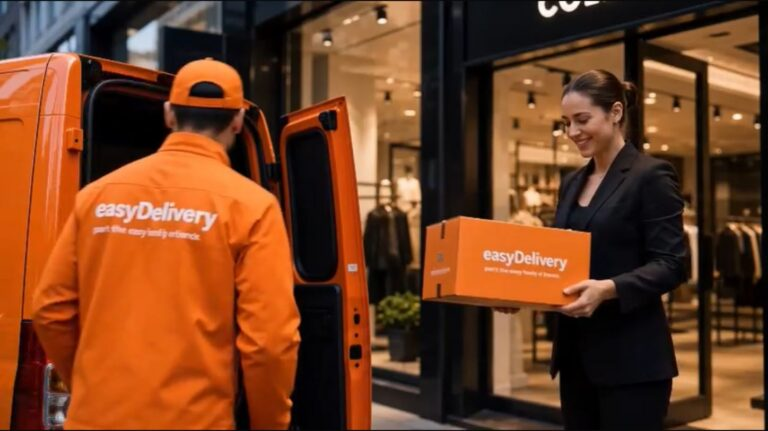
easyDelivery has expanded its platform to provide access to more than 350,000 pickup and drop-off points across Europe, strengthening its position in the out-of-home delivery market.
The network spans 16 countries: the UK, France, Germany, Spain, Italy, Ireland, Belgium, the Netherlands, Portugal, Austria, Poland, Denmark, Sweden, Norway, Finland, and Switzerland. The platform allows users to compare delivery options, locate PUDO points, manage parcel services, and access carrier networks through a single app.
Part of easyGroup, the business has been designed for consumers, independent merchants, and growing companies that need parcel options without managing multiple carrier websites, service rules, and delivery interfaces. Its next development phase is expected to include on-demand local delivery services for businesses.
Out-of-home delivery has become one of the main areas of competition in European parcel logistics. Lockers, parcel shops, post offices, retail counters, convenience stores, and other PUDO locations give carriers and merchants an alternative to repeated home delivery attempts, while reducing route pressure created by low-density residential drops and fragmented delivery windows.
A merchant sending parcels across Europe may need different carriers by country, service level, parcel profile, delivery promise, and return process. Aggregating those options through one interface can reduce administrative work and help smaller businesses access networks that would otherwise be difficult to coordinate at scale.
Returns are also helping to drive PUDO growth. Ecommerce returns shape transport cost, warehouse workload, inventory recovery, resale speed, and customer retention. A denser out-of-home network can make returns easier to inject back into logistics systems, especially where customers can choose a nearby parcel shop or locker rather than wait for a collection.
The European market is moving towards more layered delivery models. Home delivery remains important, although it is no longer the sole default. Merchants are increasingly offering lockers, parcel shops, local collection, carrier choice, and cross-border options, while back-end systems have to manage booking, labels, tracking, exception handling, and returns without fragmenting operational control.
Trust and verification are becoming more important across digital logistics systems, from parcel platforms through to freight exchange models. Certified freight exchange development, including more structured approaches to carrier assurance and transaction confidence, reflects a wider industry movement towards platforms that provide more than access. Network reach is valuable only when users can manage the transaction securely, consistently, and with enough visibility to handle exceptions.
The expansion also comes as urban logistics faces pressure from congestion, sustainability targets, delivery labour constraints, and customer expectations for convenience. PUDO points can reduce failed deliveries and improve route efficiency, but only where network density is high enough to make collection genuinely convenient. A parcel shop or locker that sits outside normal customer movement will struggle to change delivery behaviour.
Carriers can use PUDO networks to consolidate drops and improve first-time delivery success. Retailers can offer cheaper fulfilment options and wider checkout choice. Smaller businesses can narrow the service gap between their own delivery offer and that of larger ecommerce operators with more mature carrier relationships.
Adding on-demand local delivery would move easyDelivery beyond PUDO access and towards a broader orchestration role. In that model, parcel shop, locker, collection, carrier, and local delivery options can be selected according to cost, speed, location, customer preference, and merchant requirement rather than treated as separate service channels.
The economics of the final mile remain difficult. Labour, failed drops, low basket values, traffic restrictions, and uneven delivery density all pressure margins. A larger European PUDO layer does not remove those costs, but it gives shippers and merchants another way to design final-mile movement around consolidation rather than repeated door-to-door attempts.
easyDelivery’s expansion adds another platform to that structural shift, with a network large enough to influence parcel behaviour across several major markets. The practical test will be whether the app can turn broad geographic access into regular usage for merchants, customers, and carriers that need delivery choice without operational fragmentation.