IN Brief:
- EFL Project Logistics has delivered 25 battery energy storage units for Sri Lanka’s first commercial-scale BESS project.
- The move included 18 hazardous cargo units weighing 42 tonnes each.
- The project supports grid stability and renewable energy integration at Galle and Matara.
EFL Project Logistics has completed the transport and delivery of Sri Lanka’s first commercial-scale battery energy storage system, managing the movement from vessel arrival through to final positioning at project sites in Galle and Matara.
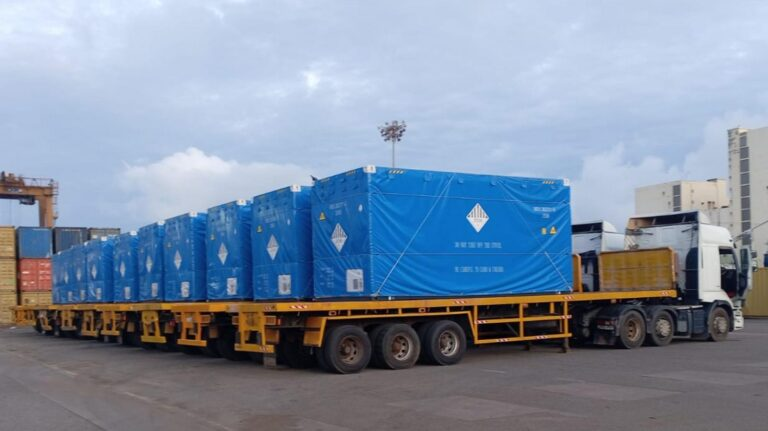
The operation involved 25 battery energy storage system units, including 18 hazardous cargo units weighing 42 tonnes each. EFL managed port handling at Colombo, customs clearance, specialised inland transport, temporary storage, unloading, and placement at the final sites. The cargo forms part of the Galle and Matara projects developed by Galilee BESS, a subsidiary of KHEN Energy.
Battery energy storage logistics sits at the junction of power infrastructure, hazardous cargo management, and heavy project transport. The cargo profile is dense, high-value, regulated, and unforgiving. Each unit has to move through port, storage, road, and site handover stages with close control over lifting, routing, documentation, and emergency procedures.
The hazardous classification adds a further layer of discipline. Battery cargo can require specific handling processes, route planning, safety checks, storage controls, and contingency arrangements. Heavy-lift planning also has to account for equipment availability, axle loads, bridge and road constraints, crane access, ground bearing capacity, and the readiness of each installation site.
Sri Lanka’s grid resilience gives the movement a broader infrastructure context. The Galle and Matara systems are intended to support renewable energy integration and help stabilise the grid as intermittent generation becomes a larger part of the energy mix. Storage assets of this kind are increasingly being treated as core grid infrastructure rather than supplementary equipment.
That shift is creating a different kind of project cargo pipeline across Asia. Solar, wind, battery storage, grid reinforcement, and renewable-linked industrial projects require logistics teams that can handle modular but heavy cargo under tighter installation schedules. The equipment may arrive in standardised units, but the movements themselves are rarely standard.
The physical sequence is often as important as the transport itself. BESS units may need temporary holding if site works are not complete, staggered delivery if installation teams are working in phases, and secure monitoring while they await final placement. Delays in customs, port handling, inland road transport, or site readiness can quickly affect commissioning schedules.
The work also reflects the move from freight forwarding to integrated project logistics. Transporting the cargo is only one part of the job. Customs documentation, hazardous goods compliance, port coordination, route engineering, storage, contractor communication, lifting plans, and final handover all have to operate as one chain. Fragmentation at any point increases the risk of delay, damage, or non-compliance.
Regional supply chains have already shown how quickly energy and industrial movements can be affected by capacity and routing pressure. Softer India–Gulf rates as capacity returned on key lanes gave shippers a temporary cost release, but project cargo is far less flexible than ordinary container freight. Heavy and hazardous energy equipment cannot be rerouted at speed without specialist planning.
The investment climate is moving in the same direction. Bangladesh’s recent steps to open logistics infrastructure to deeper foreign investment underline how South Asian economies are connecting transport, industrial development, and energy resilience. Ports, inland depots, customs systems, and heavy transport corridors now sit inside national competitiveness plans.
Battery storage projects will sharpen those requirements. The cargo needs safe ports, reliable customs processes, qualified forwarders, specialist equipment, skilled drivers, secure temporary storage, and sites that are ready to receive loads on schedule. Renewable generation targets mean little if the physical logistics chain cannot deliver the equipment needed to stabilise the grid.
EFL’s Sri Lankan movement demonstrates the practical capability required for that next stage of energy infrastructure. As more markets deploy storage, project logistics providers with early experience in hazardous battery units, heavy road movement, and site coordination will have an advantage. The work is technical, procedural, and highly visible once power systems begin to depend on it.