IN Brief:
- The Big Blue Shed provides 143,700 sq ft plus an 85,000 sq ft sprinklered mezzanine.
- Knight Property Group will refurbish the building envelope, yards, offices, and welfare accommodation.
- The six-acre site sits between the M8 and M74 within Central Scotland’s logistics Golden Triangle.
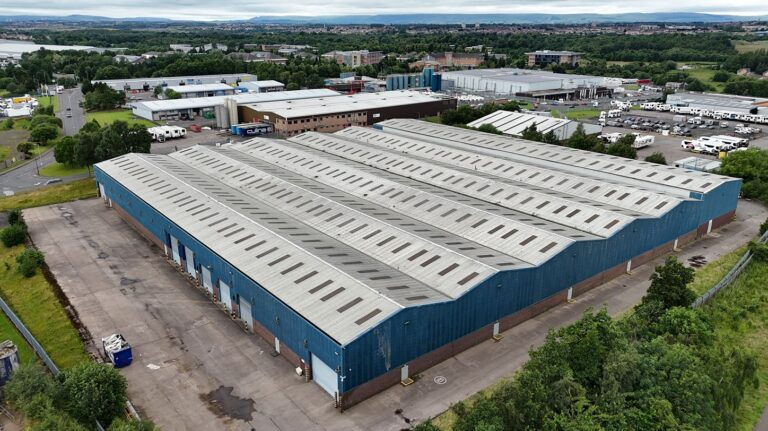
Knight Property Group has acquired the Big Blue Shed at Bellshill Industrial Estate and will undertake a comprehensive refurbishment before returning the warehouse to the occupational market during the fourth quarter of 2026.
The detached building extends to 143,700 sq ft and includes a fully sprinklered mezzanine of approximately 85,000 sq ft, giving prospective occupiers a substantial secondary level for smaller-item storage, packing, returns, production support, or other labour-intensive activity.
Occupying a six-acre site in North Lanarkshire, the property offers internal clear heights ranging from 8.5m to 10m. Five dock-level loading bays and four ground-level doors serve the warehouse, while the existing office accommodation covers about 3,900 sq ft.
Knight’s refurbishment programme will encompass the external walls, roof and wall cladding, concrete yards, surfacing, internal decoration, offices, and welfare areas. A wider rebranding exercise will reposition the highly recognisable building before completion later this year.
The site lies between the M8 and M74 and connects directly with the A725 dual carriageway, placing it within Central Scotland’s established logistics corridor. Nearby occupiers include Morrisons, DHL, Yodel, Wincanton, Müller, FedEx, MAN Truck & Bus, and several manufacturing and energy businesses.
Howard Crawshaw, managing director of Knight Property Group, said refurbishment could offer occupiers a shorter route into well-connected warehouse space than a new development requiring planning, construction, and subsequent fit-out.
Existing buildings compete with new space
Central Scotland’s distribution market is receiving investment through both refurbishment and ground-up development. Eurocentral Gateway has secured consent for around 200,000 sq ft of industrial and logistics accommodation at Motherwell, where two new buildings are intended to achieve high energy-performance standards.
Although Bellshill and Eurocentral serve overlapping occupier demand, their delivery models involve different trade-offs. A new building can provide greater clear height, modern yards, stronger building fabric, and infrastructure designed around current automation and fleet requirements; an existing structure can reach the market sooner and avoid replacing a serviceable frame.
The Big Blue Shed’s mezzanine significantly increases its usable floor area, although the suitability of that space will depend on floor loading, fire strategy, access, lifts or conveyors, and the ease with which upper-level activity can connect with inbound and outbound flows.
Ecommerce, clothing, parts, returns, and value-added services often benefit from separating smaller-item processes from bulk pallet storage. A mezzanine can provide that division without extending the building footprint, but poor vertical movement can create congestion and additional handling between levels.
Clear height of up to 10m will accommodate many conventional storage operations, yet it remains below the taller specification now common in large new logistics developments. Knight will consequently compete through motorway access, yard provision, loading, mezzanine capacity, availability, and overall occupancy cost rather than height alone.
Electrical capacity will also influence the eventual tenant profile. Warehouse power demand is rising through automated handling, battery charging, electric fleets, data systems, heating, refrigeration, and workshop equipment, while grid upgrades can take longer than the physical refurbishment of a building.
Improvements to cladding and the roof can reduce energy loss and create opportunities for solar generation, although the final specification will determine how closely the refurbished property approaches the operating cost of newer stock. Occupiers are paying greater attention to that difference as energy, carbon reporting, and building standards become more prominent within property decisions.
The site’s strongest characteristic remains its position within the road network. The M8 provides the principal east-west connection between Glasgow and Edinburgh, while the M74 runs south towards England; the A725 links the Bellshill area with both corridors.
Regional distribution, parcel handling, retail replenishment, industrial storage, and manufacturing supply can all benefit from proximity to those routes. Actual transport performance will still depend on congestion, delivery schedules, driver availability, and the configuration of the occupier’s wider network.
Large existing warehouses are receiving renewed attention as construction inflation, planning lead times, and financing costs make speculative development harder to justify. Investors must nevertheless spend enough to prevent refurbishment from becoming a cosmetic exercise that leaves the building’s operational limitations untouched.
Knight’s fourth-quarter timetable gives prospective occupiers a comparatively near-term target around which to plan racking, automation, recruitment, transport contracts, and systems installation. The work will need to progress quickly if the asset is to preserve that delivery advantage.
Bellshill already supplies the scale, loading access, motorway connectivity, and extensive mezzanine. The refurbishment must now convert those established strengths into a warehouse specification capable of competing with the newer buildings entering Central Scotland’s development pipeline.