IN Brief:
- Eurocentral Gateway has received planning consent from North Lanarkshire Council.
- The Motherwell development will provide around 200,000ft² across two industrial and logistics units.
- The buildings target EPC A ratings and BREEAM Excellent accreditation.
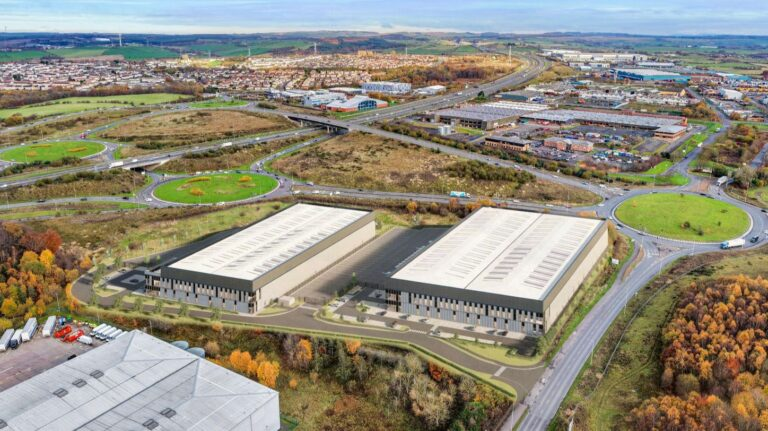
Manse LLP and J. Smart & Co. have received planning consent from North Lanarkshire Council for Eurocentral Gateway, a new industrial and logistics development at Motherwell.
The project will deliver around 200,000ft² of space across two units of approximately 80,000ft² and 120,000ft². Work is expected to begin in autumn, with practical completion targeted for autumn 2027. Porter Planning advised on the planning process, while CBRE and Colliers have been appointed as joint letting agents.
The specification places the scheme in the prime logistics category. The units will include dock and ground-level loading, 12.5m eaves, large yards, strong power provision, office space, EV charging points, energy monitoring systems, and photovoltaic panels. Both buildings are targeting EPC A ratings and BREEAM Excellent accreditation.
Eurocentral is one of Scotland’s established distribution locations, sitting close to the M8 corridor between Glasgow and Edinburgh. Its central belt position gives occupiers access to Scotland’s major population centres, road links, labour, and national distribution routes. Modern specification is becoming as important as location, with occupiers assessing whether a warehouse can support automation, EV charging, energy management, and changing vehicle movements.
Demand for logistics property has become more selective. Occupiers are no longer looking only at square footage and rent. Power availability, loading configuration, yard depth, automation readiness, labour access, charging infrastructure, and delivery timing all sit inside the property decision. A warehouse that cannot support modern handling equipment or energy-intensive operations can quickly become an operational constraint.
The EPC A and BREEAM Excellent targets reflect that change. Energy performance has moved into day-to-day operating cost, especially for warehouses running automation, high-bay lighting, refrigeration, charging infrastructure, or high-volume handling. Solar generation and monitoring systems can reduce exposure to volatile utility pricing while supporting customer and corporate sustainability requirements.
Scotland’s logistics market has also been shaped by limited prime supply and planning complexity. Industrial users need capacity that can be delivered at speed, although the planning and construction process rarely matches the pace of supply chain change. A consented two-unit scheme at an established logistics location therefore adds useful optionality for occupiers weighing location, cost, and operational specification.
The same capacity question is visible across the UK. Newark’s latest big-box logistics push in the East Midlands added potential scale to one of England’s most important distribution corridors. Eurocentral Gateway operates at a different size, but the underlying demand is similar: well-connected logistics space that can support modern transport, storage, and energy needs.
Workforce access will remain central to the site’s appeal. The UK warehouse workforce is larger and more complex than official classifications have historically suggested, and occupiers increasingly look at labour catchments with the same seriousness as motorway access. Automation can reduce repetitive tasks, but warehouses still depend on supervisors, drivers, technicians, maintenance teams, inventory staff, and operational managers.
The two-unit format gives Eurocentral Gateway a practical range. The smaller building can suit regional logistics, trade, industrial, or last-mile-linked operations, while the larger unit can support broader distribution, 3PL use, or manufacturing-linked warehousing. Dock and ground-level loading widen the vehicle and cargo profiles that can be accommodated.
Flexibility will be important as occupiers continue to adjust networks around service promises, stockholding, labour availability, and energy cost. Retail, industrial, manufacturing, ecommerce, and third-party logistics users can have sharply different requirements for racking, automation, yard movement, value-added services, and returns handling. Buildings that can accommodate several operating models without extensive redesign are likely to hold stronger long-term value.
The project now moves from planning approval into delivery. Construction cost, tenant demand, power connection, fit-out requirements, and market timing will shape how quickly the consent becomes occupied space. Scotland needs logistics buildings capable of supporting lower-emission operations, resilient distribution, and more technically demanding warehouse activity. Eurocentral Gateway adds capacity on a corridor that already carries much of that demand.