IN Brief:
- ThPA hosted Moldovan and Romanian representatives to discuss transport cooperation and supply chain connectivity.
- Talks focused on Balkan and wider European market links, including Moldova’s role as an emerging connectivity hub.
- The discussions sit alongside Thessaloniki’s wider port expansion and regional gateway ambitions.
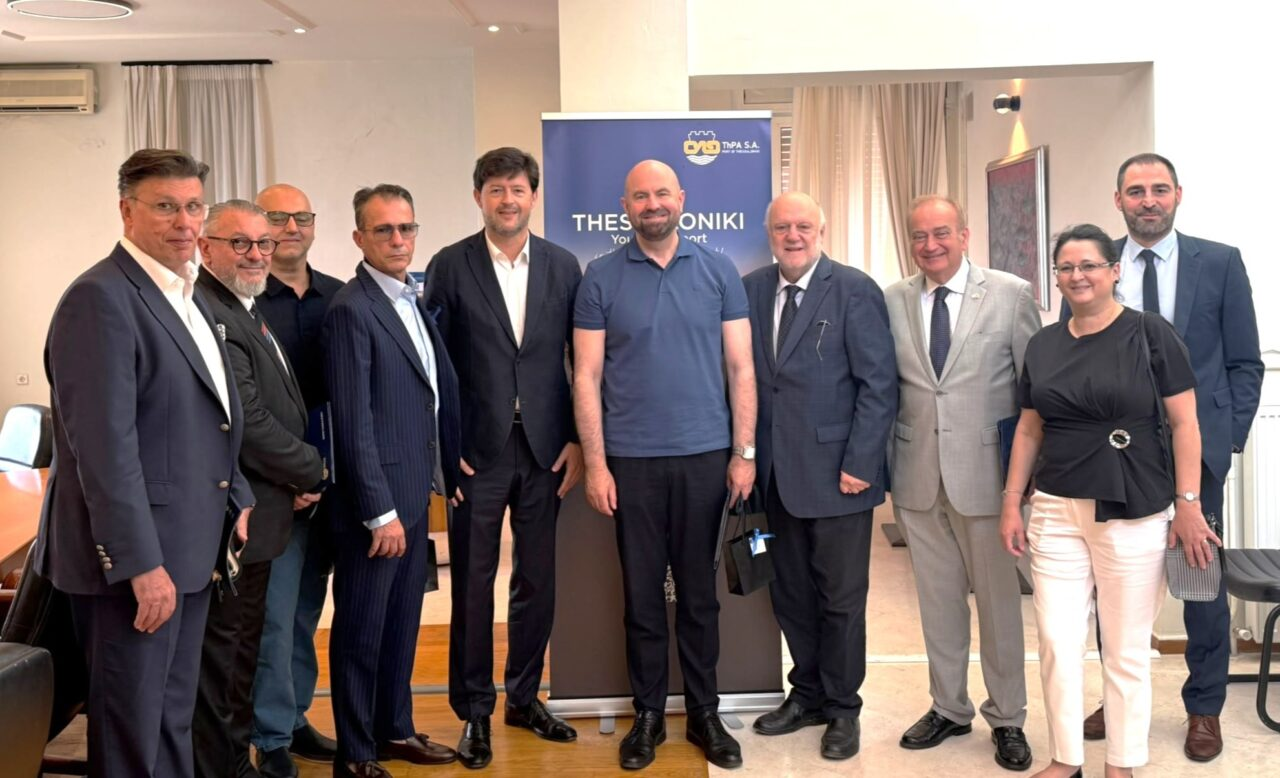
Thessaloniki Port Authority has hosted representatives from Moldova and Romania for discussions on transport cooperation and supply chain connectivity across Southeastern Europe.
The delegation included Vladimir Bolea, Deputy Prime Minister and Minister of Infrastructure and Regional Development of Moldova; Andrei Popov, Ambassador of Moldova in Greece; and Georgios Palazis, Honorary Consul of Moldova in Thessaloniki. The meeting was attended by ThPA chief executive Dr Ioannis Tsaras and company executives.
Discussions focused on strengthening logistics and transport links between the Balkans and wider European markets. Moldova’s role as an emerging connectivity hub was included in the agenda, alongside Thessaloniki’s position as a gateway to Southeastern Europe and the Mediterranean. The parties also examined logistics infrastructure development in Moldova, including international investment and technical expertise.
The meeting reinforces Thessaloniki’s position at the intersection of maritime, road, rail, and regional trade corridors. The port has long served northern Greece and Balkan hinterland markets, but its role is becoming more prominent as Southeastern Europe works to strengthen freight connectivity, reduce border friction, and create more resilient inland routes into European markets.
Moldova’s logistics options are closely tied to geography. As a landlocked country positioned between Romania and Ukraine, it depends on reliable corridors, border processes, rail connections, and regional gateway access. Stronger links with Thessaloniki would give Moldova another route into Mediterranean and European trade flows while supporting infrastructure modernisation at home.
Romania’s role adds weight to the corridor discussion. Romanian ports, road networks, rail connections, and Danube-linked routes have become more important as Eastern European cargo patterns respond to conflict, infrastructure stress, and the search for alternative routings. Cooperation between Greece, Romania, and Moldova can strengthen north-south freight movement alongside established east-west flows.
European logistics geography is being reshaped by geopolitics, infrastructure funding, nearshoring, and resilience planning. Ports that previously served mainly national hinterlands are being repositioned as regional gateways. Inland corridors, rail upgrades, customs alignment, and cross-border investment now determine whether a port can capture cargo beyond its immediate domestic market.
Thessaloniki has a natural role in that process because it can connect Mediterranean shipping with Balkan and Central European movement. Pier 6 expansion plans add a capacity dimension, while regional cooperation adds the corridor-building work needed to turn port investment into cargo movement. Quay capacity creates limited value if inland routes remain slow, fragmented, or administratively difficult.
Comparable corridor strategies are appearing outside Europe. Thailand’s revived land bridge plan seeks to reshape cargo flows through port, road, rail, and pipeline infrastructure, while Bangladesh’s logistics investment reforms place transport infrastructure closer to industrial policy. The same pattern is visible in Southeastern Europe, where trade routes are being viewed through resilience and market access rather than transport alone.
In the Balkans, the harder task is alignment. Rail capacity, border clearance, customs systems, road permits, terminal operations, investment rules, and commercial services must work together. A shipper will not choose a corridor because it appears attractive on a map; it has to offer cost, time, documentation, and reliability advantages against existing routes.
The Moldova–Romania–Thessaloniki discussions therefore move into a practical test: whether regional cooperation can be converted into services, investment, and predictable cargo flows. Technical expertise and international capital can modernise nodes, but corridor performance depends on daily coordination across multiple jurisdictions.
For Thessaloniki, the talks support a wider ambition to operate as a logistics gateway for Southeastern Europe. The port can link Mediterranean access with inland markets that need alternative routes and stronger infrastructure. That role will become more valuable as companies reassess routing exposure, border dependence, and the resilience of continental supply chains.
The meeting itself was diplomatic and commercial, but the larger work is operational. Southeastern Europe needs corridors that move cargo with fewer handoffs, clearer documentation, and enough capacity to support industrial, retail, agricultural, and project logistics demand. Thessaloniki is seeking a stronger place in that map.