IN Brief:
- Jan De Nul Australia has secured a A$50m dredging contract for Pilbara Ports’ Zone 5 Bypass Channel.
- The project creates a dedicated route around a steep-edged section of Port Hedland’s 42km shipping channel.
- The bypass is designed to protect safe, continuous movement at the world’s largest bulk export port.
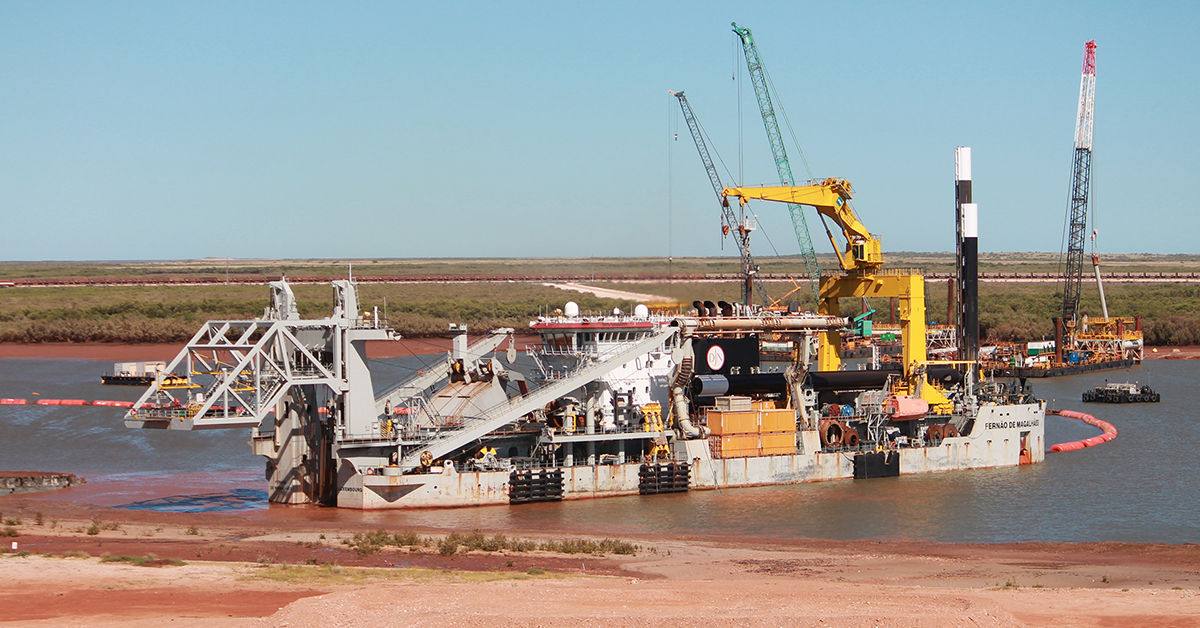
Jan De Nul Australia has won a A$50m contract to dredge Pilbara Ports’ Zone 5 Bypass Channel at Port Hedland, adding a new safety and continuity measure to one of the world’s most important bulk export gateways.
The project will create a dedicated bypass around a steep-edged section of the 42km shipping channel known as Zone 5. Some of the world’s largest bulk carriers move through the channel under tightly controlled tidal windows, often in convoy, making navigational discipline central to the port’s operating model.
Dredging is expected to begin in September. The bypass has been developed with major port users and supported by navigational simulations, environmental studies, and geotechnical investigations. Once built, it will complement existing passing lanes and refuge areas by giving vessels a safe route around the Zone 5 section if an incident affects the main channel.
Port Hedland’s export role leaves little room for prolonged disruption. The port is central to Western Australia’s iron ore trade and wider bulk commodity flows, with rail, stockyard, loading, berth, tug, pilotage, and vessel traffic systems all coordinated around high-volume movement. A navigational problem in the channel can quickly move from a marine safety issue into a commodity supply disruption.
The bypass addresses a familiar infrastructure risk: high efficiency often depends on high concentration. Bulk export ports can move vast tonnage precisely because cargo is funnelled through tightly controlled assets, but the same concentration creates exposure when a single channel section becomes unavailable. Adding an alternative route reduces the chance that one incident blocks the wider system.
That approach is increasingly visible across port investment. Southampton’s new cranes target productivity and larger container ships, while new Gulf–Iraq cargo routing adds scheduled corridor options in a politically sensitive region. Port Hedland’s bypass is neither a crane nor a new liner service, but it belongs to the same operational category: infrastructure designed to keep cargo moving when networks are under pressure.
The financial logic is strongest when measured against avoided disruption. Demurrage, berth delays, rail disruption, missed shipment windows, vessel queues, and customer uncertainty can all become expensive quickly in bulk export logistics. A bypass channel is a capital project, but the cost of a blocked or restricted channel at Port Hedland would spread across miners, carriers, traders, service providers, and end users.
The project also supports long-term planning for the Pilbara as a globally significant industrial region. Bulk ports in the region are not isolated maritime assets. They are linked to mine output, rail scheduling, maintenance systems, energy use, labour availability, export contracts, and international commodity demand. Strengthening one navigational weak point helps protect the broader chain that feeds the port.
Execution will need careful coordination because dredging work inside a live export environment carries its own constraints. Equipment movements, environmental controls, safety procedures, port scheduling, and vessel traffic management will need to operate around continuing trade. The commercial value of the project depends on delivering the bypass without undermining the continuity it is designed to protect.
Port Hedland’s scale gives the channel works wider significance. Bulk shipping can appear less visible than containerised trade because the cargo is often tied to long-term industrial flows rather than consumer-facing shelves, yet disruption at a major bulk gateway can affect steelmaking, energy infrastructure, construction, and industrial production far beyond the port boundary.
Jan De Nul’s contract turns a resilience measure into a live marine engineering programme. The bypass does not seek to transform Port Hedland’s cargo base or create a new market. Its function is more direct: preserve navigational options, reduce disruption risk, and protect the continuity of a port where the channel itself is one of the most valuable logistics assets in the system.