IN Brief:
- CEVA Logistics has launched a Hanoi-Chicago air charter operating three times per week.
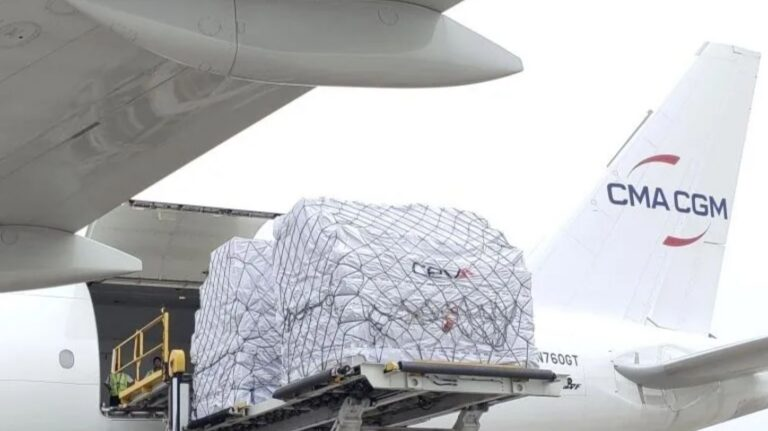
- The company has also renewed its Wuxi-Chicago charter, now using CMA CGM Air Cargo capacity.
- The programme gives shippers more controlled capacity across fast-growing Asia-US manufacturing lanes.
CEVA Logistics has launched a new Hanoi-Chicago air charter, adding scheduled transpacific capacity as Vietnam’s role in global manufacturing continues to grow.
The service connects Hanoi’s Noi Bai International Airport with Chicago O’Hare and will operate three times per week using Boeing 777 freighter capacity. Alongside the new Vietnam route, CEVA has renewed its Wuxi-Chicago charter, launched in 2025, which will now use CMA CGM Air Cargo aircraft on a twice-weekly schedule offering up to 100 tons of capacity per flight.
Both services feed into CEVA’s Chicago gateway, a 700,000ft² multi-function facility with 350,000ft² of dedicated freight space, an 8,000ft² free trade zone, and a 6,000ft² dual-chamber cold storage unit. The gateway also operates as a certified cargo screening facility, with ETD, x-ray, and K-9 inspection available to support onward customs clearance and destination trucking.
The Hanoi launch gives CEVA a stronger position in a market where manufacturers are spreading production footprints across Southeast Asia while keeping China embedded in regional sourcing networks. Vietnam has become an increasingly important export platform for electronics, consumer goods, apparel, components, and higher-value manufactured products, and that growth is creating more demand for stable air freight options into North America.
Although ocean freight remains the default for most Asia-US cargo, air freight remains the pressure valve for production changes, missed sailings, product launches, high-value goods, and urgent replenishment. Scheduled charter capacity gives freight buyers a clearer alternative to short-notice spot bookings, particularly when peak demand, tariff changes, or carrier schedule disruption tighten access to aircraft space.
The renewed Wuxi-Chicago service keeps Chinese export capacity inside the same controlled network. Rather than signalling a clean shift away from China, the combined Hanoi and Wuxi programme reflects a more complex regional sourcing pattern, with manufacturers using multiple Asian origins to manage cost, resilience, and customer commitments. Multi-origin consolidation across China will also feed cargo into the Wuxi gateway through CEVA’s ground network.
Air cargo infrastructure is being rebuilt around the same need for tighter control. The West Coast has already seen the airport side of that pressure, with SFO’s $300m automated cargo terminal plan designed to raise unit load device handling capacity and improve air freight flow. CEVA’s charter programme addresses the capacity layer from the forwarder side, joining aircraft access, screening, cold storage, free trade zone capability, and onward trucking into a more managed service chain.
Chicago gives the programme a strong inland distribution base. Its position as a major US air cargo and trucking hub allows transpacific cargo to move into national distribution networks without relying entirely on coastal gateways. That geography is useful for manufacturers supplying Midwest, East Coast, and central US customers, and it gives CEVA scope to reduce avoidable transfer delays after arrival.
The service also sits inside a wider shift among large forwarders toward controlled air networks. Volatile capacity markets have made pure brokerage models harder to manage when customers need fixed schedules. Controlled charters carry their own utilisation risk, but they give providers stronger command of flight frequency, cargo acceptance, and network design.
With Hanoi added to the programme and Wuxi renewed, CEVA is strengthening a transpacific air bridge shaped by manufacturing diversification rather than short-term market noise. The test will be whether the service can maintain load factors, schedule discipline, and competitive pricing as Asia-US demand moves through seasonal cycles. If it can, the network gives shippers another way to keep production-led freight moving without relying entirely on a spot market that rarely rewards late decisions.