IN Brief:
- Port of Tanjung Pelepas has signed a digitalisation memorandum of understanding with Siemens.
- The partnership will cover pilot projects, operational technology integration, AI, IoT, and predictive maintenance.
- The agreement strengthens smart-port capability at a major Southeast Asian container gateway.
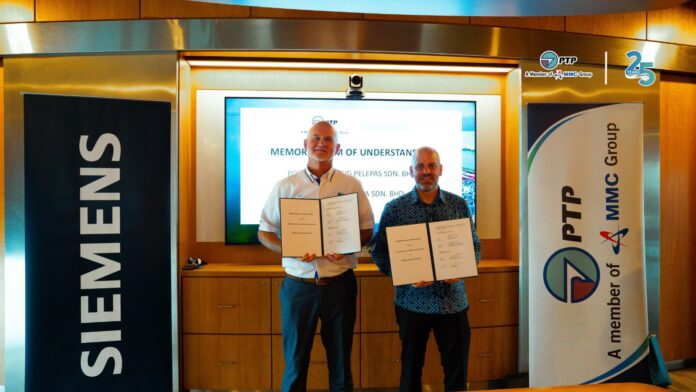
Port of Tanjung Pelepas has signed a memorandum of understanding with Siemens to accelerate digital transformation and improve operational performance at the Malaysian container hub.
The agreement brings together PTP’s large-scale port operation with Siemens’ expertise in industrial digitalisation, automation, and smart infrastructure. It was formalised by PTP chief executive Mark Hardiman and Siemens Malaysia president and chief executive Tindaro Danze.
The partnership will focus on pilot projects, capability development, and operational technology integration trials. The work will include artificial intelligence, Internet of Things systems, predictive maintenance, smart asset tracking, and energy optimisation, with projects tested in a live port environment to assess scalability and return on investment.
Ports have spent years adding digital tools around documentation, gate systems, vessel planning, and terminal operating systems. The next phase is more industrial. Equipment reliability, asset lifecycle management, energy use, training, maintenance, and operational technology integration are now part of the same performance equation as berth productivity and yard flow.
PTP’s position gives the agreement weight beyond Malaysia. The terminal is one of Southeast Asia’s major transhipment hubs, handling container flows that connect regional manufacturing with mainline shipping services. A transhipment port depends on precision. Missed connections, equipment downtime, yard congestion, and slow vessel turnaround can ripple into feeder services, carrier schedules, and inland distribution plans.
Smart-port programmes can become vague when they are detached from daily operations. The PTP-Siemens work is more useful where it can strengthen asset uptime, reduce manual interventions, improve energy control, and give operations teams better visibility over equipment condition. Predictive maintenance has clear value in this setting, since crane, yard, gate, and power-system performance all shape how reliably cargo moves through the terminal.
Workforce development is also built into the agreement. That is a necessary part of port digitalisation, since increasingly automated terminals still rely on operators, engineers, planners, maintenance teams, and supervisors who understand both the machinery and the data behind it. Training cannot sit behind technology deployment; it has to move with it, particularly where AI and IoT systems influence operational decisions.
Southeast Asian freight corridors are becoming more contested as manufacturing spreads across the region. Port investment is following trade growth, while operators in Europe are also strengthening gateway roles through inland connectivity, as seen in Thessaloniki’s deeper push into Balkan trade routes. The same competitive pattern is visible in Asia: ports are being judged not only on quay length and crane count, but on how well they integrate with the logistics corridors behind them.
Energy optimisation gives the partnership another practical layer. Ports are heavy energy users, with large equipment, refrigerated containers, lighting, buildings, and vehicle fleets all contributing to demand. Smarter asset control can reduce waste, but it can also support future electrification if ports need to manage charging loads, renewable integration, and equipment scheduling more carefully.
PTP and Siemens will need to convert pilots into operational changes that survive outside demonstration conditions. A port can trial sensors, dashboards, and AI models quickly, but scaling them across live terminal operations requires process discipline, procurement alignment, maintenance support, cybersecurity, and clear ownership of data.
The agreement gives PTP a structured route into that work. Smart-port investment is no longer an optional innovation exercise for large gateways; it is becoming part of how terminals protect capacity, equipment reliability, and regional relevance as cargo flows become more demanding.