IN Brief:
- Vengrove has acquired two UK mid-box logistics properties for £25m.
- The assets cover almost 200,000 sq ft across Rabone Park in Smethwick and Stone Cross Park in Warrington.
- The deal strengthens VRE Evergreen Logistics Partners’ exposure to regional logistics space.
Vengrove has acquired two UK mid-box logistics assets in the West Midlands and North West for £25m, adding almost 200,000 sq ft of warehouse and industrial space to its VRE Evergreen Logistics Partners portfolio.
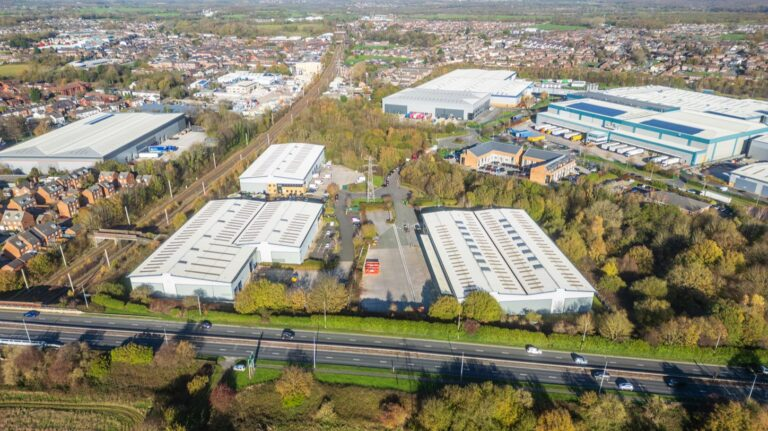
The transaction includes two self-contained units at Rabone Park in Smethwick, totalling nearly 68,000 sq ft, and three fully let units at Stone Cross Park in Warrington, totalling 129,236 sq ft. The assets were acquired from an institutional vendor and add to Vengrove’s logistics investment activity across the UK, Germany, and France.
Mid-box space serves a different function from national big-box fulfilment centres. It supports regional distribution, industrial supply, trade operations, light manufacturing, spare parts networks, service logistics, and local delivery operations that need well-located capacity without the cost or scale of a very large standalone warehouse.
The locations give the acquisition practical depth. Smethwick provides access to the West Midlands conurbation and its manufacturing base, while Warrington sits within a strong North West distribution corridor connecting Liverpool, Manchester, and wider regional markets. Both regions combine motorway access, labour depth, and dense industrial demand.
Modern regional space remains hard to secure in many markets. Speculative development of mid-box and multi-let industrial units has been running below the long-term average, leaving occupiers competing for buildings that meet operational requirements around power, yard configuration, dock access, energy performance, and transport links.
At the larger end of the market, Logicor’s Bardon logistics consent has demonstrated continuing demand for power-ready Midlands capacity, while Thorpe Park Leeds has advanced a 596,500 sq ft logistics and advanced manufacturing scheme. Vengrove’s acquisition works at a smaller scale, but it reflects the same occupier requirement for space that fits a network rather than simply adding floor area.
Smaller and mid-sized warehouses often carry more operational weight than their footprint suggests. A regional node may handle service parts, returns, trade counter supply, replenishment stock, or high-frequency local deliveries. If that node is poorly located or outdated, transport mileage, labour utilisation, and delivery reliability can deteriorate across the wider network.
The fully let nature of the Warrington units also gives the portfolio income visibility. Investors have become more selective in a higher-rate environment, but logistics assets with occupational demand and upgrade potential remain attractive. Vengrove has pointed to opportunities for sustainability improvements, which could support asset value as occupiers place more emphasis on building performance.
Energy performance is now tied closely to operating cost. Lighting, insulation, solar potential, EV charging, power resilience, and energy monitoring all influence warehouse economics, particularly where occupiers are reporting carbon data or bidding for contracts that include sustainability requirements. Older assets in strong locations can retain value if they can be upgraded without undermining operational continuity.
Regional logistics property also sits at the intersection of inventory and transport strategy. Companies holding less stock in fewer large centres can lose resilience when transport disruption or demand volatility appears. Conversely, too many small sites can create unnecessary property and labour cost. Mid-box units often provide the middle layer that allows businesses to balance service levels with network efficiency.
The acquisition adds useful capacity in two mature logistics markets rather than chasing speculative exposure in unproven locations. Its value will rest on rental growth, occupier retention, upgrade execution, and the continued need for regional nodes that can support both industrial supply and consumer-facing distribution.
As warehouse networks become more selective, the strongest assets are those that combine location, specification, and adaptability. Vengrove’s latest deal fits that pattern, adding practical regional capacity at a point when many occupiers are still trying to find space that works operationally rather than merely appearing available on a market report.