IN Brief:
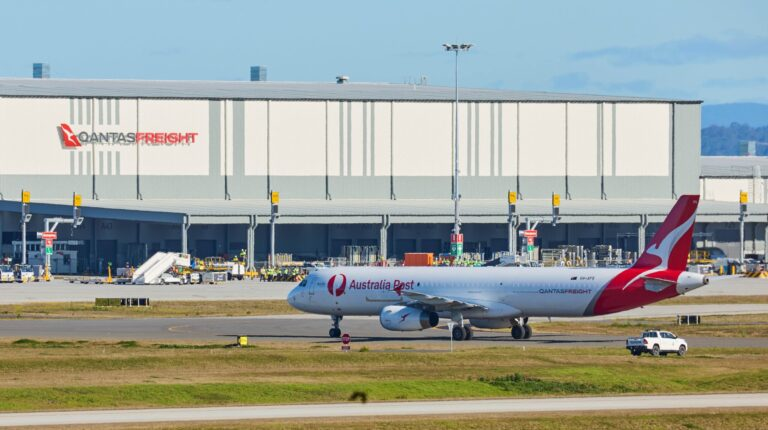
- A Qantas Airbus A321 became the first dedicated freighter aircraft to land at Western Sydney International Airport.
- The readiness flight tested aircraft handling, cargo transfer, ground operations, systems, and airside coordination.
- Regular domestic freight services will begin on 27 July from a new 24,000 sq m terminal.
Qantas Freight has completed the first dedicated freighter aircraft trial at Western Sydney International Airport, moving the new cargo terminal into its final stage of operational preparation before scheduled services begin.
Operating as flight QF7301, the airline’s Airbus A321 freighter landed at the airport at 2pm and was used to test aircraft handling, cargo-transfer procedures, ground operations, airside coordination, and the systems connecting Qantas with the airport’s Cargo Precinct. Regular domestic freighter operations are scheduled to begin on 27 July.
Qantas will operate from a new 24,000 sq m terminal designed to process more than 850 tonnes of freight each week. The facility forms part of a 24-hour cargo operation that will support express parcels, ecommerce orders, spare parts, medical products, food consignments, and other freight whose value depends heavily on speed and predictable delivery.
Igor Kwiatkowski, executive manager of Qantas Freight, said: “Western Sydney International Airport is set to become one of Australia’s key air freight hubs and today’s flight was an important opportunity to test key procedures ahead of starting operations.”
Although the successful arrival and departure provided the most visible measure of readiness, the trial also exercised the less conspicuous processes that determine whether an air-freight terminal performs reliably. Stand allocation, ramp equipment, security controls, warehouse systems, unit-load-device handling, landside collection, and the exchange of shipment data must all remain aligned with a tightly controlled aircraft schedule.
A live freighter can expose weaknesses that remain hidden during desktop exercises, particularly where responsibilities pass between airline staff, handlers, airport teams, security personnel, hauliers, and freight forwarders. Delays of only a few minutes at several handover points can erode the connection times on which express and time-critical services depend.
A freight cluster takes shape
Western Sydney’s growing population, motorway access, available industrial land, and developing airport infrastructure are already drawing fulfilment and distribution investment into the region. Amazon’s planned expansion in Bradfield, including additional fulfilment capacity, adds another large-scale operation to a market increasingly organised around the new airport and its surrounding transport corridors.
Although air cargo represents only one part of that logistics cluster, the airport’s round-the-clock operating model broadens the range of services that carriers and forwarders can build around it. Overnight departures and arrivals allow consignments to move while road networks are quieter, while later acceptance times can extend the working day for manufacturers, retailers, healthcare suppliers, and parcel operators.
Sydney’s established air-freight market has long operated within the physical and scheduling constraints of Kingsford Smith Airport, where passenger activity, surrounding development, and overnight restrictions shape cargo capacity. Western Sydney International adds runway and terminal space in a location where roads, warehouses, security processes, and industrial development can be planned around a new gateway rather than fitted around a mature passenger hub.
Additional infrastructure will not create a successful cargo hub on its own, because freight gateways derive much of their value from network density. Frequent services give shippers more routing choices, larger volumes support specialist handling and customs capability, and concentrated activity encourages forwarders, hauliers, maintenance providers, and packaging specialists to establish nearby operations.
Qantas provides an anchor tenant with an existing domestic freight network, allowing the terminal to begin with established cargo flows rather than waiting for an entirely new market to form. Domestic services can connect Western Sydney with other Australian cities while feeding international routes elsewhere within the airline group’s network.
The Airbus A321 freighter is well suited to this type of high-frequency domestic operation, combining containerised and palletised capacity with economics appropriate for routes that would not consistently fill a wide-body aircraft. Express parcels, retail replenishment, production components, and urgent spares can consequently move in scheduled volumes without requiring exceptionally large consignments.
Between the trial and the start of regular operations, teams must complete staff familiarisation, system validation, equipment checks, contingency planning, and final coordination with landside transport providers. Road arrivals will need to match terminal cut-off times closely, while shipment and security data must reach handlers before physical cargo enters the airside process.
Once services begin, the early measures of performance will be practical: aircraft turned around on schedule, cargo transferred without damage or delay, accurate shipment status, and road collections completed without congestion around the terminal. Those results will influence whether forwarders allocate more time-sensitive traffic to Western Sydney and whether other carriers accelerate their own plans.
The readiness flight has moved the Cargo Precinct beyond construction and systems installation into live network operation. From 27 July, the airport must convert its new capacity into consistent freight performance, with more than 850 tonnes of weekly throughput passing through a terminal whose commercial value will be determined one connection at a time.