IN Brief:
- Volvo Group Australia has opened a 21,000 sq m parts distribution centre in Minto.
- The site holds 72,000 SKUs, including traction batteries and components for battery-electric vehicles.
- A high-density AS/RS retrieves parts automatically and delivers them directly to operators.
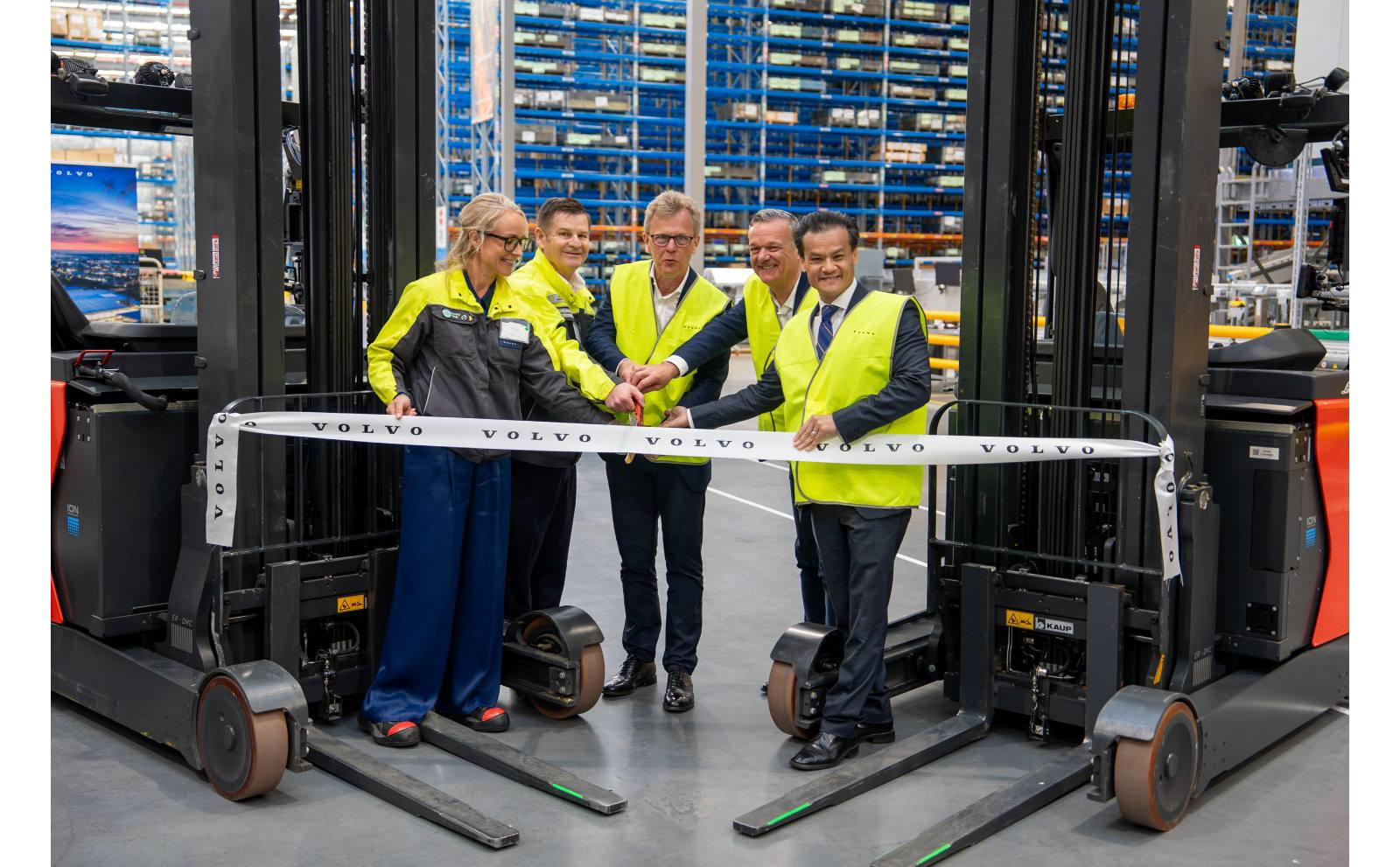
Volvo Group Australia has opened a 21,000 sq m parts distribution centre in Minto, western Sydney, introducing the first automated storage and retrieval installation of its type within Volvo Group’s global logistics network.
Twice the size of the distribution centre it replaces, the new operation can accommodate 72,000 stock-keeping units and will support customers across freight transport, public transport, marine, and industrial markets in Australia and New Zealand. Inventory includes conventional service parts, traction batteries, and components for a growing population of battery-electric commercial vehicles.
A high-density, computer-controlled AS/RS stores and retrieves parts before delivering them directly to operators at dedicated workstations. Purpose-built cranes move within the racking, reducing long picking routes, work at height, and the repeated handling associated with conventional aisle-based storage.
Height-adjustable benches, anti-fatigue matting, and an expanded materials-handling fleet have also been incorporated into the design. Together with the goods-to-person retrieval system, those measures are intended to reduce bending, lifting, walking, and other movements that accumulate across thousands of daily order lines.
Martin Merrick, president and chief executive of Volvo Group Australia, said the centre would improve parts availability, shorten lead times, and raise first-time fill rates. Those measures directly influence the time required to return trucks, buses, engines, and industrial equipment to service after maintenance or component failure.
The Minto facility replaces an operation established in 1975, when Volvo supported a narrower vehicle range, carried fewer electronic components, and managed inventory through far less integrated systems. The new warehouse must accommodate several generations of combustion-engine equipment while adding batteries, power electronics, thermal-management systems, sensors, and charging-related components.
Aftermarket networks absorb fleet complexity
Commercial-vehicle electrification is increasing the immediate complexity of aftermarket logistics because diesel and electric fleets will remain in service together for many years. Distributors must preserve support for established drivetrains while introducing high-value electrical assemblies that require different packaging, handling, fire controls, diagnostic capability, and transport procedures.
As the SKU base expands, conventional storage can become progressively less efficient. More product locations lengthen picking routes, while lower-volume specialist parts consume positions that may be difficult to organise around traditional fast- and slow-moving inventory classifications. Automated high-density storage allows the operation to increase selection without increasing travel at the same rate.
Goods-to-person retrieval also strengthens repeatability. The system controls where each item is stored, determines the sequence in which loads reach an operator, and records the movement against the inventory file. Those controls can reduce misplacement and selection errors, particularly where visually similar components serve different vehicle models or technical generations.
Parts availability has become a central element of competition across the commercial-vehicle sector. Daimler Truck’s expansion of its UK service network reflects the same emphasis on workshop coverage, inventory access, and fleet uptime alongside vehicle sales. A modern truck may be purchased on the strength of fuel economy or technology, but its operating value still depends on whether a failed component can be diagnosed, supplied, and fitted quickly.
For fleet operators, a delayed part can remove an income-producing vehicle from service, disrupt driver and route planning, and force the use of replacement capacity. First-time fill rate consequently affects far more than warehouse productivity, because each unsuccessful order can prolong downtime through another transport leg and workshop booking.
Battery-electric components introduce additional inventory risk through their value, weight, and technical sensitivity. Stocking too little can leave vehicles immobilised, while excessive holdings tie up significant capital and may become vulnerable to design changes or obsolescence. Better demand data and controlled storage cannot eliminate that balance, but they allow inventory decisions to be executed with greater accuracy.
The centre has been designed to achieve a 5-Star Green Star rating, covering energy performance and the quality of the working environment. Automation increases electrical demand through cranes, controls, conveyors, and charging equipment, so building efficiency and energy management are becoming inseparable from warehouse-system design.
Volvo Group has invested almost A$400 million in Australia over the previous 18 months across distribution, retail, and operational capability. The scale of that commitment reflects the commercial importance of the installed fleet: new-vehicle sales create future demand, while parts and service networks determine whether customers can keep those assets productive throughout their working lives.
Automation will not compensate for poor forecasting, unreliable inbound suppliers, or insufficient transport capacity between Minto and regional service points. It does, however, give the operation a denser and more controlled platform from which those wider processes can be managed.
With combustion and electric product lines continuing in parallel, aftermarket complexity is unlikely to recede soon. Volvo’s Sydney hub has been built for that prolonged overlap, using additional capacity and automated retrieval to prevent a broader component range from becoming longer downtime.