IN Brief:
- Herba Ricemills has installed an automated pallet-storage system at San José de la Rinconada.
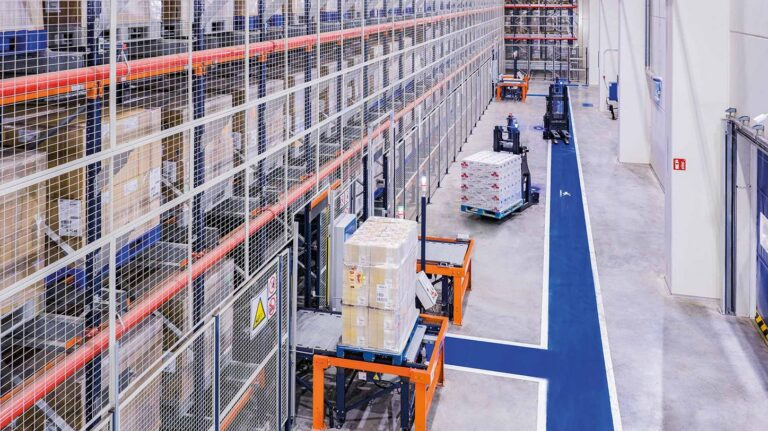
- The 18.5m-high installation combines a stacker crane, Pallet Shuttle, AGVs, conveyors, and Easy WMS.
- Productivity has increased by around 25%, while picking errors have fallen by more than 95%.
Herba Ricemills has automated storage and retrieval at its San José de la Rinconada rice plant near Seville, increasing warehouse productivity by approximately 25% and cutting picking errors by more than 95%.
The Ebro Foods business has installed an 18.5m-high pallet warehouse designed by Mecalux, combining an Automated Pallet Shuttle, stacker crane, pallet conveyors, automated guided vehicles, semi-automated shuttle racking, flow lanes, and the Easy WMS warehouse-management platform.
With capacity for 5,400 pallets, the system manages ingredients, auxiliary materials, finished goods, and stock awaiting inspection. The site supplies Spanish brands including Brillante and Sabroz, as well as products exported under names such as Cigala, Minute, and Lassie.
Inbound loads pass through three inspection stations before AGVs transfer them to a pallet conveyor. From there, a stacker crane and shuttle place each pallet in a system-assigned position, removing manual location decisions from the storage process.
Outbound inventory is selected through Easy WMS and the company’s enterprise resource planning system, after which a transfer car directs pallets into the appropriate flow channel. Separate flow racking accommodates quarantined stock while inspection and quality-control work is completed.
Before the investment, the ERP system contained inventory records but operators placed loads manually on racking or the warehouse floor. That arrangement required more travel, used the available cubic space less efficiently, and created more opportunities for physical stock to diverge from its recorded location.
Manuel Matías Martínez, head of warehousing and logistics management at the plant, said the installation had shortened order-fulfilment times, improved space use, and produced a steadier flow of material. Real-time records now cover location, origin, batch, status, inventory, and destination.
Traceability moves with the pallet
Rice production involves more than the movement of a uniform agricultural commodity, because finished ranges vary by treatment, pack format, brand, batch, market, and customer specification. Similar-looking pallets may consequently carry different labelling, export documentation, quality status, or release conditions.
By connecting every physical movement with the warehouse-management record, the automated system reduces reliance on an operator interpreting a stock file and then locating the corresponding load correctly. Each pallet is assigned and retrieved through the same digital workflow, preserving its relationship with batch and quality information.
That control is particularly valuable when stock must be quarantined. Product awaiting inspection can remain physically separated while its status is visible across the system, reducing the risk of unreleased inventory entering a production or despatch sequence prematurely.
High-volume storage and product variety create different equipment requirements, which explains the combination of automated and semi-automated technologies across the plant. Shuttle racking can accommodate deep lanes of similar stock, while the stacker crane and conveyors handle controlled transfer between inbound, storage, quality, and outbound processes.
Food manufacturers are increasingly integrating production and distribution rather than treating the warehouse as a separate downstream activity. Domino’s £25 million Avonmouth supply-chain centre follows a comparable logic, bringing manufacturing, storage, quality processes, and delivery planning into a more closely coordinated facility.
Ready-to-serve products add further pressure because ranges can expand quickly and order profiles may differ sharply between domestic retailers and export markets. Increasing warehouse labour alone does not resolve congestion when information, inspection, production, and pallet movement remain poorly aligned.
Automation uses vertical space more effectively and removes much of the travel associated with conventional forklifts, although it also concentrates operational dependency. Mechanical availability, software integration, preventive maintenance, spare-parts support, and recovery procedures become central to continuity when a common conveyor or crane serves a large share of the warehouse.
The Herba installation consequently depends on the performance of the whole system rather than one item of equipment. AGVs, conveyors, shuttles, the stacker crane, ERP, and WMS must exchange accurate instructions while preserving inspection, quarantine, and despatch controls.
A reduction of more than 95% in picking errors indicates that the integration is delivering a measurable operational result. Incorrect selections in food logistics can interrupt production, create customer shortages, complicate export documents, and hinder the isolation of stock during a quality investigation.
Herba is preparing for further expansion in Africa and the Middle East while continuing to supply established European markets. Greater geographic reach will introduce more varied order profiles, labelling requirements, lead times, and transport arrangements, placing additional pressure on inventory accuracy.
The Seville warehouse gives the plant capacity to absorb that growth without increasing manual handling at the same rate. More importantly, it creates a controlled pallet flow in which ingredients, finished products, and quality status remain visible from receipt to despatch.