IN Brief:
- Repsol supplied 2,800 tonnes of bioethanol to the 16,000 TEU Antonia Maersk.
- Barcelona completed its first commercial bunkering operation using the alcohol-based marine fuel.
- Repeatable supply, certification, storage, and vessel demand must now develop across additional ports.
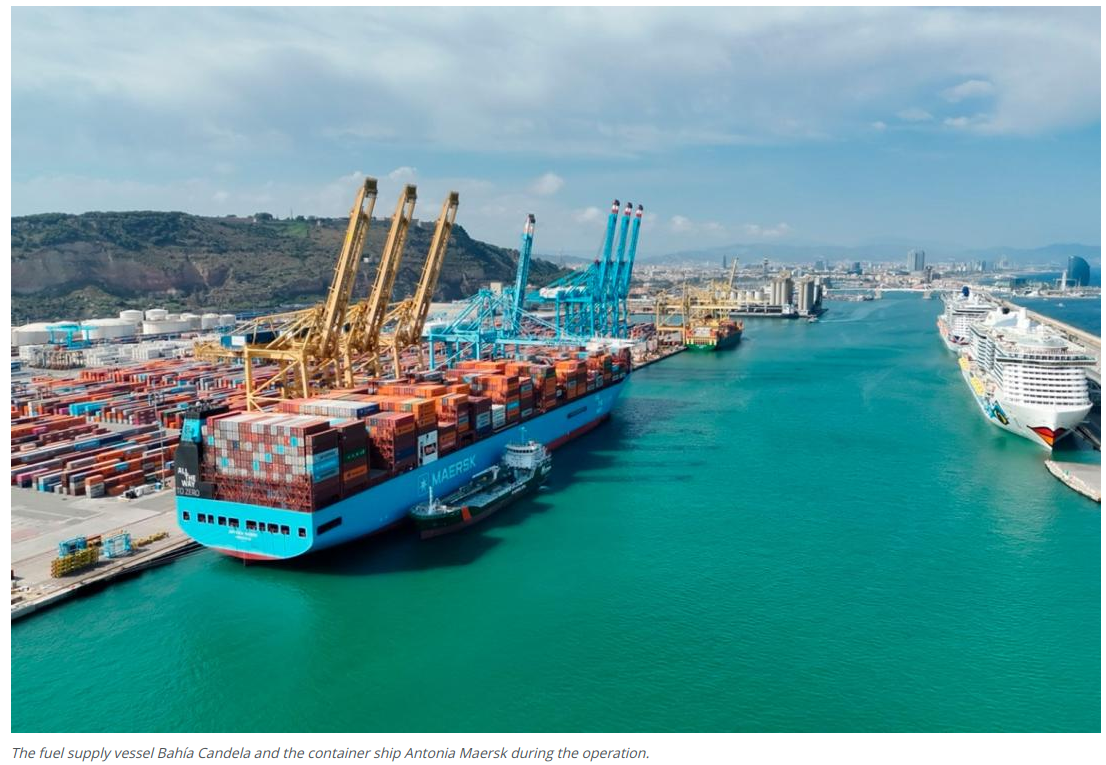
Repsol has supplied 2,800 tonnes of bioethanol to the 16,000 TEU container ship Antonia Maersk, completing the Port of Barcelona’s first commercial bunkering operation using the alcohol-based marine fuel.
The transfer took place while the vessel carried out normal port activity, testing whether storage, loading, safety, documentation, and shipboard delivery could be completed at commercial scale without disrupting container operations.
Fuel was delivered by the hybrid bunker vessel Bahía Candela, operated by Mureloil, which used battery power during the transfer. Running the bunker barge electrically removed its local engine emissions while it was alongside the container ship.
Antonia Maersk forms part of A.P. Moller–Maersk’s dual-fuel fleet, whose engines can operate using conventional fuel and compatible alcohol-based alternatives. That flexibility allows vessels to continue trading while renewable and synthetic fuel availability develops across the ports on their rotations.
A delivery of 2,800 tonnes moves the exercise beyond a small technical trial, exposing the complete supply chain to the volumes required by deep-sea shipping. Fuel sourcing, storage, bunker-vessel capacity, terminal coordination, safety controls, and documentation all need to function within a limited port call.
Bioethanol presents different handling characteristics from conventional marine fuel, requiring compatible tanks, pumps, hoses, seals, vapour controls, firefighting arrangements, and crew procedures. Port emergency plans must also reflect the behaviour of the fuel rather than adapting established heavy-fuel processes without modification.
Quality and sustainability records travel alongside the physical product because the fuel’s carbon performance depends on feedstock, production energy, processing, transport, and chain of custody. Two cargoes sold under the same broad fuel name can carry materially different lifecycle emissions.
Barcelona’s location on major Mediterranean container routes gives the operation significance beyond the individual call. Vessels trading between Asia, northern Europe, North Africa, and the Atlantic can use the port, although a single supply point cannot support an entire global rotation.
Carriers require confidence that fuel will be available in sufficient volume and to a consistent specification at several strategic ports. A dual-fuel vessel forced to rely predominantly on conventional bunkers will not achieve the emissions profile assumed when the investment was made.
Vessels are only one part of the fuel system
Shipping decarbonisation is frequently presented through new engines and vessel orders, whereas the slower infrastructure challenge sits across production plants, storage terminals, bunker barges, certification systems, and port approvals. Each part requires capital before demand is fully established.
Fuel producers face the risk of building capacity which carriers are not yet ready to use, while shipping companies hesitate to commit vessels before reliable supply exists. Commercial bunker operations begin to reduce that uncertainty, although regular repeat volumes will carry more weight than a first delivery.
Bioethanol competes with biomethanol, e-methanol, liquefied biomethane, ammonia, hydrogen-derived fuels, advanced biofuels, and battery-supported propulsion. Each pathway has a different combination of energy density, infrastructure maturity, production cost, safety requirements, and lifecycle emissions.
Alcohol-based fuels can be handled as liquids at relatively moderate conditions, avoiding some of the cryogenic requirements associated with other alternatives. Their lower energy density compared with conventional bunker fuel can require larger tanks or more frequent refuelling, affecting vessel design and cargo capacity.
Feedstock will remain central to the commercial and environmental case. Fuel produced from wastes or residues may carry a different lifecycle result from crop-based material, while synthetic ethanol would depend on large quantities of renewable electricity, hydrogen, and captured carbon.
European emissions regulation is increasing the value of verified origin and lifecycle performance. Carbon pricing and fuel-intensity rules connect voyage cost with documented emissions, making certification as operationally important as the fuel’s physical availability.
Ports will need to manage several alternative fuels simultaneously rather than waiting for one universal solution. Storage segregation, safety training, firefighting, transfer equipment, and land allocation could become more complex as different vessel classes adopt different pathways.
Barcelona’s bunker barge addressed local emissions during the transfer, while the surrounding freight chain will also influence the port’s overall carbon profile. A US$75m electric-drayage programme at the Port of Los Angeles reflects the parallel effort to reduce emissions between marine terminals and inland warehouses.
Cleaner marine fuel produces a stronger result when cargo is also handled by low-emission terminal equipment and moved inland using electric trucks or rail. Ports capable of coordinating those systems may gain an advantage as cargo owners demand more complete emissions accounting.
Repsol and Maersk have shown that Barcelona can manage one large bioethanol delivery under commercial conditions. The next phase requires regular availability, competitive pricing, assured certification, and enough bunker capacity to serve several vessels without displacing conventional operations.
Fuel supply will also need to withstand variation in vessel arrival times, since container ships do not always reach port according to the original schedule. Storage and barge operators must absorb delay without leaving renewable fuel unavailable when the next ship arrives.
Alternative-fuel vessels are entering service faster than a fully connected global bunkering network can be built. Ports able to handle large, routine, and properly documented deliveries will shape which trade lanes can reduce emissions first, while those without supply will remain dependent on conventional fuel regardless of the machinery installed aboard the ship.