IN Brief:
- Sierra is MSC’s second dedicated container service between the Far East and Mexico.
- The rotation links Qingdao, Tianjin, Busan, Manzanillo, and Lázaro Cárdenas.
- Its launch coincides with a fourth phase of expansion at Contecon Manzanillo.
MSC has launched its second dedicated container service between the Far East and Mexico, adding direct capacity between three Northeast Asian ports and the country’s two principal Pacific gateways.
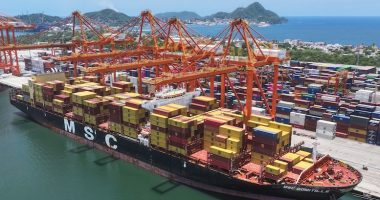
The Sierra service began calling at Contecon Manzanillo with the arrival of the MSC Domitille. Its rotation covers Qingdao, Tianjin, Busan, Manzanillo, Lázaro Cárdenas, and a return to Qingdao, giving importers and exporters another scheduled connection between Asian production centres and Mexican industry.
Contecon Manzanillo, operated by International Container Terminal Services Inc, is continuing the fourth phase of its expansion programme as cargo volumes grow through the port. The work is designed to increase terminal capacity and support larger container exchanges without overloading the existing berth and yard system.
More than 1.7 million twenty foot equivalent units moved through Manzanillo during the first five months of 2026. The figure maintains its position as Mexico’s largest container gateway and underlines the pressure on terminals, road connections, rail capacity, customs processes, and container depots serving the surrounding market.
Sierra provides an additional route for automotive parts, electronics, machinery, chemicals, textiles, consumer goods, and production equipment sourced across China and South Korea. Mexico’s expanding manufacturing base still relies heavily on Asian suppliers, even as more final assembly and component production moves closer to North American customers.
Direct sailings can reduce transhipment stages and provide a clearer schedule than services routed through another regional hub. They also require sufficient cargo in both directions, since the economics of a dedicated loop depend on vessel utilisation, equipment circulation, and the availability of export loads for the return journey.
José Antonio Contreras, Chief Executive Officer of Contecon Manzanillo, said: “The arrival of this service reflects our commitment to strengthening the terminal’s operational capabilities and creating the conditions for greater connectivity.”
He added that the terminal intends to strengthen Manzanillo’s position as a preferred gateway while giving customers more efficient access to international markets. Delivering that objective will require the terminal expansion and its inland connections to keep pace with the additional maritime capacity.
Asian sourcing supports Mexican production growth
Mexico’s position within North American manufacturing has strengthened as companies have reconsidered long supply chains, trade exposure, and the location of final assembly. The change has not severed established Asian sourcing relationships; instead, it has increased the flow of components and equipment required to support factories operating within Mexico.
Automotive and electronics plants may source sophisticated subassemblies from several countries before combining them into products destined for the United States, Canada, Mexico, or overseas markets. A direct Asia service gives procurement teams another option for managing those inbound flows, particularly when capacity or reliability weakens on an existing route.
Manzanillo and Lázaro Cárdenas provide substantial Pacific capacity, although inland transport determines how quickly imported containers reach industrial locations. Cargo may travel hundreds of kilometres by rail or road, making equipment availability, train departures, terminal dwell, customs release, and highway conditions part of the ocean service’s effective transit time.
Rail operators are strengthening the continental leg at the same time. The Southeast Mexico Express developed by CSX and CPKC adds another connection between Mexican production markets and the south eastern United States, illustrating how port services and cross border rail are evolving around the same manufacturing flows.
Additional carrier capacity can improve competition and schedule choice, though it can also place pressure on freight rates if supply grows faster than cargo demand. Carriers may respond by changing vessel size, omitting calls, or combining services, leaving shippers to assess performance over several months rather than relying on the initial published rotation.
Contecon’s expansion will therefore influence the route’s reliability. Berth and crane capacity must be matched by yard space, gate appointments, customs availability, and inland departures, particularly when several large vessels arrive within a narrow period. An efficient port call can still produce delayed delivery when boxes remain inside a crowded terminal.
Empty container positioning presents another constraint because import heavy routes can accumulate equipment in inland markets. Export cargo helps rebalance the system, but carriers may still need to move empty boxes between depots, ports, and production regions to maintain availability for subsequent sailings.
Mexico’s manufacturing expansion gives Sierra a substantial commercial foundation, while the direct Asian rotation gives factories and forwarders another way to distribute risk across carriers and gateways. Its durability will depend on schedule reliability, inland capacity, and balanced cargo volumes rather than the number of ports printed on the service map.
As more production is coordinated across Asia, Mexico, and the wider North American market, direct ocean capacity will remain central to the model. Sierra strengthens that link, but the full benefit will be realised only when terminals, customs, rail, road, and container equipment operate as a connected freight system.