IN Brief:
- Xiamen Ocean Gate Terminal can now transfer containers directly between vessels and freight trains.
- Automated cranes, guided vehicles, 5G connectivity, and an internal railway spur support the operation.
- The integrated system is designed to reduce handling, dwell time, cargo damage, and road dependence.
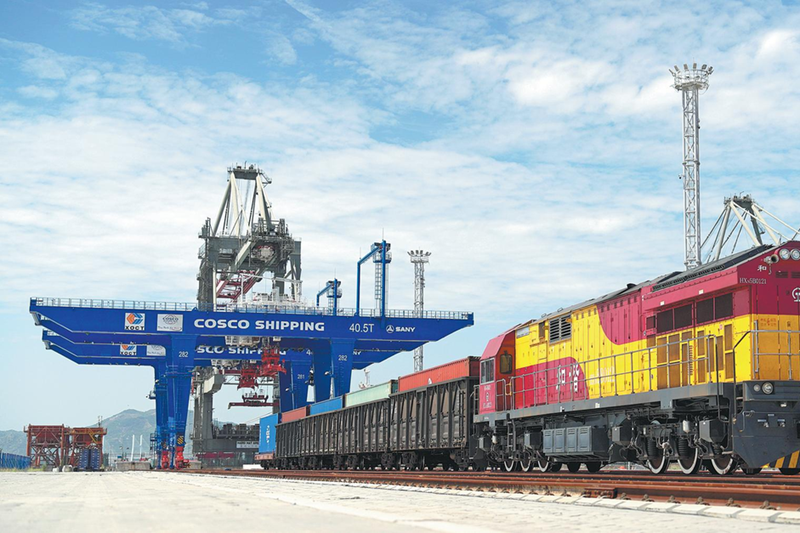
COSCO Shipping has connected the automated handling systems at Xiamen Ocean Gate Container Terminal directly with inland rail, allowing containers to move between vessels and trains without an intermediate transfer through an external yard or inspection area.
A railway spur extending for more than 1.5km now runs into the terminal operating area, linking the berth, container yard, and rail loading zone within one managed system. Three parallel tracks can accommodate as many as 40 railway wagons at once, while the installation has annual design capacity of 300,000 TEU and 250,000 tonnes of breakbulk cargo.
Containers arriving by train can move towards vessel loading without leaving the port estate, while imported boxes discharged from ships can be assigned directly to inland rail departures. By removing secondary lifts and road transfers between separate facilities, the system reduces the number of handling stages attached to each movement.
Xiamen Ocean Gate has operated as a fully automated container terminal since March 2016. Its equipment includes three automated dual trolley quay cranes, 16 automated rail mounted gantry cranes, 18 automated guided vehicles, and eight container transfer platforms, all coordinated through a central terminal operating system.
Before a vessel reaches the berth, the operating software creates a handling plan and distributes instructions across the terminal equipment. Sensors support container identification, alignment, lifting, and placement, while remote operators supervise the process from control rooms away from the quay.
Automation has reduced the number of frontline operating personnel by 70% and increased overall efficiency by 20%. Electric horizontal transport has replaced conventional internal combustion equipment across the automated operation, limiting local emissions and noise while simplifying energy management within the terminal boundary.
Since 2020, a full coverage 5G network has supported autonomous driving, remote machinery control, intelligent tallying, and security systems. High definition cameras fitted to quay cranes identify container numbers, trailer details, and visible damage, allowing tally operations to be completed from an indoor control environment.
Although automated terminals can increase crane and yard productivity, cargo frequently encounters a slower process once it reaches the edge of the facility. Truck availability, customs checks, disconnected depots, and irregular rail schedules can leave containers waiting even when the quay operation has completed its work efficiently.
Xiamen’s railway connection brings the onward mode into the same planning environment as the berth and yard. Train loading can be sequenced against vessel discharge, while containers intended for inland destinations can be directed towards the correct rail service before they become buried within a general import stack.
That coordination should reduce unnecessary reshuffling, which consumes crane time without moving cargo closer to its destination. Every additional lift also creates another opportunity for damage, misrouting, or documentation errors, particularly where a container passes between different operating companies and information systems.
Rail provides an alternative to long distance road haulage from the port, although reliable performance will depend on train paths, locomotive availability, inland terminal capacity, and the punctuality of connecting vessels. Late ship arrivals can still disrupt planned rail departures unless the operating system can reassign cargo without delaying other services.
The expansion follows similar efforts to automate landside freight movements at other ports. Trials at the Port of Tyne placed an autonomous terminal tractor into a live quayside environment, examining how vehicle control, communications, crane activity, and cyber security could function within one operating system.
Xiamen extends that approach beyond short terminal movements by connecting automation with a scheduled inland transport mode. The port’s location gives the railway access to manufacturing and distribution centres across Fujian and, through the wider rail network, towards inland regions including Hubei and the Chengdu Chongqing area.
The terminal has also developed adjacent services for vehicle exports and cross border ecommerce, including warehousing, inspection, customs declarations, container loading, and maritime booking. The rail spur adds another controlled route through that broader logistics platform.
Ports have spent heavily on faster cranes and denser yards, yet much of the remaining delay occurs between systems rather than within individual machines. Xiamen’s latest development concentrates on that interface, reducing the physical and digital separation between maritime handling and inland departure.
Its performance will ultimately be measured through train utilisation, container dwell time, yard rehandling, damage rates, and schedule reliability. The underlying principle is already clear: automation produces a larger return when it follows the cargo beyond the quay rather than stopping at the terminal gate.