IN Brief:
- The proposed National City hub would provide up to 70 charging ports for medium- and heavy-duty electric trucks.
- Solar generation and battery storage are planned alongside a Trucking-as-a-Service model for fleet operators.
- Environmental and coastal approvals have advanced the project, but commercial and building approvals remain before construction.
Port of San Diego has advanced plans for a large electric truck charging hub in National City, moving the project through environmental and coastal-development milestones while lease and building approvals remain outstanding. The proposal is designed around medium- and heavy-duty freight vehicles serving the port and surrounding logistics network.
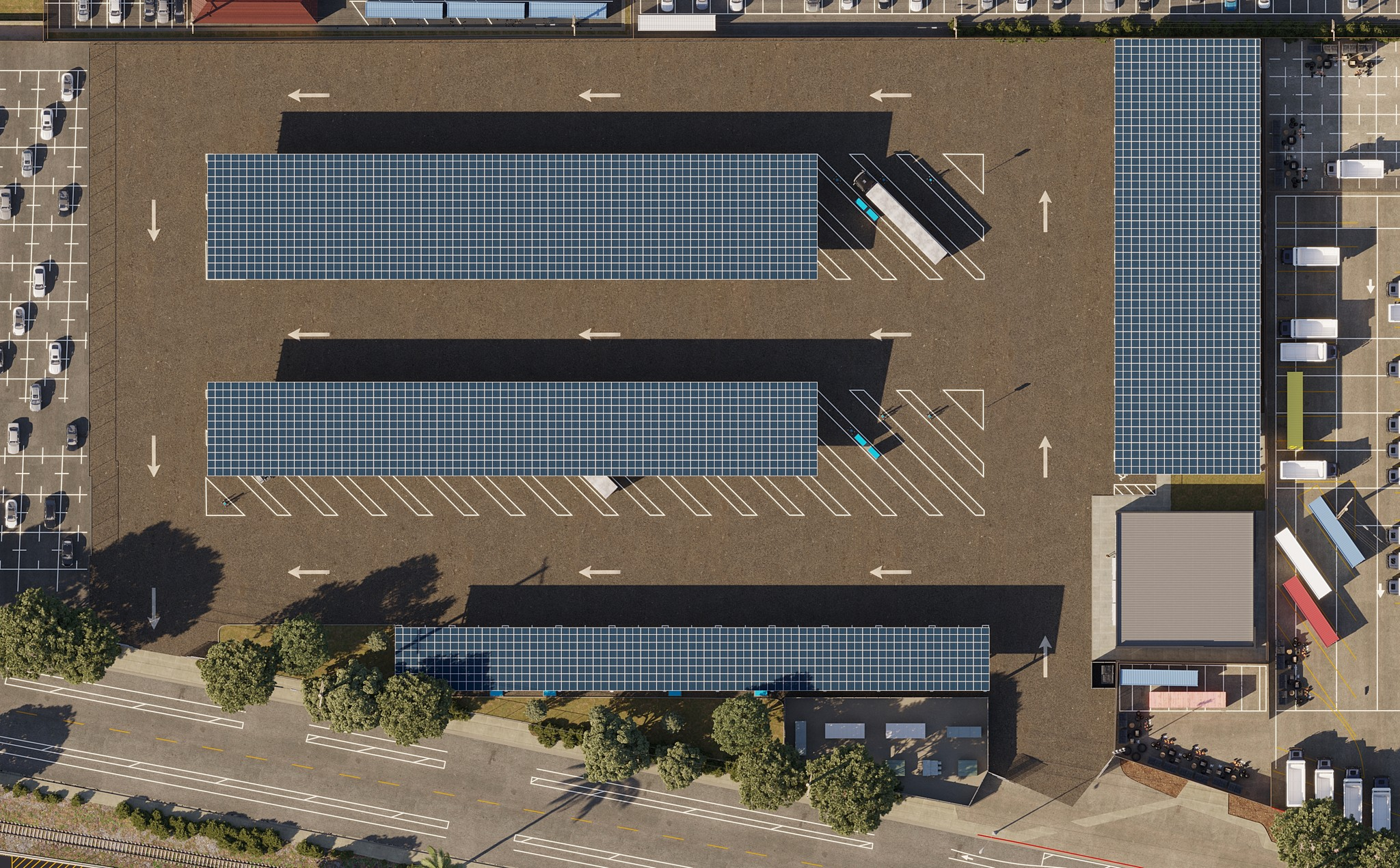
The Tidelands Avenue Electric Truck Hub would provide up to 70 charging ports close to the National City Marine Terminal and established truck routes. Placing high-capacity charging near cargo activity addresses one of the main constraints facing battery-electric drayage fleets: vehicles need dependable power without long detours that consume driver time and battery range.
Skycharger is developing the project around a mixture of daytime fast charging and secure overnight charging. Its current plans include capacity for up to 70 trucks to charge simultaneously, with overnight provision for 46 vehicles. That allows operators with different duty cycles to use the same site rather than designing the facility around one fleet pattern.
The energy system includes approximately 1.7MW of on-site solar generation and battery storage intended to reduce peak grid dependence and improve resilience. Heavy truck charging creates much larger electrical loads than passenger-car charging, particularly when several vehicles arrive around the same terminal or driver schedule.
Battery storage can help smooth those peaks by charging when grid demand or energy costs are lower and discharging when trucks require power. It does not remove the need for a strong grid connection, but it can reduce some of the strain created by dozens of high-power chargers operating together.
The proposal also includes a Trucking-as-a-Service model intended to make electric vehicles more accessible to smaller fleets and independent operators. Skycharger’s concept combines access to a charged truck with maintenance, financing support, charging, and a route towards eventual ownership.
That commercial model is particularly relevant to port drayage. Many operators run small fleets and do not have the balance sheet, depot space, or electrical infrastructure required to buy several electric tractors and install private high-power chargers. Shared infrastructure can spread part of that fixed cost across more users.
Drayage is also one of the more suitable heavy-duty applications for electrification because many journeys are repetitive and vehicles frequently return to the same port and warehouse areas. The operating case deteriorates, however, if drivers have to queue for chargers or travel significant distances away from cargo terminals to find available power.
Location is therefore as important as charger specification. A 70-port site near established freight routes can become part of the working logistics network rather than an energy facility that drivers must plan around separately. Vehicle dispatch, terminal appointments, driver hours, and charging availability all need to fit into the same schedule.
The project has now passed significant environmental and coastal-development stages, but that should not be confused with construction approval. Lease arrangements and additional permitting still have to be completed before work can begin, leaving a gap between the current planning milestone and usable charging capacity.
That gap is common across freight-electrification projects. Truck manufacturers can supply vehicles on a much shorter cycle than utilities, substations, leases, civil works, and local permits can be delivered. Fleets risk acquiring vehicles before power is ready if those programmes are not sequenced carefully.
The Port of San Diego is already investing in lower-emission cargo handling and maritime operations, making truck charging the landside extension of a broader clean-air programme. Electrifying equipment inside terminal boundaries only addresses part of port-related emissions if the drayage fleet connecting terminals with warehouses and distribution centres remains diesel-powered.
For fleet operators, the more useful measure will be charger availability and cost once the hub becomes operational. A theoretically high charging capacity means little if equipment downtime, queueing, or electricity pricing makes diesel equipment cheaper or easier to schedule.
The Trucking-as-a-Service element may prove as important as the infrastructure itself because it tackles vehicle acquisition alongside charging access. Small operators need confidence that an electric truck will be available, maintained, and financially workable before changing an established diesel duty cycle.
San Diego has moved the project further through the planning process, but the decisive stage still lies ahead. A lease, permits, utility delivery, and construction must turn the proposed 70-port facility into operating infrastructure. Only then can port hauliers test whether shared charging close to the cargo terminals can reduce one of the most persistent barriers to heavy-duty fleet electrification.