IN Brief:
- UGL has renewed its One Rail Australia locomotive maintenance agreement for five years.
- The contract covers most of the fleet, including engines, bogies, rotables, and other maintenance work.
- Work will continue at UGL’s Hunter Valley Maintenance Centre and Broadmeadow workshops in Newcastle.
UGL Transport has renewed its locomotive maintenance agreement with One Rail Australia for five years, extending a relationship that covers the majority of the freight operator’s fleet and supports specialist engineering work in Newcastle.
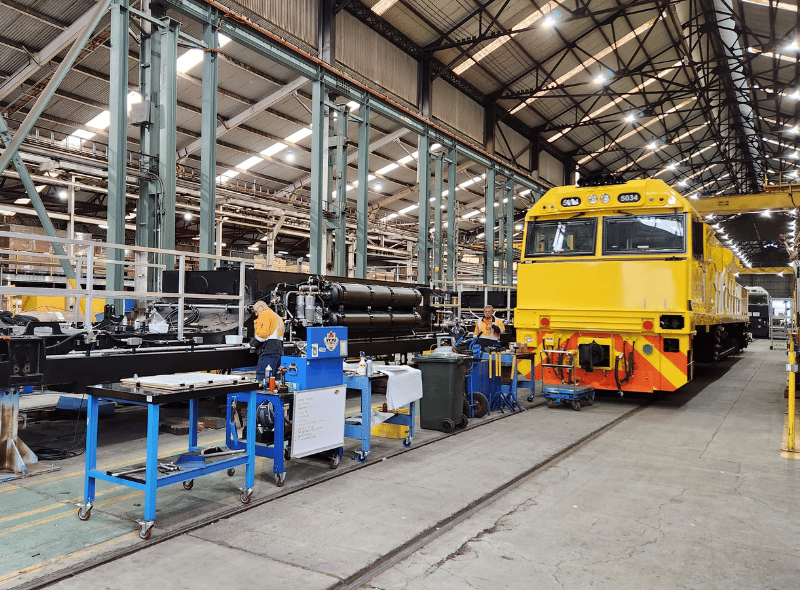
The agreement includes extension options and covers maintenance and overhaul services for engines, bogies, rotables, and other locomotive systems. UGL will carry out the work through its Hunter Valley Maintenance Centre and Broadmeadow workshops.
UGL and One Rail Australia have worked together for more than 15 years. The relationship began when locomotives were manufactured at UGL’s Broadmeadow facility and has continued into long-term servicing and overhaul of the operating fleet.
The renewed contract gives both companies a defined planning horizon for maintenance activity. Locomotives can be scheduled into workshops around operating requirements, component condition, overhaul intervals, and parts availability rather than relying on isolated repair events.
Fleet availability underpins freight capacity
Rail freight capacity depends on more than access to train paths. A locomotive that is unavailable for maintenance removes traction capacity from the operating plan and can force an operator to substitute another unit, change a consist, or alter a planned service.
Planned maintenance is intended to limit that exposure by identifying work before a failure removes a locomotive unexpectedly. Engines and bogies require deeper scheduled interventions, while rotables can be removed, overhauled, and returned to the component pool for later use.
That component model allows workshop activity to be separated from the time a complete locomotive spends out of service. A replacement unit can be fitted while the removed component is repaired, provided the operator and maintainer hold enough serviceable inventory to support the fleet.
The five-year term gives UGL visibility over the volume of work required to sustain that arrangement. It also allows One Rail Australia to retain an established maintenance provider with experience of the locomotive classes already in operation.
UGL says the contract covers the majority of One Rail Australia’s fleet. The company has not disclosed the total contract value, the precise number of locomotives included, or forecast availability improvements, so the agreement is a continuation of an established maintenance programme rather than a quantified capacity expansion.
The Newcastle facilities combine rolling-stock maintenance with engineering capability developed around locomotives originally built at Broadmeadow. Maintaining those assets in the same industrial region retains experience of equipment that has been operating in Australian freight service for more than a decade.
Long-term maintenance supports operating consistency
Freight operators need maintenance programmes that fit around customer demand rather than compete with it. Taking too many locomotives out of service at once can reduce available haulage capacity, while delaying essential work increases the risk of failures during operations.
A multi-year agreement gives the operator and maintainer more scope to sequence planned work, prepare components, and allocate workshop labour against expected fleet requirements. It also creates a stable basis for specialist skills that depend on recurring maintenance volumes.
The work covered by the agreement is broader than routine inspection. Engine, bogie, and rotable overhauls require mechanical, electrical, testing, and component-management capability, with completed work returned to service under defined engineering and safety requirements.
One Rail Australia’s freight operations cover long-distance Australian routes, where equipment reliability can affect train paths, crew utilisation, terminal appointments, and subsequent services using the same equipment.
The renewed contract does not remove those operating risks, but it keeps responsibility for a large part of fleet maintenance with an established supplier. UGL retains the workload supporting its Newcastle maintenance infrastructure, while One Rail Australia retains continuity in the engineering programme behind its locomotives.
The agreement also illustrates the long service life of heavy rail assets. Locomotives manufactured more than a decade ago can remain productive when engines, bogies, and other systems are maintained and overhauled through structured programmes rather than replaced as complete vehicles.
No major fleet procurement accompanies the announcement, and the contract should not be treated as one. Its operational role is more prosaic: keeping existing locomotives serviceable, planning overhaul capacity over several years, and maintaining specialist workshop capability around the fleet.
That work takes place away from the main line, but it remains part of usable freight capacity. The five-year renewal keeps the Newcastle maintenance programme tied to One Rail Australia’s locomotives and extends an engineering relationship that began with the assets themselves.