IN Brief:
- Riga, Ventspils, and Liepāja have completed a €3.24 million joint port digitisation programme.
- The platform combines vessel, berth, permit, payment, mapping, access-control, analytics, and logistics data.
- Shared infrastructure replaces parallel systems and provides a common base for further multimodal data integration.
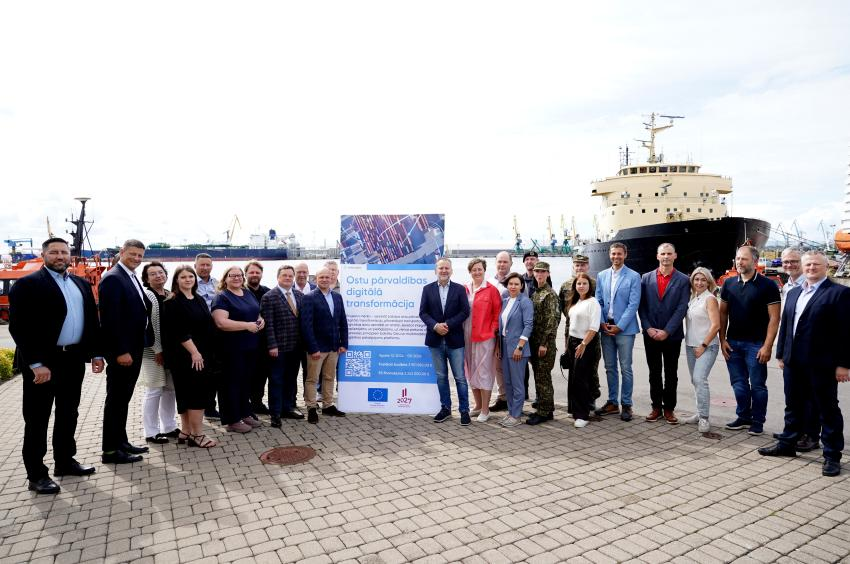
Latvia’s three largest ports have completed a joint digital platform connecting core operational and customer-service systems across Riga, Ventspils, and Liepāja.
The project was led by the Freeport of Riga Authority with the Freeport of Ventspils Authority, the Liepāja Special Economic Zone Authority, and several government bodies. Development ran from December 2024 to August 2026 and received €3.24 million from the European Union’s Recovery Fund.
The Port and Multimodal Logistics Services Platform brings several previously separate functions into a common digital environment. Ship agents, shipping lines, terminals, and service providers can access information covering vessel calls, berths, port services, permits, passes, contracts, and payments through the same system.
The platform also provides a common communications environment, live vessel tracking, and digital maps containing port-infrastructure information. Combining those functions reduces the number of separate interfaces involved in planning a vessel call and managing the services surrounding it.
Vessel Traffic Services gain a unified view of ship movements and port operations, with the authorities expecting less manual data processing and closer coordination between port services, pilots, tug operators, and ship agents. Latvia’s State Border Guard will also receive more complete real-time information on vessel movements and port-issued permits.
The technical structure extends beyond a single customer portal. It incorporates a Port Community System, Port Information System, geographic-information tools, access-control functions, data analytics, and a data-exchange layer connecting with the Latvian Maritime Administration, Latvian Railways, SKLOIS, and other state and port information systems.
That integration reflects how quickly a vessel call crosses organisational boundaries. Berth planning affects pilots and towage, cargo movement affects terminal and landside resources, and port access can involve permits, security systems, customs information, rail capacity, and road transport before a shipment leaves the gateway.
When each organisation maintains a separate system, the same information may have to be entered several times and reconciled when records differ. Latvia’s shared platform is designed around an “enter once, use everywhere” approach, allowing authorised data to pass between connected systems rather than being repeatedly re-keyed.
The three ports also chose to develop common infrastructure rather than build separate versions of similar applications. That avoids duplicating development work and is intended to reduce ongoing maintenance costs while giving the ports a common technology base for later services.
The approach is significant in a comparatively small national port system. Riga, Ventspils, and Liepāja still compete for cargo and investment, but many of the digital processes required to manage vessels, permissions, infrastructure information, and public-sector interfaces are fundamentally similar.
Sharing the underlying systems does not require the ports to operate identically. Each gateway can retain its own commercial relationships and physical operating model while using common data structures and interfaces where standardisation removes unnecessary administrative work.
Latvian Railways’ connection is particularly relevant to the project’s multimodal element. Ports are only one stage in the movement of export and import cargo, and the timing of ship operations can affect train formation, inland terminal activity, and equipment availability elsewhere in the network.
Better exchange of operational information can reduce some of the disconnect between maritime and rail planning, although the benefit depends on the quality and timeliness of the data being shared. A digital link adds little if the underlying status information is incomplete or updated too late to influence an operating decision.
The same applies to terminal and road activity. Digital permits and real-time vessel information can help service providers plan labour and equipment, but the physical operation still depends on available cranes, yard space, gates, vehicles, and people. The platform removes information friction rather than replacing those assets.
Cybersecurity and system resilience also become more important as functions are consolidated. A fragmented environment creates duplication, but it can also isolate failures. Once several ports and public bodies depend on common infrastructure, availability, access control, recovery arrangements, and data governance become part of day-to-day operational resilience.
Latvia had already introduced elements of the project before final completion. A unified vessel tracking and traffic-monitoring system was deployed earlier in 2026, giving Riga, Ventspils, and Liepāja a common real-time maritime view while the remaining systems were still being implemented.
The completed platform now gives the ports a foundation for further cargo planning, logistics, and data-exchange services without requiring every new function to be developed independently at three locations. Future integrations can be added to a common architecture rather than another collection of standalone systems.
Its value will be measurable in ordinary operating tasks: fewer duplicate entries, faster permissions, clearer vessel information, better coordination, and less time spent reconciling records between organisations. Digital port projects often arrive wrapped in ambitious language; the practical test is whether ships, cargo, documents, and decisions spend less time waiting for one another.