IN Brief:
- Belgian inland waterways carried 40.5 million tonnes in Q1 2026, up 5.1% from the previous quarter.
- Containerised barge freight reached 3.6 million tonnes, increasing 9.3% quarter on quarter.
- Annual growth remained modest, leaving the recovery inside a weaker wider European inland-freight market.
Statbel has recorded a 5.1% quarterly increase in freight carried on Belgium’s inland waterways, with vessels moving 40.5 million tonnes during the first quarter of 2026 compared with 38.5 million tonnes in the final three months of 2025.
The annual comparison was more restrained. First-quarter tonnage was 0.7% above the same period of 2025, indicating that the strong sequential increase partly reflects recovery from a weaker final quarter rather than a sudden acceleration in underlying freight demand.
Container transport followed the same pattern more sharply. Barges carried 3.6 million tonnes of containerised goods during the quarter, up 9.3% from Q4 2025 but still 2.3% below the first quarter of last year.
Statbel’s dataset covers freight carried by all vessels using Belgian inland waterways, including foreign-registered craft. It therefore reflects activity across the waterway network rather than the commercial performance of Belgian operators alone.
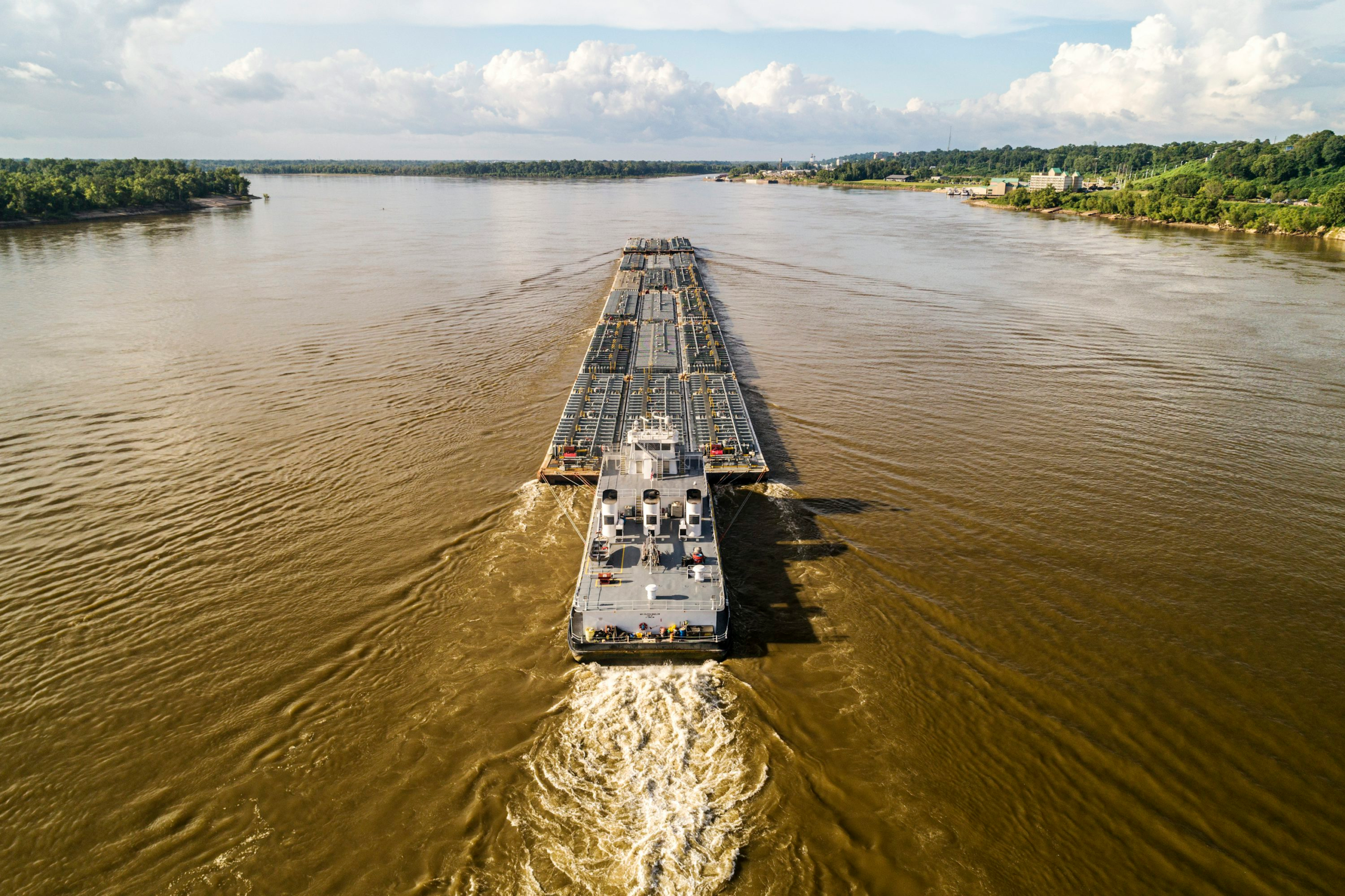
That distinction is particularly relevant in Belgium, where inland navigation is tied closely to cross-border industrial flows and the North Sea port system. Barges connect seaports, terminals, factories, distribution centres, and neighbouring markets, allowing large volumes of containers, bulk materials, chemicals, fuels, and industrial goods to move without relying entirely on road capacity.
The latest quarterly recovery arrives against a weaker European background. Eurostat recorded 118 billion tonne-kilometres of inland-waterway freight across the EU in 2025, down 3% from 2024. Germany and the Netherlands together accounted for 71.9% of the EU total, leaving Belgian barge activity closely connected with the performance of the wider Rhine and North Sea logistics system.
Belgium’s 5.1% sequential increase therefore does not by itself establish a European turnaround. Waterway volumes can move significantly between quarters because of industrial production, seaport arrivals, commodity demand, water conditions, lock availability, and the timing of individual bulk and container flows.
The smaller 0.7% annual increase gives a better indication of how far total activity has moved from the corresponding period a year earlier. Container freight provides an even clearer warning against overstating the rebound: volumes increased strongly from Q4 but had not regained their Q1 2025 level.
Seaport conditions also remain uneven. Port of Antwerp-Bruges handled 133.9 million tonnes of maritime cargo in the first half of 2026, down 2.4% year on year, with containers contributing to weakness in the general-cargo segment. Industrial action and disrupted vessel schedules have added further variability to the amount and timing of freight arriving for onward movement.
Inland barges remain strategically useful in that environment because a single vessel can remove a significant number of truck movements from congested port corridors. The economic advantage, however, depends on dependable terminal windows and sailing times rather than theoretical carrying capacity alone.
A delayed deep-sea vessel can cause a barge to miss its loading slot, while a congested inland terminal can leave cargo waiting after the waterborne leg is complete. Low unit transport costs can be offset quickly when inventory sits idle or a factory has to compensate for uncertain arrival times.
Belgian and neighbouring port operators are increasingly using digital tracking to address part of that problem. Port of Antwerp-Bruges and North Sea Port use pushed-barge tracking data to share information on convoy composition and vessel location, allowing lock schedules to be planned with greater visibility.
The technology does not add physical waterway capacity, but it can reduce the operational waste created when infrastructure managers and operators lack an accurate view of approaching traffic. Better arrival information can also help terminals coordinate resources around actual movements rather than static schedules that may already be obsolete.
The longer-term modal case for inland freight depends on those operational details. European transport policy has repeatedly identified waterways as a way to shift freight away from road, but the latest Eurostat figures show that inland navigation has not automatically gained traffic simply because it offers lower-emission transport at scale.
Shippers still make modal choices around total cost, lead time, reliability, frequency, and inventory exposure. A waterway service that requires additional buffer stock or repeatedly misses production windows can struggle to compete with road transport even when its tonne-kilometre economics are attractive.
Belgium’s first-quarter numbers consequently show a recovery in immediate utilisation rather than a structural shift in freight transport. The stronger container result is encouraging sequentially, but the annual decline means the sector still has ground to recover before the increase can be described as sustained growth.
The next quarters will show whether the 40.5 million-tonne result marks the beginning of a firmer trend or simply a rebound from a weak end to 2025. For barge operators, ports, and cargo owners, the more useful measure will be whether higher volumes can be carried without giving back the cost advantage through congestion, missed windows, or unreliable inland connections.