IN Brief:
- Shanghai–Genoa and Shanghai–Rotterdam spot rates fell as Asia-Europe capacity began increasing.
- Carriers are revising individual services and selectively restoring Suez transits rather than changing global capacity uniformly.
- Sogese expects gradual rebalancing, improving European capacity, and softer rates without a sharp return to pre-crisis freight economics.
Asia-Europe container rates are softening as congestion in Asian ports, selective returns through the Suez Canal, and route-specific demand changes alter how carriers deploy ships across individual trade lanes.
Sogese‘s September Europe Container Market Update cites Drewry’s 3 September World Container Index, which put Shanghai-Genoa spot rates at $4,368 per 40ft container, down 10% week on week, while Shanghai-Rotterdam fell 5% to $4,092. Scheduled blank sailings on Asia-Europe are also set to fall from four to one, returning capacity to a route where pricing has started to ease.
The transpacific is behaving differently. Shanghai-Los Angeles rose 5% to $7,185 per 40ft container in the same Drewry assessment, while Shanghai-New York increased 3% to $9,587, reinforcing the extent to which capacity and pricing are now diverging by corridor rather than moving together across the global liner network.
Andrea Monti, CEO of Sogese S.r.l, said: “The container market is becoming increasingly fragmented by trade corridor, with freight rates, cargo demand and available capacity moving in different directions across major routes. Asia-Europe rates have started to soften from their mid-year highs while transpacific markets remain firmer, prompting carriers to adjust individual services and vessel deployments rather than manage capacity uniformly across their networks.”
Carrier networks are being recalibrated service by service
Recent timetable changes fit that pattern. Ocean Alliance has revised its CPNW transpacific service by dropping Qingdao, Ningbo, and Kwangyang while adding Kaohsiung and Yantian, and its MTE service has dropped Haiphong and added Port Klang. Maersk’s seasonal TPX service, introduced for peak demand between Vietnam, South Korea, and the US West Coast, is ending at the close of the third quarter as scheduled.
COSCO and OOCL are adding Red Sea capacity. A seven-vessel Asia-Red Sea service is scheduled to connect Northeast Asia with Jeddah via Singapore and the Suez Canal, while a separate direct China-Jeddah service links Shanghai, Ningbo, and Nansha with Saudi Arabia’s principal Red Sea gateway.
The changes do not amount to a uniform expansion or contraction of carrier networks. Port calls, vessel allocations, and service strings are being changed according to demand, congestion, voyage economics, and competitive pressure on each corridor, leaving global fleet size as a poor proxy for the capacity available to a shipper on a particular route.
Suez is becoming part of that calculation again. A shorter Asia-Europe voyage releases effective ship capacity because vessels complete round trips faster, while Cape of Good Hope diversions continue to absorb a meaningful share of the fleet. Sogese estimates those diversions are tying up between 5% and 7% of global container capacity, or roughly 1.7m to 2.4m TEU.
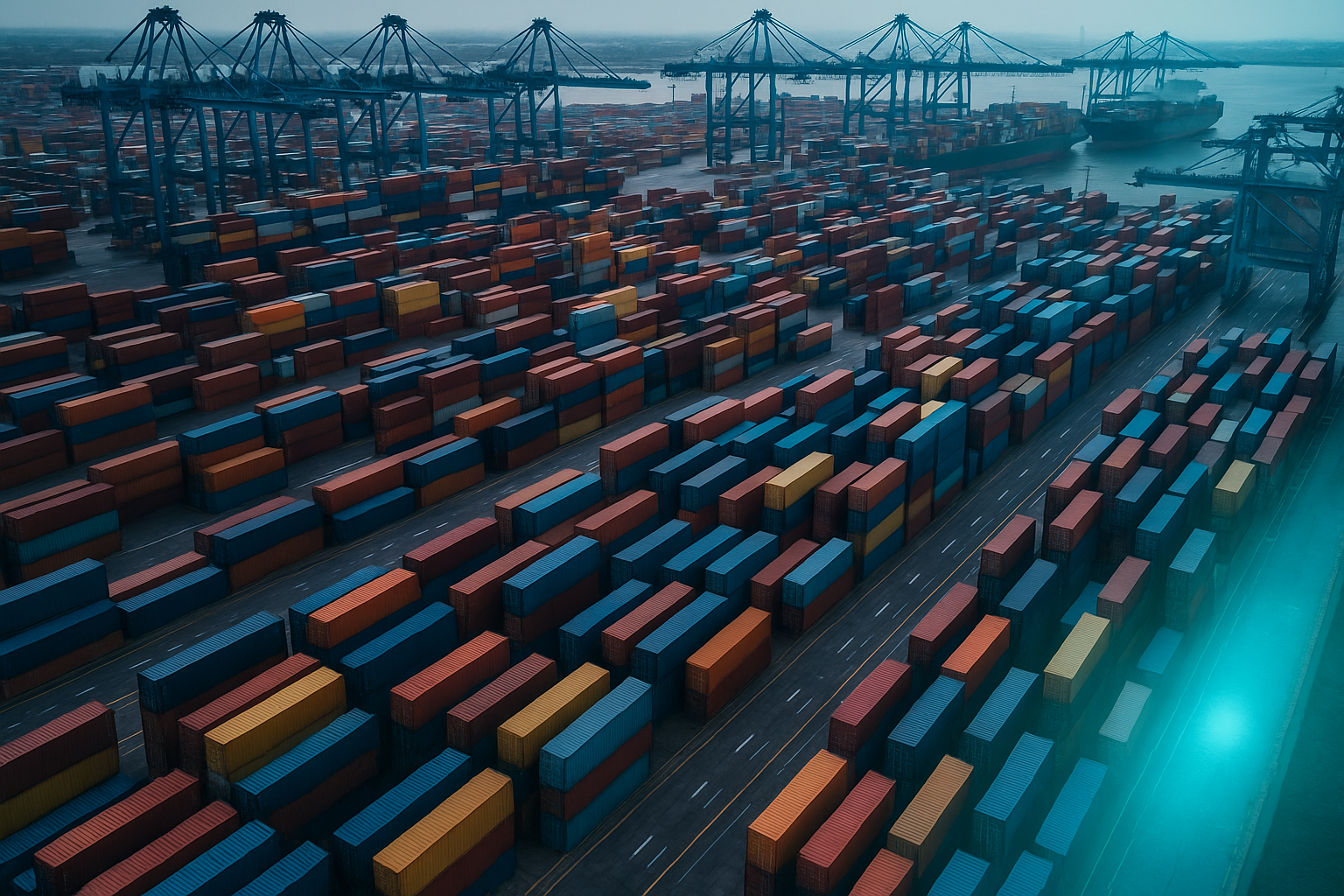
The report also cites Linerlytica data putting Asian port congestion at 4.3m TEU, above the 4.0m TEU it associates with the pandemic peak. Congestion therefore adds a second capacity penalty: vessels are spending longer waiting at ports while longer Cape routings keep more ships tied up in transit.
Monti said: “Congestion has become the more urgent variable. Carriers were waiting for the security picture to stabilise before committing capacity back through Suez. What has changed is that the cost of waiting has gone up faster than the risk of moving.”
European capacity can improve before rates normalise
Selective Suez returns can increase effective Asia-Europe capacity even without new vessels entering service. More productive round trips add available ship days to the corridor, which helps explain why Asia-Europe rates can soften while the global fleet and overall cargo market remain relatively tight elsewhere.
The effect is uneven within Europe. Sogese points to first-half container volumes in the Western Ligurian port system covering Genoa, Savona, and Vado Ligure falling 2.7% year on year to around 1.45m TEU. Gateway traffic rose 1.6%, while transshipment declined 21.3%, showing a substantial difference between cargo serving the local hinterland and boxes being routed through Mediterranean hubs.
National data cited in the report shows a steeper Italian decline in the first quarter, with overall container volumes down 4.6%, Trieste down 23.6%, Savona down 14.1%, and Genoa down 4.9%, even as Italian exports grew 1.3%. Those figures suggest that cargo generation and port throughput are no longer moving in parallel where carrier routing decisions shift transshipment away from individual gateways.
Scale remains another structural factor. Gioia Tauro handled a record 4.5m TEU in 2025, up 14%, while Tanger Med handled 11.1m TEU, up 8.4%. The difference gives carriers a substantially larger transshipment pool at the Moroccan hub when deciding where to concentrate calls and connecting services.
Sogese’s base case is gradual rebalancing rather than a sharp rate correction. It expects freight rates to soften progressively while remaining above pre-crisis levels, selective Suez services to expand, Asia-Europe capacity to improve as vessel productivity rises, and equipment availability to strengthen across parts of Europe.
European cargo owners may consequently gain more booking options without seeing freight economics revert quickly to pre-crisis conditions. The less comfortable part is network stability: port rotations, sailing frequencies, and transshipment structures are still being rewritten route by route, so additional capacity can arrive alongside greater uncertainty over exactly where carriers will deploy it.