IN Brief:
- JNPA and CESL will develop public charging and battery-swapping facilities at five parking locations inside the port.
- The infrastructure is intended to support heavy tractor-trailers alongside buses, cars, three-wheelers, and two-wheelers.
- The rollout extends a port electrification programme that already includes electric trucks, battery swapping, and existing charging points.
Jawaharlal Nehru Port Authority has signed an agreement with Convergence Energy Services Limited to develop public electric-vehicle charging and battery-swapping facilities at five parking locations within the port, extending its electrification programme beyond a limited number of existing charging and swapping points.
The planned infrastructure is intended to serve a wide range of vehicles, including tractor-trailers, buses, cars, three-wheelers, and two-wheelers. JNPA signed the agreement with CESL after an earlier memorandum of understanding established the framework for EV charging and battery swapping at the port. The latest agreement puts a defined five-location deployment around that earlier commitment.
Heavy vehicles are the most demanding part of the mix because tractor-trailers form the landside link between container terminals, distribution facilities, and the wider road network. Charging a passenger car can often be absorbed around relatively flexible dwell time; charging a working tractor unit is more sensitive to queueing, shift patterns, and vehicle utilisation. Battery swapping offers another route, but only where vehicles, packs, and station equipment are compatible and enough charged batteries are available to keep turnaround predictable.
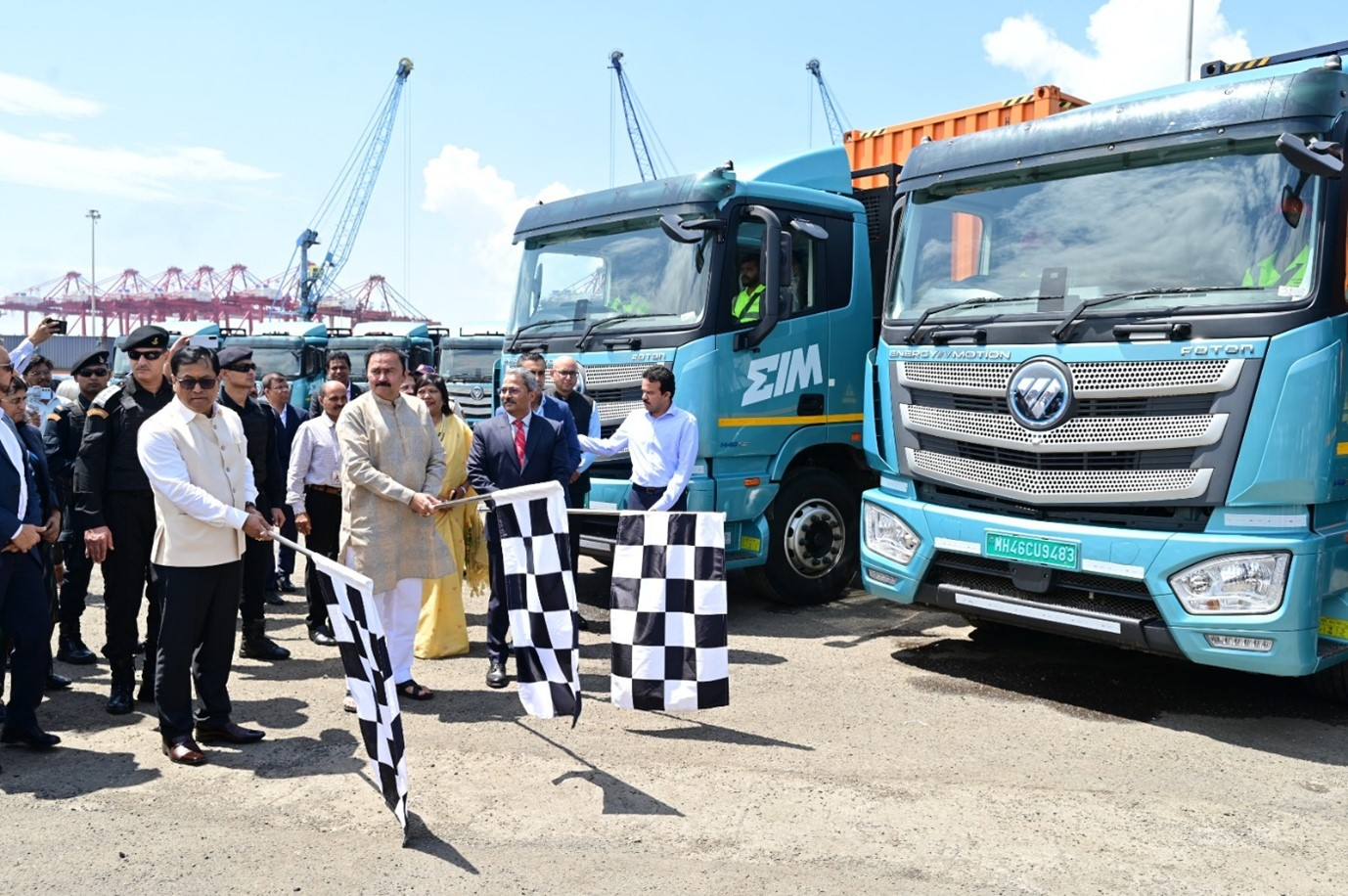
JNPA has already built a base for that model. The port has reported 53 electric trucks operating in container yards, supported by two battery-swapping stations and six charging points, alongside electric and compressed natural gas vehicles used elsewhere in its operations. In September 2025, a fleet of heavy electric trucks with swappable batteries was also introduced at the port, with a heavy-duty swapping station commissioned at the same time.
The five new public locations extend an operating system rather than beginning one from scratch. They also broaden the infrastructure beyond a fleet-specific pilot. Publicly accessible charging and swapping can support vehicles owned or operated by multiple transport companies, which is necessary if electrification is to spread beyond terminal-controlled fleets.
The scale of the port makes landside capacity material. JNPA handled 8.17 million TEU in the 2025/26 financial year, up 11.94% from 7.30 million TEU a year earlier, while total cargo reached 102.01 million tonnes. Containerised cargo accounted for more than 90% of total tonnage. Every increase in vessel and terminal throughput has to be matched by enough road, rail, and storage capacity to clear cargo from the waterfront.
JNPA is addressing that requirement on more than one mode. The port recently started a 360-TEU long-haul double-stack service on the Dedicated Freight Corridor, increasing the amount of containerised cargo that can leave the port in a single rail working. Electric tractor-trailers do not replace that rail capacity; they operate around it, handling terminal, yard, and shorter-distance road legs where trains are either unavailable or unsuitable.
CESL develops clean-energy and mobility projects through public-sector programmes and commercial delivery models. At JNPA, the practical measure will be whether charging and swapping capacity is available at the places and times freight vehicles actually need it, rather than simply adding another set of electrical assets to the port estate.
The current agreement does not specify charger ratings, the number of chargers or swapping bays at each location, battery standards, capital cost, or commissioning dates. Site count alone therefore says little about usable heavy-vehicle capacity. A facility designed mainly for cars and two-wheelers has a different electrical connection, parking requirement, and throughput profile from one designed to turn tractor-trailers through a swapping cycle.
A distributed network also changes the resilience calculation. If heavy vehicles depend on one swapping point or one cluster of chargers, an equipment fault or queue can affect several transport cycles at once. Five locations can spread demand across the port, although the benefit will depend on charger power, battery availability, and the electrical capacity behind each site.
JNPA has previously said it plans to deploy more than 150 electric trucks by December 2026 while continuing the conversion of other port vehicles. Reaching that scale will make charging availability, battery inventory, and equipment uptime routine operating concerns, particularly if electric units are expected to work across several terminals and parking areas.
The agreement moves the port’s EV infrastructure towards a distributed operating network. Once the sites are commissioned, the useful measures will be how many heavy-vehicle movements they can support each day, how long trucks spend charging or swapping, and whether the added infrastructure can keep pace as JNPA increases both container throughput and electrically powered landside movements.