IN Brief:
- Einride will adapt NVIDIA DRIVE Hyperion’s compute, sensors, software, and safety architecture for heavy-duty freight.
- The next Einride Driver will integrate NVIDIA Halos, while Blackwell infrastructure and Cosmos will support model development and validation.
- Einride expects its network to reach 1,500–2,000 vehicles by 2028, with around 80% of captured demand considered suitable for medium-term automation.
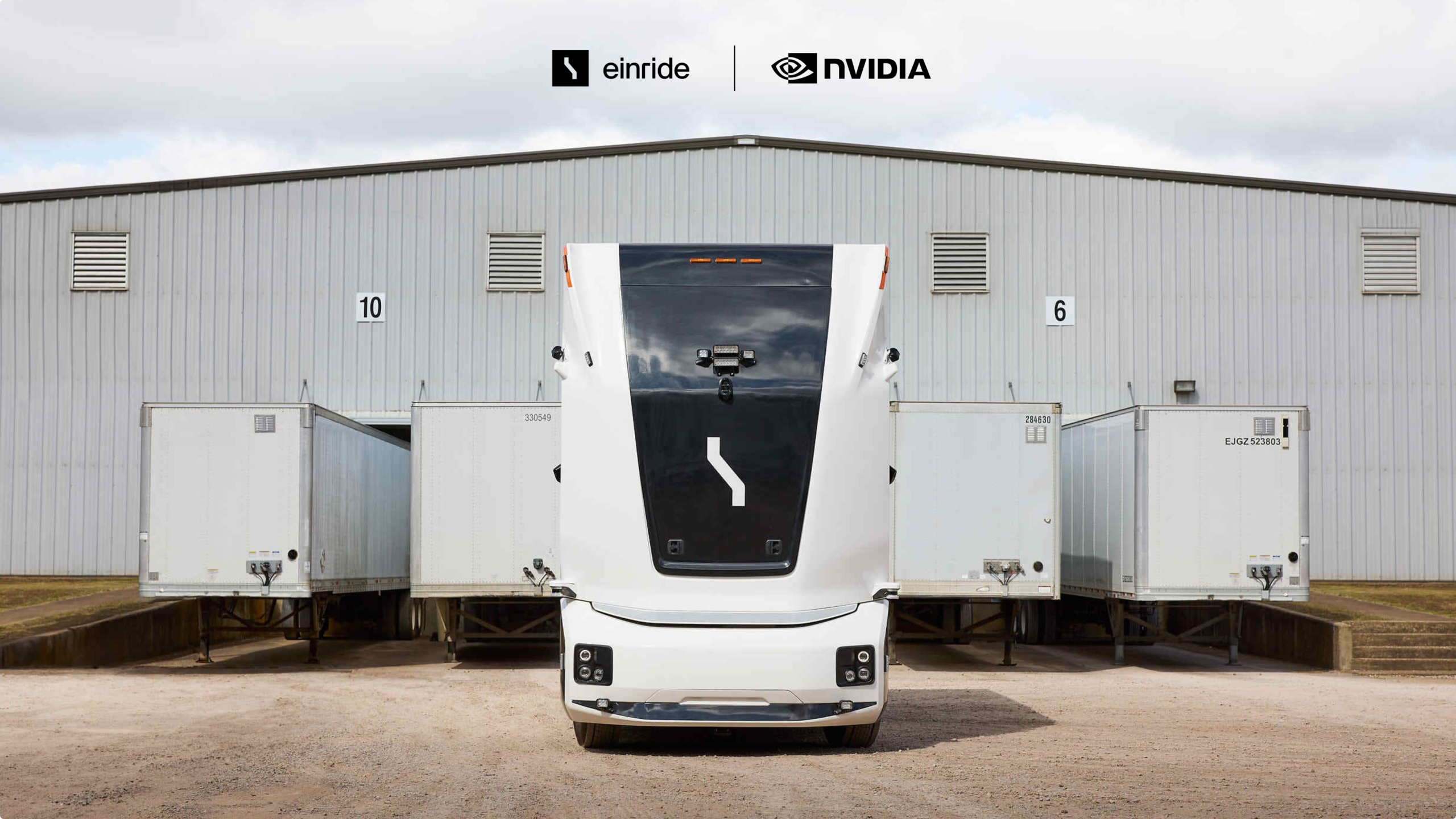
Einride will build the next generation of its autonomous-driving system on NVIDIA DRIVE Hyperion, adapting the platform’s compute, sensing, software, and safety architecture for heavy-duty freight.
The collaboration extends Einride’s autonomous programme towards highway and suburban trucking and gives the company a defined technical foundation for future versions of the Einride Driver. NVIDIA will provide underlying compute and development technologies, while Einride retains responsibility for its autonomous-driving stack, safety validation, regulatory approvals, and customer deployment.
DRIVE Hyperion is designed as a reference architecture for Level 4 autonomy, combining computing hardware with the sensors and software required for highly automated operation. Einride intends to adapt that base to the different dimensions, duty cycles, and operating requirements of heavy commercial vehicles.
The next Einride Driver will also integrate NVIDIA Halos, the supplier’s automotive safety system. Einride says the combination is intended to provide a repeatable technical architecture as autonomous vehicles move into a larger freight network.
Training and validation form another major part of the agreement. Einride plans to use NVIDIA Blackwell infrastructure through an Exemplar Cloud partner to train and refine autonomous models, while NVIDIA Cosmos will support camera-data curation and the generation of synthetic scenarios.
Synthetic data addresses a practical problem in autonomous vehicle development: rare events are difficult to collect at useful scale through road driving alone. A vehicle may travel many thousands of kilometres without repeatedly encountering a particular combination of road layout, traffic behaviour, weather, or obstacle positioning.
Simulation allows developers to create additional examples of those situations and test model responses before the same conditions occur during customer operations. The generated scenarios still have to be validated against real-world behaviour, but they broaden the range of situations available during development.
Einride currently operates hundreds of electric trucks across the US, Europe, and the Middle East and has autonomous vehicles in contracted customer operations. The company expects its wider vehicle network to reach between 1,500 and 2,000 units by 2028 based on demand already captured on its platform.
It estimates that around 80% of that captured demand could be suitable for automation in the medium term. That figure describes the company’s view of technical and operational suitability rather than a commitment that the same proportion of vehicles will be autonomous by 2028.
Actual deployment will still depend on regulation, route characteristics, customer requirements, safety cases, and the economics of each operation.
The NVIDIA collaboration follows Einride’s continued move from restricted-site autonomy towards public-road freight. Recent customer deployments have included cabless autonomous operations on public roads, expanding the range of conditions its systems must handle.
Highway and suburban routes introduce greater variability than closed or heavily controlled industrial environments. Vehicles have to interact with conventional road users, changing traffic, junctions, roadworks, and other events that cannot be engineered away through site rules.
Heavy trucks also behave differently from passenger vehicles. Their mass, braking distances, trailer movement, and manoeuvring requirements all have to be considered when autonomous software predicts road-user behaviour and plans a response.
Compute performance is therefore critical. Sensors generate large volumes of data, while the driving system has to identify road users, interpret the environment, predict movement, and select a safe action quickly enough for a heavy vehicle travelling at road speed.
Using a reference architecture can reduce some of the hardware engineering required for each new generation. Einride can concentrate more of its development effort on freight-specific integration, driving behaviour, remote operations, and safety validation rather than designing every compute and sensing layer independently.
Standardisation becomes increasingly important as fleets grow. A small autonomous trial can tolerate highly customised hardware and intensive engineering support. A network of hundreds or thousands of vehicles requires common components, software versions, diagnostics, maintenance routines, and upgrade processes.
Safety assurance also benefits from controlling the number of hardware variants. Each significant configuration change creates additional validation work before vehicles can operate in commercial service.
NVIDIA’s involvement does not turn Einride into a customer buying a complete autonomous-driving product. Einride remains responsible for developing and operating the freight system end to end, while NVIDIA supplies technologies underpinning compute, sensing, model development, and safety.
That division reflects the increasingly integrated nature of autonomous freight. Vehicles, sensors, compute, training infrastructure, safety systems, remote supervision, charging, and freight-planning software all have to function as one operating environment.
The next measure will be deployment rather than processor specifications. Wider highway and suburban operations will show whether the common architecture can reduce engineering effort while delivering the uptime, intervention rates, and safety performance required for contracted freight work.