IN Brief:
- Audi has demonstrated automated loading and unloading of finished vehicles on railway wagons at its Ingolstadt plant.
- Unikie's Marshalling Solution combines with Telekom 5G, edge infrastructure, vehicle SIMs, and external LiDAR sensing.
- Around 70% of newly produced Volkswagen Group vehicles travel by rail, giving the technology a substantial potential operating base.
Deutsche Telekom and Finnish software company Unikie have demonstrated automated loading and unloading of finished vehicles onto railway wagons at Audi’s Ingolstadt plant, extending vehicle automation into one of the more constrained stages of outbound automotive logistics.
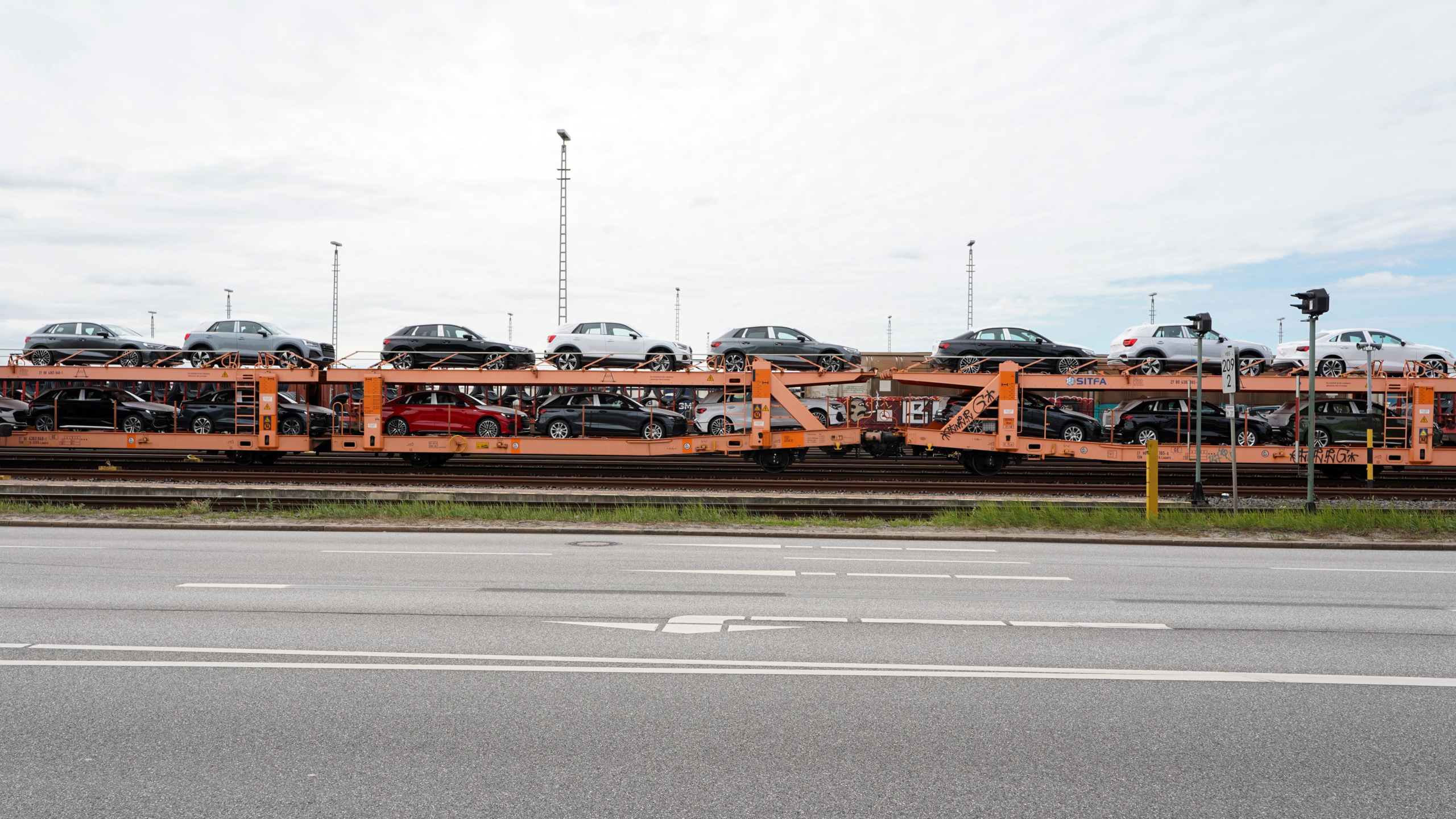
The demonstration forms part of the AutoLog research project and follows earlier work at Volkswagen’s port operation in Emden. At Ingolstadt, vehicles were driven automatically onto rail wagons and unloaded again using Unikie’s Marshalling Solution alongside Telekom connectivity and digital infrastructure.
Telekom provides the communications layer connecting vehicles with control systems. The setup includes 5G connectivity, SIM cards installed in the vehicles, edge cloud infrastructure for rapid data processing, and a fibre backbone supporting the mobile network, while external LiDAR sensors provide environmental and positioning data for automated manoeuvring.
The physical task is demanding because cars have to be positioned accurately within confined railway wagons. Minor deviations that would be inconsequential in an open yard become operationally important when finished vehicles are parked closely together and loading has to proceed without causing cosmetic or structural damage.
Enno Borchers, Industry Partner Automotive at Deutsche Telekom, said: “Automated driving could become a game changer in vehicle logistics.” The Ingolstadt work moves that proposition beyond movements inside factories and compounds by adding the interface between finished vehicle handling and rail transport.
Rail already has a substantial role in Volkswagen Group distribution. Around 70% of its newly produced vehicles are transported by rail, according to Telekom, but many of the movements between production areas, storage compounds, railway wagons, ports, and onward distribution still depend on people repeatedly driving individual cars over comparatively short distances.
Those handovers consume time without adding value to the vehicle itself. A driver has to reach a car, move it to the next staging point, position it correctly, leave the vehicle, and then return for another movement. Across a large production site and thousands of vehicles, relatively short journeys can become a significant labour and coordination requirement.
Automation is intended to remove selected movements rather than replace the complete outbound logistics operation. Vehicles still have to be sequenced against train capacity, destination, production status, and dispatch schedules, while staff remain responsible for exceptions, loading supervision, railway operations, and the wider transport plan.
The AutoLog architecture also differs from vehicle autonomy intended for public roads. Some of the intelligence sits within the surrounding infrastructure, allowing external sensors, connectivity, and edge computing to support vehicles operating in a controlled logistics environment. The site can therefore provide information about routes and loading positions that an individual car would otherwise have to determine independently.
Using infrastructure in that way can reduce the amount of specialist autonomy hardware required in every finished vehicle, but it transfers some dependency into the logistics site. Mobile coverage, sensor calibration, software interfaces, edge processing, and control systems become part of the material flow, so failures in digital infrastructure can interrupt vehicle movements as effectively as a mechanical handling problem.
Exception management will consequently determine how readily the system can scale. An automated process has to cope with obstructed routes, vehicles that do not respond as expected, changes in train loading sequence, communications faults, and cars requiring manual inspection without creating a queue that blocks the rest of the outbound operation.
The same applies to integration with production planning. Finished vehicles leave assembly in a particular sequence, but trains are loaded according to destination, timing, and transport constraints. Automation becomes more valuable when it can respond to those changing priorities rather than simply driving cars along a predetermined route.
Volkswagen’s earlier AutoLog work at Emden tested automated movements around an automotive terminal. Adding rail loading in Ingolstadt extends the operating envelope into an intermodal handover where accuracy and sequencing matter more than speed alone. A system capable of operating across factories, yards, ports, and rail interfaces would remove several manual transitions from the same vehicle journey.
The development remains a demonstration rather than a group-wide deployment, and no commercial rollout timetable has been announced. Its industrial significance comes from the scale of the process being addressed: with rail carrying around seven in ten newly produced Volkswagen Group vehicles, even incremental automation of loading and handover activity has a large recurring operating base.
The next measure will be repeatability rather than another demonstration. Automated rail loading has to deliver the same positioning accuracy, safe operation, and recovery from exceptions through normal production peaks before it can become routine infrastructure in finished vehicle distribution.