IN Brief:
- Maersk manages PUMA facilities in California, Arizona, and Indiana totalling about 2.3 million sq ft.
- All three warehouses use AutoStore systems for wholesale, retail, and ecommerce fulfilment.
- Torrance will add multi-client capacity from 2027 and can handle roughly 20 million units annually.
Maersk has begun managing PUMA’s North American distribution network, taking operational responsibility for three highly automated US warehouses with a combined footprint of about 2.3 million sq ft.
The facilities are located in Torrance, California, Phoenix, Arizona, and Whitestown near Indianapolis, Indiana. Together they support PUMA’s wholesale customers, retail stores, and online shoppers, extending a logistics relationship that already includes fulfilment, air freight, customs services, and inland transport.
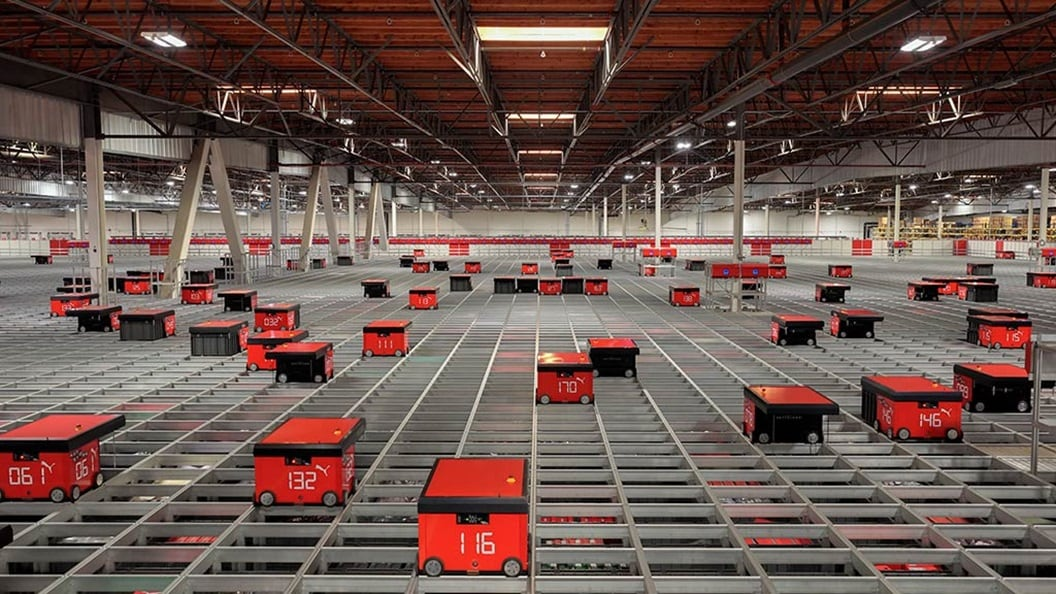
Torrance covers approximately 672,000 sq ft, Phoenix around 1.02 million sq ft, and Whitestown about 636,000 sq ft. All three use AutoStore automated storage and retrieval technology, with inventory held in compact grids and robots bringing bins to workstations for picking and packing.
The agreement is different from a conventional outsourced warehouse contract in which the logistics provider supplies the building and automation. PUMA has already invested in the US distribution infrastructure; Maersk is being brought in to operate those assets and connect them more closely with the wider transport and logistics services it provides.
That puts the immediate emphasis on extracting more value from installed capacity rather than designing a new network from scratch. Maersk says its role will combine operational expertise, technology, and logistics services to improve the performance of PUMA’s existing automated facilities.
AutoStore reduces travel within the warehouse by bringing goods to employees rather than requiring pickers to walk to storage locations. The compact grid also increases storage density, but overall fulfilment performance still depends on inventory accuracy, workstation capacity, replenishment, labour, carrier cut-offs, and the flow of orders into the system.
PUMA’s network serves several channels with different operating patterns. Wholesale orders can involve larger quantities for retail partners, PUMA stores require replenishment, and ecommerce generates smaller orders destined for individual consumers. Running those flows through the same automated estate requires inventory and capacity to be allocated across channels rather than optimised for one customer type.
The three locations create a geographic spread across western, south-western, and central US markets. Their usefulness depends not only on warehouse throughput but also on where stock is positioned relative to demand, because automation cannot compensate for inventory being held in the wrong part of the network.
Maersk will also use available capacity for other customers. From 2027, the Torrance facility is expected to become Maersk North America’s first AutoStore operation supporting multiple clients, with capacity offered to brands requiring automated fulfilment near major air and ocean gateways and the Southern California consumer market.
The Torrance site is capable of handling roughly 20 million units a year, according to Maersk. Opening spare capacity to additional customers can improve utilisation of an expensive automated asset, but it also turns a dedicated PUMA operation into a shared environment with more varied order profiles, service requirements, and inventory rules.
Multi-client automation places additional demands on software and operating discipline. Each brand can bring different product dimensions, packaging standards, returns processes, seasonal peaks, and cut-off times. The operator has to keep those flows separated at inventory level while sharing the same building, robots, workstations, and labour pool.
Maersk already operates more than 70 fulfilment facilities across North America covering approximately 22.5 million sq ft. Globally, it reports more than 500 warehouses with over 100 million sq ft of space, giving the PUMA sites access to a much larger contract logistics network.
The three-centre agreement tests Maersk’s integrated logistics model inside customer-owned infrastructure. Warehouse performance can be connected with inland transport, air freight, customs activity, and other services rather than managed as an isolated operation, although the release does not quantify the cost or service improvements expected from that integration.
The absence of quantified targets is worth retaining. Maersk says it intends to improve efficiency, responsiveness, and asset utilisation, but it has not published baseline throughput, labour productivity, fulfilment cost, or service levels against which those improvements will be measured.
That leaves the physical scale and operating model as the clearest facts at launch: three AutoStore-equipped warehouses, about 2.3 million sq ft in total, and one logistics provider managing flows across wholesale, retail, and ecommerce channels.
Torrance adds a further development from 2027 when the same automation begins serving other brands. The move will show whether capacity originally built around one major customer can support a broader multi-client fulfilment model without compromising the performance expected by PUMA.