IN Brief:
- More than 1,600 Geekplus robots now operate across two LPP Logistics fulfilment facilities in Poland.
- The automation provides 1.4 million high-bay storage locations reaching approximately 12 metres in height.
- RoboShuttle and P-series robots are coordinated through a management system designed to orchestrate fleets exceeding 1,000 robots at an individual site.
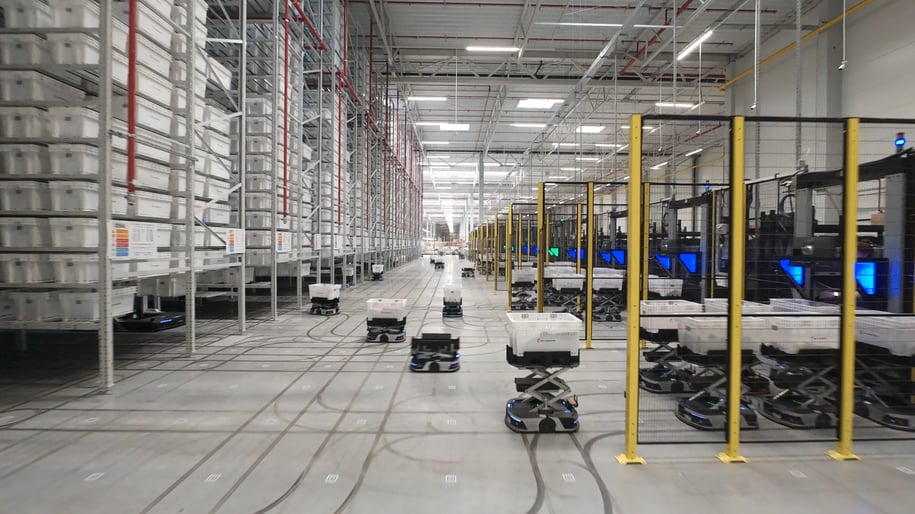
Geekplus has expanded warehouse robotics across two LPP Logistics fulfilment centres in Poland, with more than 1,600 autonomous robots now working across storage, movement, and order processing operations.
The installations provide around 1.4 million automated high-bay storage locations, with storage extending to approximately 12 metres. LPP is using a mix of Geekplus RoboShuttle and P-series equipment selected around the operating requirements of each facility rather than deploying an identical robot configuration at both sites.
LPP Logistics is the logistics operation serving fashion group LPP, giving the systems a workload characterised by large product assortments, changing seasonal demand, and high SKU diversity. Apparel distribution combines relatively small individual items with a large number of variants, placing pressure on storage density and picking accuracy as ranges change through the year.
Vertical automation allows the warehouses to use significantly more of the available building height. Instead of limiting frequently accessed stock to levels that can be reached manually, high-bay systems use robots to retrieve containers from storage positions well above the normal operator working zone.
That changes the relationship between warehouse height and labour movement. Employees no longer need to travel through equivalent rack space for every pick, while goods can be brought towards fixed work areas. The mechanical and software system assumes responsibility for a much larger proportion of the movement that would otherwise take place inside the storage area.
The scale of the robot fleet creates a separate coordination challenge. More than 1,600 machines operating across two sites require task allocation, route planning, charging management, congestion control, and recovery procedures that go well beyond programming an individual autonomous mobile robot.
Geekplus says its Robot Management System can coordinate more than 1,000 robots within one site. At that scale, traffic management becomes part of warehouse infrastructure: several machines may need access to the same aisles, storage positions, workstations, or charging areas without creating queues that erode the throughput gained from automation.
The company has also reported a 99% measured efficiency gain from the LPP automation. Geekplus does not provide enough methodology in the announcement to establish the underlying baseline or reproduce that result independently, so the figure should be treated as a supplier measurement rather than a general productivity benchmark.
The physical scale provides a clearer indication of the programme. Two operating locations, 1.4 million automated storage positions, storage reaching around 12 metres, and more than 1,600 robots place the deployment firmly beyond a limited pilot or isolated goods-to-person installation.
LPP and Geekplus are also standardising elements of system design and deployment between locations. Reusing established engineering methods can reduce the amount of integration work required when another site is added, while still allowing the equipment mix to change according to the local product and building profile.
Repeatability becomes increasingly valuable when automation expands across several fulfilment centres. If every warehouse uses entirely different interfaces, controls, maintenance procedures, and operator training, the logistics organisation can end up managing a collection of independent technology projects rather than a common operating platform.
Fashion demand also gives LPP a reason to retain modularity. Promotional periods, seasonal launches, and assortment changes can increase workload rapidly, while the quantity and type of stock held in each facility change throughout the year.
Geekplus says robot capacity, workstations, and throughput can be expanded as requirements increase. Physical constraints remain around storage grid size, charging provision, packing capacity, conveyors, and outbound docks, so scaling the robot fleet alone will not increase every part of the operation at the same rate.
Human work remains part of the system. Geekplus describes the deployment as reducing repetitive manual handling and walking while staff supervise processes and deal with exceptions. Damaged stock, unusual products, equipment faults, inventory discrepancies, and process changes still require intervention even where routine product transport has been automated.
That changes the maintenance burden as well as the labour profile. Large robot fleets require battery management, software updates, spare parts, sensor maintenance, network availability, and trained technicians capable of returning failed equipment to service without disrupting the remaining fleet.
As utilisation rises, automation becomes more critical to business continuity. A short interruption affecting a handful of robots may have little effect when spare capacity is available; disruption to fleet management or common infrastructure can be more serious when thousands of movements depend on the same control architecture.
LPP’s programme has therefore moved beyond proving that mobile robots can perform warehouse tasks. The current challenge is operating large automated fleets repeatedly across more than one facility while preserving the flexibility needed by a fashion business whose inventory and demand patterns continue to change.
The two-site deployment provides the scale to test that model. Future expansion will depend on whether LPP can add storage and robot capacity without moving constraints towards workstations, packing, dispatch, or transport, and whether standardised engineering reduces the complexity of bringing additional sites into the automated network.