IN Brief:
- Cyngn says autonomous missions across its deployed fleet increased 45% quarter on quarter during Q2 2026.
- Distance travelled rose 67%, while autonomous driving hours increased 55%, with June producing a fleet activity record.
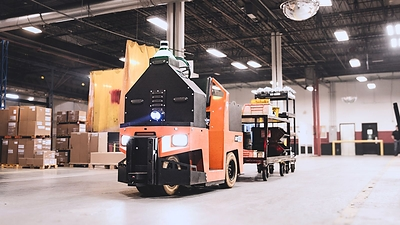
- DriveMod Tuggers operate on established indoor and outdoor routes and can haul loads of up to 12,000lb.
Cyngn has reported a 45% quarter-on-quarter increase in autonomous missions across its deployed industrial vehicle fleet during the second quarter of 2026, as customers made greater use of its DriveMod autonomous tuggers for recurring material movements.
The company says distance travelled by the fleet increased 67% over the same period, while autonomous driving hours rose 55%. June produced the highest level of activity recorded across the deployed fleet to date.
The percentages are company reported and Cyngn has not published the underlying number of missions, miles, vehicles, or autonomous hours. They cannot therefore be used to calculate absolute fleet productivity or compare DriveMod performance directly with conventional tugger operations or competing autonomous systems.
They do provide a measure of utilisation after deployment, an area where industrial automation projects can struggle once the initial installation is complete. A vehicle may operate successfully on a trial route without becoming a material part of daily production, leaving the customer with equipment that works technically but remains underused.
Cyngn’s figures indicate that its deployed vehicles performed more work during Q2 across all three reported activity measures. Missions, distance, and autonomous hours increased together, suggesting that customer operations were using the installed fleet more extensively rather than activity being reflected through only one reporting measure.
DriveMod Tuggers are designed around repetitive materials movement within manufacturing and logistics sites. Cyngn says the vehicles operate on established routes, can travel indoors and outdoors, and are managed through its Cyngn Insight fleet software.
The tugger can haul loads of up to 12,000lb, putting the equipment into applications such as movement of components, carts, containers, or other materials between storage, production, and staging areas. Those movements are frequently repetitive, making them candidates for automation where routes and handover points can be sufficiently standardised.
A production plant may require the same component movement dozens of times during a shift. A warehouse may repeatedly transfer containers between storage and a processing area. In both cases, the driving activity itself can add little variation even though the material is essential to the surrounding operation.
Automating that journey does not automate the complete process. Loads still have to be prepared correctly, routes must remain clear, vehicle priorities need to match production demand, and staff or other machinery may be responsible for activity at either end of the autonomous movement.
That makes utilisation an important measure. A tugger deployed on a high frequency route across several shifts can potentially replace a large amount of repetitive driving. The same vehicle used for occasional low-volume movements will produce a considerably weaker operational case regardless of its autonomous capability.
Cyngn says its commercial strategy is increasingly focused on moving vehicles beyond initial deployment and into repeated everyday workflows. The latest utilisation data supports that narrative, although the absence of absolute fleet figures limits how far the results can be independently assessed.
The 67% increase in distance is greater than the 45% rise in mission count. That difference could reflect longer routes, changing customer mix, greater utilisation at particular sites, or other variations in the deployed fleet. Cyngn has not provided enough detail to identify the cause, so the relationship should not be interpreted as a direct productivity measure.
The same caution applies to the 55% increase in autonomous hours. Waiting time, route length, traffic conditions, loading processes, and operating speed can all influence the number of hours required to complete a given quantity of missions.
Fleet management becomes more significant as usage rises. Several autonomous vehicles operating within one facility need task allocation, route coordination, charging schedules, and recovery procedures to prevent the automation itself creating congestion at junctions or shared loading positions.
Maintenance demand also increases with utilisation. More missions and distance mean additional wear on tyres, driveline components, batteries, sensors, and safety equipment, while software and mapping have to remain aligned with physical changes inside customer facilities.
Cyngn has continued to expand work with existing customers, including a September announcement covering an additional production workflow at a Fortune 100 heavy equipment manufacturer. That type of follow-on deployment is particularly relevant because it shows a customer moving beyond one initial autonomous route into another application.
The company also markets a typical payback period of less than two years for DriveMod Tugger deployments. That remains a supplier target rather than an independently established outcome, and actual economics will vary with utilisation, labour costs, operating hours, maintenance, and the amount of additional infrastructure required at each site.
The latest Q2 figures are therefore most useful as evidence of activity rather than proof of financial return. Autonomous missions, distance, and operating hours all increased, indicating that customers are asking deployed vehicles to perform more routine work.
Whether that continues will depend on the ability to add routes without increasing supervision, downtime, or fleet complexity at the same rate. For industrial operators, that progression from successful deployment to sustained high utilisation is the point at which autonomous materials movement begins to function as ordinary plant equipment rather than a technology trial.