IN Brief:
- The Chunlei Malting Co. acquisition was completed in summer 2026 and the facility inaugurated on 23 October.
- Yancheng adds 220,000 tonnes of annual malt production capacity alongside Malteurop’s existing Baoding plant.
- The site uses local biomass for industrial heat and renewable electricity supported by battery storage.
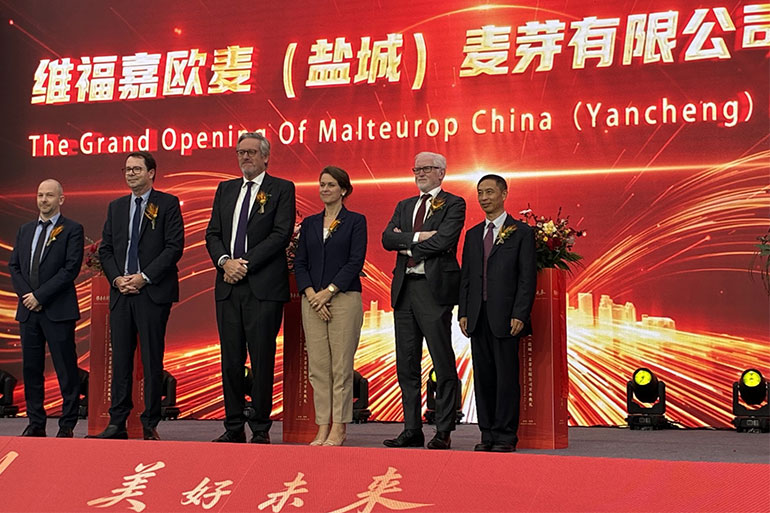
Malteurop has expanded its Chinese manufacturing network with the acquisition of Chunlei Malting Co., adding a facility capable of producing 220,000 tonnes of malt annually near Yancheng in Jiangsu province. The French company, part of the VIVESCIA cooperative group, inaugurated the plant on 23 October following completion of the acquisition during summer 2026.
Although announced at the October inauguration, the transaction had already been completed during the summer. Chunlei was already under the group’s ownership when the October event took place, while the newly presented facility extends an industrial presence built around Malteurop’s longstanding production operation in Baoding, Hebei province. The company has operated in China for approximately three decades.
Yancheng lies around 300 kilometres north of Shanghai and provides additional processing capacity close to established transport infrastructure. The plant is intended to supply Chinese breweries while strengthening Malteurop’s position in export markets. The group has not disclosed the purchase price, the facility’s current utilisation or the proportion of its output already contracted to customers. The physical capacity also creates continuing requirements for inbound barley supply and outbound malt storage, both of which must be coordinated with production planning if the installed equipment is to operate close to its design rate.
VIVESCIA estimates that the stated annual capacity could produce enough malt for approximately two billion litres of beer. This expresses the scale of the processing equipment in terms of potential downstream production, rather than reporting actual beer output or confirmed malt sales. Production during any given year depends on raw materials, operating schedules, process yields and orders.
Malt production connects agricultural grain supply with industrial brewing. Suitable barley must be selected, inspected and stored before processing, while the finished malt must meet the characteristics required by different customers. Expanding production capacity increases the need to coordinate those inbound and outbound movements as well as the physical processing equipment.
Malting begins by steeping barley in water, raising its moisture content before controlled germination. The developing grain then passes through kilning, where heat reduces moisture and stabilises the product for subsequent storage. The timing and environmental conditions of these steps help determine the characteristics of each malt grade, linking consistent production to both process management and grain quality.
Because raw material properties vary between consignments, the plant must control the inputs accepted and the conditions under which they are processed. A nominal annual capacity does not establish that every tonne of barley delivered becomes a tonne of finished malt, nor does it guarantee output at the installed limit throughout the year. Process losses, maintenance and product specifications also influence the quantity available to customers.
With the additional Chinese location, Malteurop has a broader manufacturing footprint from which to serve domestic and international demand. It has not announced how production will be divided between Baoding and Yancheng, although having two sites creates scope for allocating manufacturing and deliveries according to customer requirements and available capacity.
Energy provision at the Yancheng plant adds another operational consideration. VIVESCIA says industrial heat is supplied by locally sourced biomass, principally rice straw, while electricity is generated using wind and solar resources supported by battery storage. The two systems address different energy demands associated with processing barley into malt.
Heat is needed particularly during kilning, when the germinated grain must be dried under controlled conditions. Rice straw can serve as a fuel source, provided it is collected, transported, stored and prepared consistently enough to support reliable combustion. Using an agricultural residue introduces a local supply chain for thermal energy alongside the plant’s established grain purchasing requirements.
Assessing emissions from biomass requires consideration of feedstock collection, transport and combustion as well as the wider production system. VIVESCIA describes the plant as low carbon, but it has not published an independently verified lifecycle assessment establishing a quantified reduction against conventional malting operations.
Wind and solar generation address electricity consumption, with batteries capable of moderating some differences between production and demand. The company has not stated the generating capacity, battery duration or total electricity requirement, so the announcement does not allow a calculation of renewable coverage across a full operating year.
Alongside the present acquisition, VIVESCIA has identified possible further investment and cooperation with local malting and brewing companies. Those ambitions have not been accompanied by a new investment decision, construction schedule or committed capacity increase. The confirmed industrial addition remains the existing Yancheng operation with its 220,000-tonne annual capacity.
October’s inauguration places Malteurop’s earlier acquisition within its wider Chinese business, expanding processing capability and providing another location for managing grain, energy and finished product logistics. Future expansion will depend on separate commercial and investment decisions, while the current plant is already part of the group’s manufacturing network.