IN Brief:
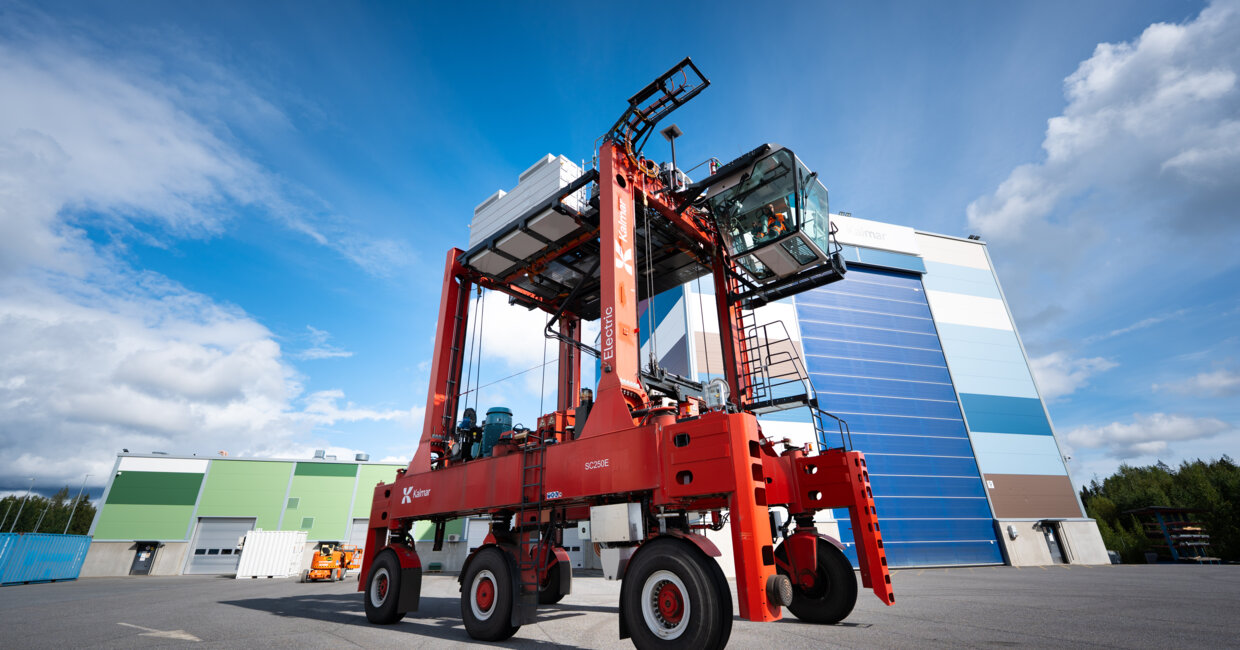
- Kalmar will supply ten fully electric straddle carriers to Norfolk International Terminals during the third quarter of 2027.
- Lithium-ion batteries provide up to 600 minutes of operating time, depending on duty cycle and conditions.
- The machines will include a collision-warning system providing visual and audible alerts to operators.
Kalmar has secured an order for ten fully electric straddle carriers from the Port of Virginia, expanding the American terminal operator’s investment in battery-powered container-handling equipment. The machines will be delivered to Norfolk International Terminals during the third quarter of 2027, with lithium-ion batteries and collision-warning systems included in the specification.
The order was recorded in Kalmar’s third-quarter 2026 intake and will add electric handling equipment to a terminal undergoing a substantial capacity expansion. Norfolk International Terminals is the largest facility operated by the Port of Virginia and already uses semi-automated stacking cranes alongside a fleet of hybrid straddle carriers. Introducing battery-electric machines will provide another propulsion option within its container-handling operations.
Straddle carriers move containers between storage areas, terminal handling positions and transport connections by lifting loads within their supporting frames. Their ability to travel independently through suitable yard layouts allows them to perform movements that would otherwise require coordination with other handling equipment. Operators can assign individual machines to different tasks according to the containers awaiting collection and the available capacity within the terminal.
Those movements involve repeated lifting, lowering, acceleration and braking, with energy demand varying according to container weight and travel distance. Moving a loaded container across the yard requires traction power, while raising it into a storage position adds a separate lifting demand. The equipment must then be positioned for its next assignment, sometimes travelling without a load before beginning another handling cycle.
Kalmar’s fully electric straddle carriers use lithium-ion batteries to supply power for these activities. The manufacturer’s stated operating capability extends to 600 minutes, although the available working period depends on the conditions and intensity of use. In its technical guidance, Kalmar describes an approximate net operating range of 300 to 600 minutes, reflecting differences between light, medium and heavy handling cycles.
A carrier travelling relatively short distances with moderate loads may use energy at a different rate from one undertaking continuous heavy lifting and longer movements. Battery capacity therefore has to be considered alongside the work assigned to each machine, rather than treating the maximum operating duration as a guaranteed period available during every shift.
Charging arrangements will also affect how the new carriers are integrated into the terminal. Equipment must be available when containers need to move, while batteries require sufficient charging time and electrical capacity to support the next period of operation. Charging during planned breaks can reduce interruptions to handling activity, although the suitability of that approach depends on the terminal’s work patterns and the charging systems selected.
The Port of Virginia has not specified the charging infrastructure to be installed for this order. Its eventual arrangement will need to account for the number of electric machines, their daily utilisation and the power available at the relevant charging locations. These factors determine whether charging can be accommodated within existing operating breaks or requires additional scheduling arrangements.
The machines will also incorporate Kalmar’s Collision Warning System, which provides visual and audible alerts when potential collision risks are detected. Straddle carriers work in areas containing other equipment, containers and associated terminal activities, making awareness of surrounding movements important when travelling or positioning loads.
Warning equipment can assist operators in recognising hazards while they control the machine, but it does not replace established traffic arrangements, operating procedures or personnel training. The protection provided depends on how the system is configured and the conditions in which the machine is operating. Kalmar’s specification identifies the technology as an operator warning system rather than a commitment to fully autonomous collision prevention.
Once delivered, the electric carriers will operate within a terminal that uses several types of container-handling equipment. Semi-automated stacking cranes manage container movements within designated storage areas, while straddle carriers provide more flexible transport and positioning capability. Their activities must be coordinated so that containers can move between quay operations, storage positions and onward road or rail connections.
The Port of Virginia states that, following its ongoing expansion, Norfolk International Terminals will have more than 90 semi-automated stacking cranes and 113 Kalmar hybrid straddle carriers. The ten newly ordered electric machines represent a separate addition to the terminal’s handling equipment. The stated number of hybrid carriers should not be interpreted as the total count of all straddle carriers once the electric machines have arrived.
The terminal’s annual handling capacity is expected to reach 3.6 million twenty-foot equivalent units following expansion. This capacity reflects the combined infrastructure available for handling containers, including berths, cranes, storage areas and transport connections. It is not a throughput increase attributable solely to the ten electric carriers, whose contribution will depend on their deployment within the wider operating system.
Containers discharged from vessels must be moved through storage and prepared for onward transport, while export containers follow the reverse sequence before loading. Norfolk International Terminals connects with road freight services and rail networks serving inland markets. The timing of these transfers affects how equipment is allocated, particularly when arriving cargo needs to connect with scheduled train movements or customer collection arrangements.
Battery-electric handling equipment changes the energy requirements associated with those movements. The carriers produce no exhaust emissions at the point of operation, although the overall greenhouse gas effect depends on the electricity supplied and the emissions associated with its generation. Their introduction therefore contributes to equipment electrification without establishing a quantified reduction in total port emissions before operational results are available.
The Port of Virginia aims to achieve net-zero Scope 1 and Scope 2 carbon emissions by 2040. Scope 1 covers direct emissions from sources under the organisation’s control, while Scope 2 covers emissions associated with purchased energy. Replacing combustion-powered equipment can reduce direct emissions, with the outcome for purchased electricity influenced by the energy supply and the way the new machines are used.
Patrick Jefferson, Director of Operations at Norfolk International Terminals, has identified improved safety and sustainable operations as priorities for the investment. Kalmar’s relationship with the Port of Virginia dates to 2007, and the new order extends its involvement in supplying equipment for the terminal’s container-handling operations.
Delivery is scheduled for completion during the third quarter of 2027, after which the port will be able to integrate the electric carriers into its yard operations. Their actual operating duration, charging requirements and utilisation will become measurable under Norfolk’s working conditions, alongside the performance of the existing hybrid fleet and semi-automated handling equipment.