IN Brief:
- Qube is starting a A$13m upgrade at the former Albany Bulk Handling site in Western Australia.
- The project will move the facility beyond woodchip handling into grain, mineral sands, and critical minerals.
- The open-access model is designed to reduce bottlenecks, demurrage exposure, and seasonal export constraints.
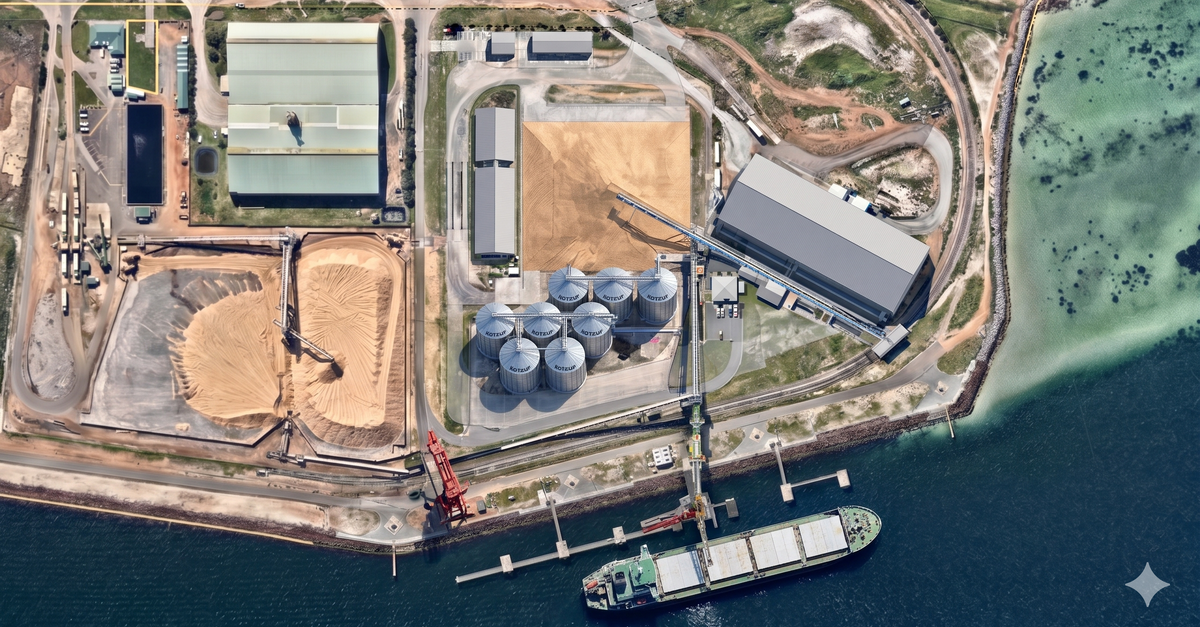
Qube is beginning a A$13m upgrade at the former Albany Bulk Handling site in Western Australia, converting the facility from a woodchip-only operation into a broader multi-commodity export platform.
The first stage covers hardstand improvements, strengthening of the ship-loader, and installation of a new grid. Once complete, the site will be able to handle grain, mineral sands, and critical minerals, widening the Port of Albany’s cargo base and giving regional exporters more options during seasonal and project-led volume peaks.
Qube acquired Albany Bulk Handling in 2025 for A$25m, adding infrastructure leased from Southern Ports Authority to its bulk logistics portfolio. The upgrade now moves that acquisition into its operational phase, with a second stage under consideration that could include fixed grain storage, covered multi-commodity shed capacity, and improved open stockpile segregation.
Opening the facility to all users gives the project its supply chain weight. Bulk export systems can become constrained when storage, loading, or access is tied too closely to one commodity or one set of users. A facility able to receive and load different cargoes gives producers, miners, traders, and vessel planners more room to manage the conflicts that often build around harvest peaks, project cargo movements, and mineral export programmes.
Albany’s role is not the same as a major container gateway, but regional port capacity carries its own commercial pressure. Grain, minerals, wood products, and other bulk commodities often move from production areas where distance to port directly affects margins. When exporters are pushed toward less convenient gateways, additional road haulage, vessel waiting time, and stockpile pressure can weaken competitiveness before cargo even reaches the quay.
The project therefore sits within a broader Australian port investment pattern. While large container terminals are adding crane capacity and digital systems to manage bigger vessels, regional bulk ports are being asked to become more flexible, more open, and better able to handle mixed cargo flows. At the other end of the scale, Southampton’s latest crane investment shows how gateway productivity is being reworked around larger vessel calls; Albany’s challenge is smaller in physical scale but similarly bound to cargo flow, berth use, and inland efficiency.
Hardstand and ship-loader capability are practical but decisive elements. Better hardstand gives operators more scope to assemble cargo before vessel arrival, while a strengthened loader supports more reliable loading across different products. Segregation also becomes more important as the commodity mix broadens, particularly where contamination risk, moisture control, stockpile management, and documentation all affect cargo acceptance.
Demurrage exposure remains one of the clearest costs the upgrade is designed to reduce. Bulk shipping depends on cargo readiness and berth coordination. When product is not assembled, handling equipment is constrained, or stockpiles cannot be managed cleanly, vessels wait and costs accumulate quickly. Extra handling flexibility does not remove weather, market, or vessel scheduling risk, but it gives operators more control over the loading sequence.
Critical minerals add a longer-term dimension. Energy transition supply chains are increasing demand for export routes that can support emerging mineral projects without waiting for entirely new dedicated infrastructure. Where existing port assets can be upgraded for multi-commodity handling, capital can be deployed faster and with less duplication than building separate capacity for every new cargo stream.
The Great Southern region also gains from the open-access model. Regional producers and exporters need predictable routes to Asia, the Middle East, and wider international markets, but they also need competition in the port services that sit between farm, mine, warehouse, vessel, and buyer. Qube’s investment creates another operating option and gives Albany a stronger case as a diversified export gateway.
Bulk handling rarely attracts the attention given to automated warehouses or container megaships, yet its role in industrial supply chains is fundamental. Stockyards, conveyors, loaders, grids, storage sheds, and berth access determine whether commodity flows remain commercially viable. Albany’s upgrade is a direct investment in those basics, with enough flexibility to serve the next mix of exports rather than only the last one.