IN Brief:
- Audi and Agile Robots are already testing component picking in the carmaker’s Ingolstadt Production Lab.
- Audi says its existing sequencing operation involves roughly one million picks daily, not picks completed by the trial robots.
- Dassault Systèmes and NVIDIA support virtual testing; production performance and deployment dates remain unreported.
Audi and Agile Robots have begun a proof of concept at the carmaker’s Ingolstadt Production Lab in which mobile humanoid robots pick components from containers and arrange them in the order required for vehicle assembly. Dassault Systèmes and NVIDIA are supporting a virtual modelling environment for the trial. The robots are being evaluated for difficult logistics work; Audi has not announced a deployment on its series production lines.
Unveiled at NVIDIA GTC Berlin on 21 October, the project addresses an operation Audi performs at considerable scale. The company says its demand-driven material supply process involves approximately one million picking operations each day to deliver parts to assembly stations in the correct sequence. That figure refers to the established production logistics network, not to output achieved by the humanoids or a performance target met during the test.
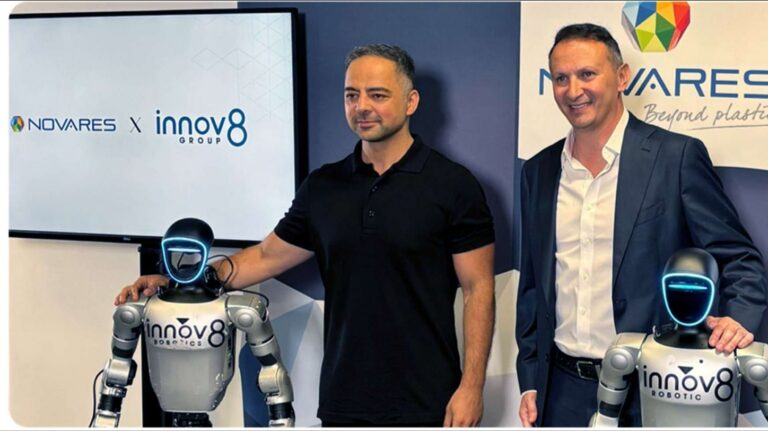
Agile Robots’ machines have a mobile base and two arms positioned to work at human height. At the Production Lab they are already removing parts from material containers and placing them into the intended assembly sequence. This arrangement is designed to make variable picking work accessible without necessarily building a fixed robotic cell around each container. The ability to perform the demonstrated task in a laboratory is not evidence that the same cycle time or reliability has been achieved across live production shifts.
The sequence of components is as important as the total quantity supplied to a line. Vehicles assembled with different specifications may require different parts at successive stations, and the wrong selection can interrupt a build even if sufficient stock is present. Some components are flexible or semi-rigid; others lie in mixed bins with their orientation changing as items are removed. A robotic controller must identify the required part, choose an available grasp, move it clear of neighbouring items and put it in a specified position without damage.
Agile Robots says the combination of AI perception and dual-arm manipulation is intended to address unsorted containers and parts with high variation. A second arm can assist when a component needs support during repositioning, while the mobile base allows the equipment to approach different work locations. The manufacturers have not disclosed a picking success rate, mean cycle time, damage rate, operating availability or comparable benchmark for the Audi application; those measures remain necessary before productivity claims can be assessed.
Dassault Systèmes is developing a virtual twin of the logistics task using DELMIA on its 3DEXPERIENCE platform and NVIDIA Omniverse libraries. The partners plan to assess task feasibility, timing, worker ergonomics and safety in the model ahead of broader physical deployment. Digital testing can expose proposed collisions or unworkable reach envelopes, but the final system still needs validation around real people, variable parts and production equipment.
A further capability, Dassault Systèmes’ LEO virtual companion, is described as a future aid for engineers. The companies envisage reducing some engineering and commissioning work from months to days, but have not disclosed trial results demonstrating that reduction at Audi. Nor is there a confirmed schedule for installing the technology across ordinary production logistics areas. The reported engineering ambition should therefore remain separate from the physical picking already under test.
Working in an automotive logistics area introduces conditions that a controlled demonstration may not reproduce fully. Trolleys, containers and pedestrians move through shared spaces, while part placement and accessible grasp points can vary between shifts. Safe operation requires suitable clearances and a response to exceptions such as damaged packaging, obscured components or a failed pick. The announcement provides no certified operating envelope or quantified safety performance for this particular deployment.
Audi’s supply chain specialists are setting the operational requirements, connecting the test to the actual assembly sequence rather than an isolated demonstration of robot dexterity. The stated objective is to assess whether some repetitive handling can be automated with minimal changes to existing working areas. The partners have not reported a reduction in staffing, labour hours or line stoppages from the project, and any workforce effects would depend on subsequent implementation choices.
A previously covered Audi rail-loading automation initiative concerns vehicle transport rather than component sequencing. The present test deals with parts handling before assembly, where a viable method must accommodate different shapes and changing presentation. Wider deployment would require evidence on repeatability, maintainability, cycle time, human interaction and integration with existing material supply systems. Audi has confirmed laboratory activity, not the completion of those industrial acceptance steps.