IN Brief:
- CATL will support battery swapping for more than 5,000 J&T Express heavy-duty trucks.
- The programme covers batteries, swap station equipment, operations, and maintenance services.
- The partnership extends electrification from trunk-line logistics into depots, fleets, and warehouse equipment.
CATL has signed a strategic cooperation agreement with J&T Express to support battery swapping for more than 5,000 heavy-duty electric trucks, pushing fleet electrification further into trunk-line logistics operations.
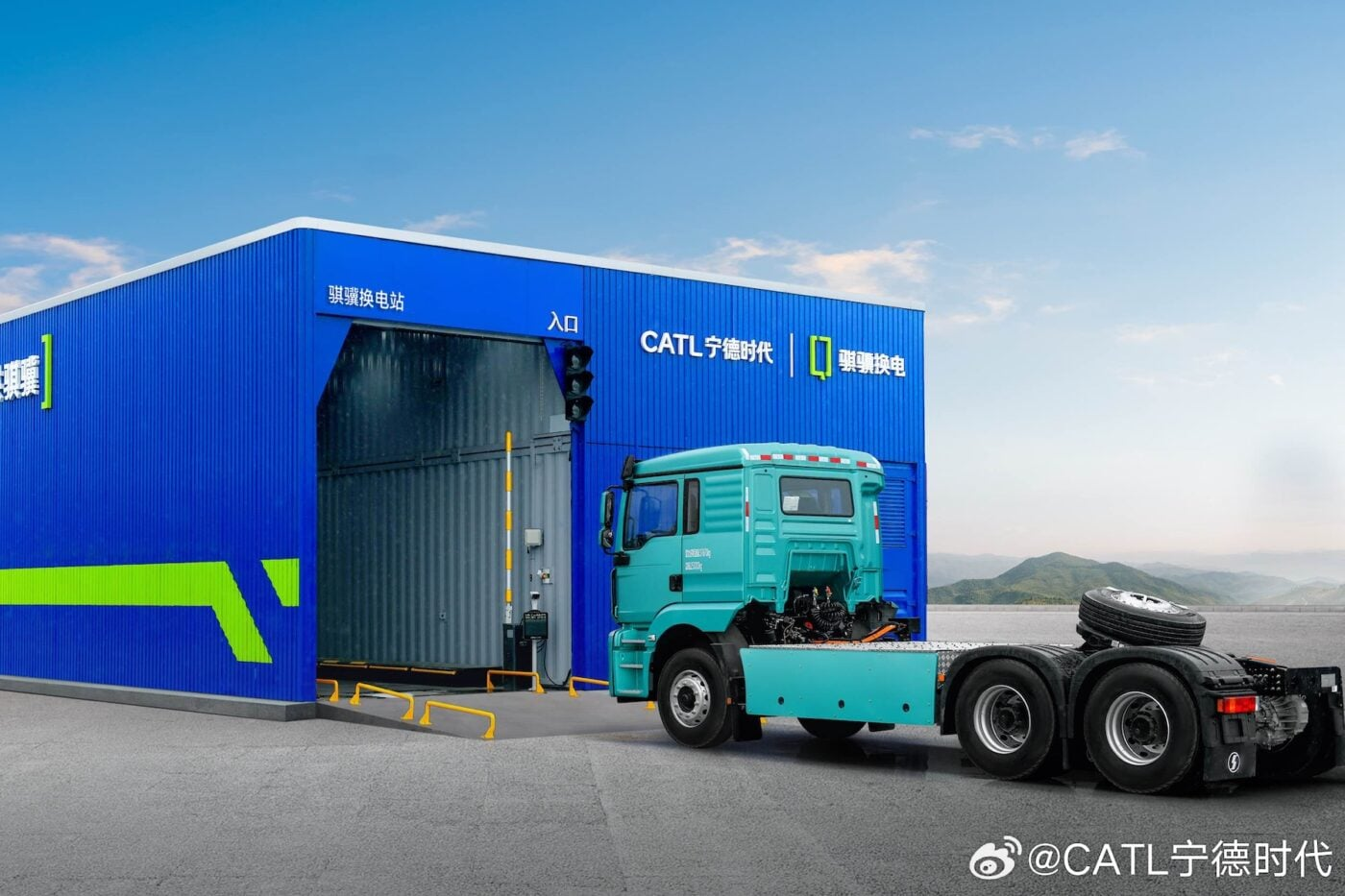
The agreement covers swappable batteries, battery-swap station equipment, and operation and maintenance services. CATL’s Qiji Energy system is designed to allow heavy-duty trucks to exchange depleted batteries for charged packs in three to five minutes, reducing the downtime that would otherwise sit inside charging windows for high-utilisation freight vehicles.
J&T Express and CATL will also extend the cooperation beyond line-haul vehicles. The partnership includes electric light-duty logistics trucks, electric warehouse forklifts, logistics automation, energy storage systems, and low-carbon logistics park development. CATL’s energy storage systems are intended to help logistics parks charge at lower-cost periods and discharge during peak load, reducing electricity cost and easing demand pressure across depot operations.
Heavy-duty freight creates a harder electrification problem than urban van fleets. Trucks running between sorting centres, parcel hubs, and regional depots operate against fixed cut-off times, high daily mileage, and tight utilisation targets. Even where charging infrastructure exists, the time spent attached to a charger can affect fleet rotation, driver scheduling, and hub throughput.
Battery swapping changes that operational sequence. The vehicle does not wait while energy is transferred into the pack; the energy asset is replaced. The fleet still needs charging infrastructure, spare battery capacity, and disciplined battery management, but the truck can return to work faster than under conventional depot charging. In parcel and express logistics, where vehicles connect sort windows and route commitments, that distinction has direct operational value.
The model also places more emphasis on network planning. Battery-swap stations must sit where trucks already move, not where land is merely available. Route density, depot dwell time, power capacity, battery inventory, and maintenance response all need to align. A swapping system that works in an isolated depot is useful; one that supports repeated trunk-line movements across a network can start to alter freight economics.
J&T Express already operates a large technology-led logistics network and has deployed more than 1,000 unmanned logistics vehicles. Adding battery-swapping trucks and electric warehouse equipment extends the electrification programme across the physical layers of logistics: trunk roads, urban delivery, depot yards, and warehouse handling. The broader system is no longer confined to the vehicle purchase decision.
That approach sits alongside the rapid development of electric logistics elsewhere in Asia. Furlenco’s expansion of EV logistics beyond Bengaluru showed how electrification is moving through local and regional delivery models, while CATL and J&T are applying the same pressure to heavier, more time-sensitive freight flows. The common thread is not the vehicle type; it is the attempt to build electric transport around operating rhythm rather than sustainability reporting alone.
China’s heavy-duty truck market has become an early proving ground for battery swapping because fleets are dense, routes are well mapped, and logistics demand is large enough to justify infrastructure investment. CATL has been expanding battery-swap systems across passenger, light commercial, and heavy-duty use cases, and its heavy-truck work now has a major parcel operator tied into the rollout.
The economics will depend on utilisation. Battery-swap infrastructure is capital-intensive and requires a pool of charged batteries, robust station maintenance, and reliable vehicle compatibility. A low-volume site risks becoming expensive idle capacity. A high-frequency logistics corridor, by contrast, can use the same assets repeatedly across scheduled movements, giving operators a clearer payback path.
The partnership also adds an energy management dimension to fleet planning. Logistics parks are becoming larger electrical systems as warehouses adopt automation, EV charging, temperature control, and onsite energy storage. Where battery swapping is combined with energy storage, operators can manage peak demand more carefully and protect vehicle availability during busy operating periods.
Fleet electrification is often discussed through the lens of regulation or emissions targets, but the decisive question for heavy freight is uptime. Diesel has retained its advantage because it is quick to refuel, widely supported, and predictable under pressure. CATL and J&T Express are attempting to narrow that operational gap by separating vehicle use from battery charging time.
More than 5,000 heavy-duty trucks gives the programme enough scale to expose the strengths and weak points of the model. Battery availability, driver process, depot discipline, vehicle compatibility, and power infrastructure will determine whether battery swapping can move from selected freight corridors into broader logistics planning. If those conditions hold, the heavy-duty electric truck may become less dependent on long charging stops and more suited to the rhythms of express freight.