IN Brief:
- Brussels Airport is building a 14,000m² logistics facility in the eastern part of its cargo zone.
- Yusen Logistics and Air Promotions Agencies will use the site for pharma and general cargo activity.
- The development targets BREEAM Excellent certification with solar, heat pump, water, and EV charging features.
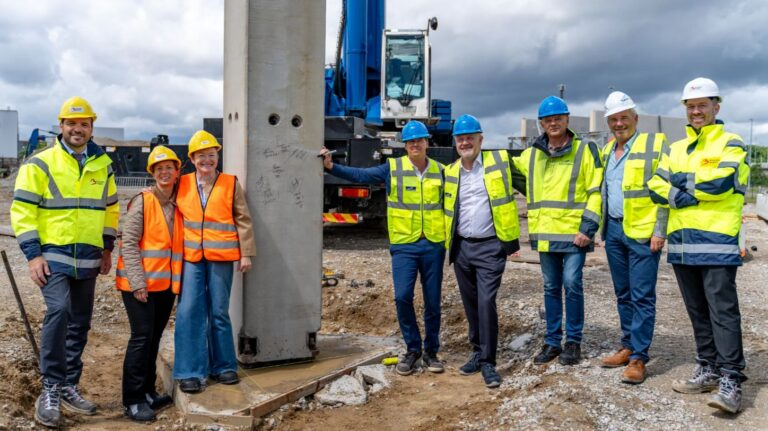
Brussels Airport is expanding its cargo estate with a new 14,000m² logistics facility under construction in the eastern part of the airport’s cargo zone.
The building will be divided into two units combining warehouse and office space. Yusen Logistics and Air Promotions Agencies will use the site to develop pharmaceutical and general cargo operations, adding modern capacity inside one of Europe’s key airfreight environments.
The project is being delivered on land freed by the demolition of an obsolete building. Replacing ageing infrastructure with a higher-performing facility gives the airport a route to increase cargo capability without relying solely on land expansion, which is often constrained around major European airports.
The facility is targeting BREEAM Excellent certification. Planned sustainability features include wood beam construction, solar panels, heat pumps, rain gardens, a rainwater storage tank, charging stations, and bicycle parking.
Air cargo real estate has become a more technical asset class as airports handle greater volumes of high-value, time-sensitive, and regulated freight. Pharmaceutical logistics places particular demands on airport estates, with handling processes shaped by temperature requirements, traceability, security, documentation, and fast movement between warehouse, apron, aircraft, and onward transport.
Brussels Airport already sits within a strong Belgian life sciences and logistics cluster. Pharmaceutical manufacturers, freight forwarders, specialist handlers, airlines, and logistics companies rely on cargo infrastructure that can support compliant operations without adding unnecessary handovers. Additional warehouse and office capacity allows existing partners to scale activity within the cargo zone rather than pushing specialist operations further from airside access.
European airports are also having to modernise older cargo estates. Schiphol’s recent cargo-estate reshaping through KLM’s relocation showed how major airport operators are reworking land use as freight patterns become more specialised. Brussels Airport’s new facility follows that same estate-renewal logic, using existing cargo land more efficiently while updating building performance.
The environmental specification adds another layer to the project. Energy performance, water management, charging infrastructure, and building certification are now part of the commercial value of logistics real estate. Cargo occupiers are under increasing pressure to demonstrate lower-emissions operations, while airport operators need buildings that remain competitive over long lease periods.
For pharmaceutical cargo, building performance and operational reliability are closely connected. Temperature-sensitive and regulated goods can create heavy energy demands, and inefficient infrastructure increases cost while limiting future flexibility. A more modern building can support compliance, reduce operating burden, and improve resilience during seasonal temperature peaks.
The development also strengthens Brussels Airport’s role in general cargo. Not every shipment moving through the facility will be pharmaceutical, but the same need for efficient handover, reliable documentation, and rapid transfer applies across many high-value industrial and commercial flows.
Airports with mature cargo clusters are increasingly competing on the quality of their logistics estates, not only on runway capacity or carrier networks. Forwarders and cargo owners want buildings that reduce dwell time, support digital documentation, and allow specialist services to operate close to the aircraft while maintaining road access for onward distribution.
As air cargo networks become more dependent on specialist verticals, the quality of airport logistics facilities becomes a competitive factor. Airlines and forwarders need airside proximity, but occupiers also need buildings that can handle modern compliance, data, energy, and labour requirements. Brussels Airport’s new facility adds capacity while replacing obsolete space with a more durable logistics asset.