IN Brief:
- Cabka’s CabCube XL range is being launched in the UK through goplasticpallets.com.
- The foldable sleeve packs are designed for oversized and irregular loads.
- The range targets reusable packaging, return logistics, and reduced storage space for empty containers.
Cabka has launched its CabCube XL sleeve pack range in the UK through goplasticpallets.com, offering a reusable alternative to metal stillages and bespoke wooden crates for bulky or irregular loads.
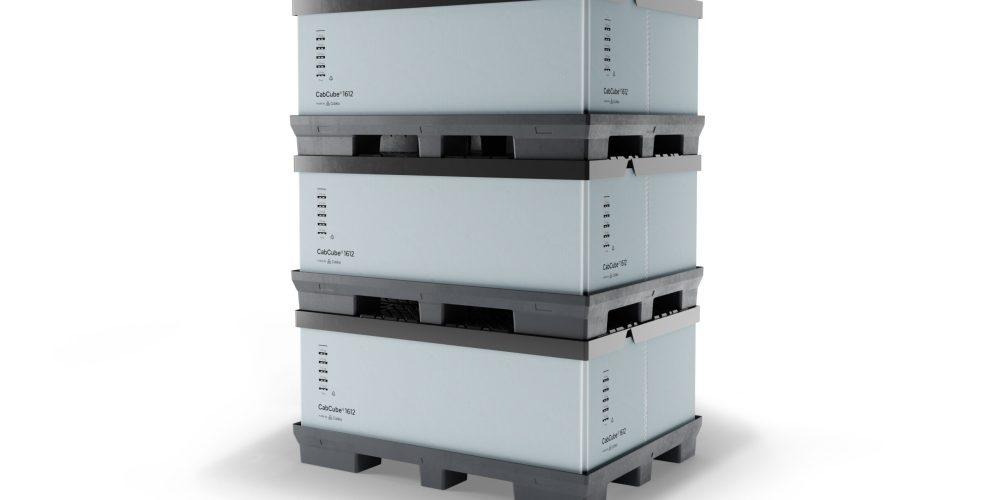
The CabCube XL range combines a pallet base, sleeve, and lid to create a large foldable container for goods that do not suit standard palletised movement. The format is aimed at manufacturers, distributors, and logistics operations handling oversized components, difficult shapes, or products that need more containment than a conventional pallet can provide.
Cabka has designed the sleeve packs for repeated use, fast assembly, and high empty-return efficiency. One CabCube XL model has a 1500 x 1200mm footprint, a 924-litre capacity, a folded height of 225mm, and a return ratio of 1:3.5. The company states that the containers can be assembled in around 15 seconds.
The target is a stubborn cost area in industrial logistics. Metal stillages and timber crates are often introduced because the product is too awkward, fragile, or valuable for standard handling. They solve the immediate protection problem, but they can leave operators with heavy assets, inconsistent availability, high storage demand, and expensive empty returns.
Foldable sleeve packs change the empty-leg calculation. Once the load has been delivered, the container collapses into a smaller volume for storage or return transport. In closed-loop or semi-closed-loop supply chains, that can reduce trailer space, free warehouse capacity, and make reusable packaging easier to control.
The launch fits a wider shift in how warehouses assess the assets around the product. Racking, pallets, totes, cages, and load carriers are being judged through durability, repairability, carbon impact, and whole-life cost rather than purchase price alone. Warehouse racking repair has already become part of the ESG conversation, and packaging assets are moving along the same path.
Reusable containers are particularly attractive where flows are repeatable. Automotive, industrial manufacturing, retail replenishment, and parts distribution can all support packaging recovery more easily than one-off freight. The economics weaken where containers disappear into uncontrolled networks, but they strengthen quickly when units can be tracked, returned, inspected, and redeployed.
Cabka’s broader CabCube range also points towards the digitisation of load carriers. RFID capability on some models allows reusable packaging to become a tracked asset rather than a passive container. That distinction is important for operators trying to reduce loss, understand pool availability, and plan container returns with the same discipline applied to stock.
Materials handling teams are also dealing with labour and safety pressures. Heavy stillages can be awkward to move, store, repair, and handle. A lighter reusable system can reduce handling friction, provided it remains strong enough for the load profile and compatible with warehouse equipment. Asset design affects warehouse productivity in small repeated increments: assembly time, stackability, forklift access, visibility, and damage resistance all show up in day-to-day operations.
Packaging regulation and cost control are placing further attention on reusable systems. EPR assessments are already pushing companies to examine packaging cost and recovery data, particularly where waste exposure is rising. Reusable transport packaging can help reduce single-use material, but only where the recovery loop is reliable enough to prevent asset loss.
The choice between a stillage, crate, pallet box, or sleeve pack is increasingly part of supply chain design. A bespoke metal stillage may remain the right answer for heavy, harsh, or highly specialised components. A wooden crate may still suit one-way export cargo. Cabka’s XL sleeve packs are aimed at the space between those options, where load protection, return efficiency, and reusability need to be balanced.
As warehouse space remains expensive and transport planners face pressure to reduce empty miles, the cost of moving air is becoming harder to hide. Foldable reusable packaging addresses that problem directly. Cabka’s UK launch gives operators another option for large industrial loads where the container itself has become part of the cost equation.